

BIOD 151 Exam 7 Diagrams
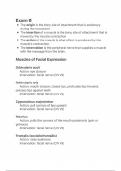
Exam 6 The origin is the bony site of attachment that is stationary during the movement. The insertion of a muscle is the bony site of attachment that is moved by the muscle contraction The action of the muscle is what effect is produced by the muscle’s contraction. The innervation is the peripheral nerve that supplies a muscle with the message from the brain. Muscles of Facial Expression Orbicularis oculi Action: eye closure Innervation: facial nerve (CN VII) Orbicularis oris Action: mouth closure: closes lips, protrudes lips forward, presses lips against teeth Innervation: facial nerve (CN VII) Zygomaticus major/minor Action: pull corners of lips upward Innervation: facial nerve (CN VII) Risorius Action: pulls the corners of the mouth posteriorly (grin or grimace) Innervation: facial nerve (CN VII) Frontalis (occipitofrontailis) Action: raise eyebrows Innervation: facial nerve (CN VII) Buccinator Action: compress cheeks Innervation: facial nerve (CN VII) Masseter Action: jaw closure Innervation: trigeminal nerve (CN V, mandibular branch) Temporalis Action: Elevates mandible, closes jaw Innervation: trigeminal nerve (CN V, mandibular branch) Muscles of the Head and Neck ● ● ● Side bending of the neck is also called side flexion or lateral flexion, which refers to moving one of the ears to the same side shoulder. Neck flexion refers to the action of moving the chin towards the sternum. Note there are several muscles that have differing actions if acting together on both sides (bilaterally) or acting on one side only (unilaterally). Semispinalis Capitis Origin: articular processes of inferior cervical & transverse process of superior thoracic vertebrae Insertion: occipital bone Action: Bilateral extend head Unilateral laterally flexes neck to same side Innervation: spinal nerves Sternocleidomastoid Origin: sternal end of clavicle and manubrium Insertion: mastoid region of skull Action: Bilateral: neck flexion Unilateral: turns face to opposite side Innervation: accessory nerve (CN XI) Splenius Capitis Origin: spinous process/ligaments of inferior cervical vertebrae Insertion: mastoid process, occipital bone of skull Action: Bilateral extend head Unilateral laterally flexes neck to same side Innervation: cervical spinal nerves Longissimus cervicis Origin: transverse processes of superior thoracic vertebrae Insertion: transverse process of middle and superior cervical vertebrae Action: Action: Bilateral extend head Unilateral laterally flexes neck to same side Innervation: cervical and thoracic spinal nerves Longissimus thoracis Origin: transverse process of all thoracic and lumbar vertebrae Insertion: transverse processes of all thoracic vertebrae Action: Bilateral extension of spine Unilaterally: lateral flexion of spine Innervation: thoracic and lumbar spinal nerves Thyrohyoid Origin: thyroid cartilage of larynx Insertion: hyoid bone Action: elevates thyroid, depresses hyoid bone Innervation: hypoglossal nerve Scalenes (anterior, middle, posterior) Origin: transverse processes of C2- C7 Insertion: first and second ribs Action: elevates ribs 1 & 2 Innervation: cervical spinal nerves ● ● Vertebrae Column The erector spinae group are superficial muscles in the back. These muscles act as the prime extensors of the vertebral column. Flexion of the spine refers to forward bending the trunk (such as a “cat” stretch). ● ● Extension of the spine refers backward bending. The vertebral column is also able to perform side bending (or lateral flexion) as well as movement around an axis (rotation). Spinalis: Medial column of erector spinae Made up of three divisions (spinalis thoracis, spinalis cervicis, and spinalis capitis) Action: extensor of the vertebral column Longissimus: Intermediate column of erector spinae Made up of three divisions (longissimus thoracis, longissimus cervicis, longissimus capitits) Iliocostalis: Lateral column of erector spinae Made up of three divisions (iliocostalis lumborum, iliocostalis thoracis, iliocostalis cervicis) ● Oblique and Rectus Muscles: Anterior The abdominal muscles perform many functions. These ● ● muscles help to support and protect the abdominal viscera (which are not protected by bony structures). These muscles, along with the muscles in the back (see above) help to provide support for upright posture and balance. Rectus abdominis Origin: pubic crest, pubic symphysis Insertion: pubis, cartilages of ribs 5-7, xiphoid process Action: flexion of spine, compression of abdominal viscera Innervation: spinal nerves (T 7-T 12) External oblique Origin: sternum, ribs (5-12) Insertion: linea alba, iliac crest Action: Bilaterally: flexion of the spine, compress the abdomen; Unilaterally: flexes trunk to same side, rotates to opposite side Innervation: lower intercostal, ilioinguinal nerves Internal oblique Origin: iliac crest, lumbodorsal fascia Insertion: inferior ribs, linea alba Action: compresses abdomen, depresses ribs, flexes spine Innervation: lower intercostal, ilioinguinal nerves Transverse abdominis – deep to internal oblique Origin: lateral inguinal ligament, inner iliac crest Insertion: linea alba, pubis Action: compression of abdomen Innervation: first lumbar nerve (T 7- L1), iliohypogastric (T12- L1), ilioinguinal (T12-L1) ● Muscles of Breathing The diaphragm is the primary muscle necessary for intaking air. The internal intercostals and the external intercostals work in opposite functions. Notice the difference in their muscle fiber orientation Diaphragm Origin: cartilage of ribs 7-12, xiphoid process, lumbar vertebrae Insertion: anterior longitudinal ligament (vertebral column) Action: expands thoracic cavity, compresses abdominal cavity Innervation: phrenic nerve (C3-5) Internal Intercostals Origin: superior border of ribs 2-12 Insertion: inferior of ribs above (1-11) Action: depresses ribs (forced expiration) Innervation: intercostal nerves External Intercostals Origin: lower border of ribs 1-11 Insertion: upper border of ribs below (2-12) Action: elevates ribs (normal inspiration) Innervation: intercostal nerves ● ● Muscles of the Shoulder and Upper Extremity The muscles on the posterior thorax assist in movement of the shoulder girdle. The trapezius is a large muscle that acts on the shoulder as well as the neck and upper spine. The trapezius is superficial to the remaining muscles shown (see Figure 5.10). Trapezius (upper, middle, lower) Origin: occipital bone, spinous process of T1-12 Insertion: lateral clavicle, acromion, and scapular spine of scapula Action: rotation, retraction, elevation, depression of scapula; extends neck and stabilizes shoulder Innervation: Accessory nerve (Cranial Nerve 11) Levator scapulae Origin: transverse process of C1-4 Insertion: medial border of scapula Action: elevates scapula Innervation: dorsal scapular nerve Rhomboids (major, minor) Origin: spinous process (minor: C7-T1) (major: T2-5) Insertion: medial border of scapula Action: retraction of scapula Innervation: dorsal scapular nerve Pectoralis minor Origin: ribs 3-5 Insertion: coracoid process of scapula Action: elevates ribs, draws scapula down and medially Innervation: medial pectoral nerve Serratus Anterior Origin: upper 8-9 ribs Insertion: medial border of scapula Action: protraction of scapula Innervation: long thoracic nerve ● ● ● ● Muscles of the Shoulder Girdle Continued The shoulder is a ball and socket joint, which permits many types of movement. The glenoid cavity of the scapula is very small compared to the head of the humerus. The large bony structure of the shoulder requires many ligaments and layers of muscle for stability. A muscle grouping known as the rotator cuff is necessary to stabilize the humeral head inside the shoulder joint. The rotator cuff is made up of the “SITS” muscles: supraspinatus, infraspinatus, teres minor, and subscapularis. (See Figure 5.14) Deltoid (anterior, posterior, middle) Origin: clavicle and scapula Insertion: deltoid tuberosity of humerus Action: abduction at shoulder (whole muscle) Innervation: axillary nerve Pectoralis major Origin: ribs 2-6, body of sternum Insertion: greater tubercle of humerus Action: flexion, adduction and medial rotation at shoulder Innervation: pectoral nerves Supraspinatus (above spine of scapula) Origin: supraspinatus fossa of scapula Insertion: greater tubercle of humerus Action: abduction at the shoulder Innervation: suprascapular nerve Infraspinatus (below spine of scapula) Origin: infraspinatus fossa of scapula Insertion: greater tubercle of humerus Action: lateral rotation at shoulder Innervation: suprascapular nerve Teres Minor Origin: lateral border of scapula Insertion: greater tubercle of humerus Action: lateral rotation at shoulder Innervation: axillary nerve Teres Major – not part of the rotator cuff Origin: inferior angle of scapula Insertion: intertubercular groove of humerus Action: extension, adduction, and medial rotation at shoulder Innervation: lower subscapular nerve Subscapularis – along inner surface of the scapula Origin: subscapular fossa of scapula Insertion: lesser tubercle of humerus Action: medial rotation at the shoulder Innervation: subscapular nerves Latissimus Dorsi Origin: spinous process of inferior thoracic and lumbar vertebrae, ribs 8-12 Insertion: intertubercular groove of humerus Action: extension, adduction, and medial rotation at shoulder Innervation: thoracodorsal nerve Coracobrachialis Origin: coracoid process of scapula Insertion: medial shaft of humerus Action: adduction and flexion at shoulder Innervation: musculocutaneous nerve Muscles of the Forearm and Elbow Biceps brachii Origin: short head- coracoid process; long head- supraglenoid tubercle of scapula Insertion: tuberosity of radius Action: flexion at elbow and shoulder; supination Innervation: musculocutaneous nerve Brachialis Origin: anterior/distal surface of humerus Insertion: tuberosity of ulna Action: flexion at elbow Innervation: musculocutaneous nerve and radial nerve Brachioradialis Origin: lateral epicondyle of humerus Insertion: lateral aspect of styloid process of radius Action: flexion at elbow Innervation: radial nerve Triceps (long head, lateral head, medial head) Origin: Lateral head – superior, lateral margin on humerus Long head – infraglenoid tubercle of scapula Medial head – posterior surface of humerus Insertion: olecranon of ulna Action: extension at elbow Innervation: radial nerve Pronator Teres Origin: medial epicondyle of humerus Insertion: mid-lateral surface of radius Action: pronation Innervation: median nerve Supinator Origin: lateral epicondyle of humerus Insertion: anterolateral surface of radius Action: supination Innervation: deep radial nerve
Document information
- Uploaded on
- April 30, 2025
- Number of pages
- 43
- Written in
- 2024/2025
- Type
- Exam (elaborations)
- Contains
- Questions & answers


