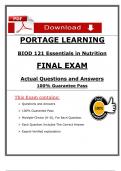
PORTAGE LEARNING
BIOD 121 Essentials in Nutrition
FINAL EXAM
Actual Questions and Answers
100% Guarantee Pass
This Exam contains:
➢ Questions and Answers
➢ 100% Guarantee Pass
➢ Multiple-Choice (A–D), For Each Question.
➢ Each Question Includes The Correct Answer
➢ Expert-Verified explanation
,### 1. If the daily caloric intake should not exceed 45% from carbohydrates
on a 2000 calorie diet, how many grams of carbohydrates should be
consumed?
A) 225 grams
B) 180 grams
C) 300 grams
D) 450 grams
Answer: A) 225 grams
Explanation:
45% of 2000 calories = 0.45 × 2000 = 900 calories from carbs
Since 1 gram of carbs provides 4 calories:
900 cal ÷ 4 cal/g = 225 grams
---
### 2. The ABCDEs of nutritional assessment stand for:
A) Anthropometric, Biochemical, Clinical, Dietary, Environmental
B) Activity, Biochemical, Clinical, Dietary, Exercise
C) Anthropometric, Biological, Clinical, Dietary, Emotional
D) Activity, Biological, Clinical, Dietary, Environmental
Answer: A) Anthropometric, Biochemical, Clinical, Dietary, Environmental
Explanation:
- Anthropometric: Measurement of body size and composition (e.g., weight,
height, BMI).
- Biochemical: Lab tests to assess nutrient levels (e.g., blood iron).
, - Clinical: Physical signs/symptoms of nutritional deficiencies.
- Dietary: Evaluation of dietary intake to identify deficiencies or excesses.
- Environmental: Factors like socioeconomic status affecting nutrition.
### 3. True or False: The Dietary Guidelines for Americans provides
guidance for making informed decisions related to both food and physical
activity choices.
A) True
B) False
Answer: A) True
Explanation: The Dietary Guidelines aim to promote overall health through
recommendations on healthy eating patterns and physical activity levels to
reduce chronic disease risk.
### 4. Which of the following are examples of micronutrients?
A) Carbohydrates and fats
B) Vitamins and minerals
C) Proteins and water
D) Fiber and cholesterol
Answer: B) Vitamins and minerals
Explanation: Micronutrients are nutrients required in small amounts for
vital body functions. Vitamins regulate body processes (e.g., vitamin C
supports immune function), while minerals provide structure and regulate
processes (e.g., calcium for bone strength).
BIOD 121 Essentials in Nutrition
FINAL EXAM
Actual Questions and Answers
100% Guarantee Pass
This Exam contains:
➢ Questions and Answers
➢ 100% Guarantee Pass
➢ Multiple-Choice (A–D), For Each Question.
➢ Each Question Includes The Correct Answer
➢ Expert-Verified explanation
,### 1. If the daily caloric intake should not exceed 45% from carbohydrates
on a 2000 calorie diet, how many grams of carbohydrates should be
consumed?
A) 225 grams
B) 180 grams
C) 300 grams
D) 450 grams
Answer: A) 225 grams
Explanation:
45% of 2000 calories = 0.45 × 2000 = 900 calories from carbs
Since 1 gram of carbs provides 4 calories:
900 cal ÷ 4 cal/g = 225 grams
---
### 2. The ABCDEs of nutritional assessment stand for:
A) Anthropometric, Biochemical, Clinical, Dietary, Environmental
B) Activity, Biochemical, Clinical, Dietary, Exercise
C) Anthropometric, Biological, Clinical, Dietary, Emotional
D) Activity, Biological, Clinical, Dietary, Environmental
Answer: A) Anthropometric, Biochemical, Clinical, Dietary, Environmental
Explanation:
- Anthropometric: Measurement of body size and composition (e.g., weight,
height, BMI).
- Biochemical: Lab tests to assess nutrient levels (e.g., blood iron).
, - Clinical: Physical signs/symptoms of nutritional deficiencies.
- Dietary: Evaluation of dietary intake to identify deficiencies or excesses.
- Environmental: Factors like socioeconomic status affecting nutrition.
### 3. True or False: The Dietary Guidelines for Americans provides
guidance for making informed decisions related to both food and physical
activity choices.
A) True
B) False
Answer: A) True
Explanation: The Dietary Guidelines aim to promote overall health through
recommendations on healthy eating patterns and physical activity levels to
reduce chronic disease risk.
### 4. Which of the following are examples of micronutrients?
A) Carbohydrates and fats
B) Vitamins and minerals
C) Proteins and water
D) Fiber and cholesterol
Answer: B) Vitamins and minerals
Explanation: Micronutrients are nutrients required in small amounts for
vital body functions. Vitamins regulate body processes (e.g., vitamin C
supports immune function), while minerals provide structure and regulate
processes (e.g., calcium for bone strength).