SOCIAL WORK LCSW EXAM
(PRACTICE) QUESTIONS AND
ANSWERS
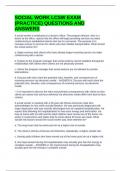
A social worker is employed at a doctor's office. The program director, who is a
doctor at the office, reports that the office will begin providing services via video
conferencing to established clients who live in rural areas. The purpose is to
increase access to services for clients who lack reliable transportation. What should
the social worker do?
a. Begin services with clients who have already begun receiving service via video
conferencing with a doctor.
b. Explain to the program manager that social workers cannot establish therapeutic
relationships with clients when clients are not physically present.
c. Inform the program manager that social workers are not allowed to provide
telemedicine.
d. Discuss with each client the potential risks, benefits, and consequences of
receiving services via electronic media. - ANSWER-d. Discuss with each client the
potential risks, benefits, and consequences of receiving services via electronic
media.
---It is important to discuss the risks and potential consequences with clients so that
clients are aware how services delivered via electronic media differ from face-to-face
contact.
A social worker is meeting with a 50-year-old African-American male who
acknowledges he has some suicidal ideation. He was previously diagnosed with
major depression and was recently discharged from an inpatient hospitalization. He
reports that following his hospitalization he has more energy and feels better. He
lives at home with his wife and his adult children have moved out of the home. He
works in construction and states that he works about 60 hours per week. What
suicide risk factors should the social worker pay close attention to?
a. The long hours that he works put him at a higher risk of suicide.
b. The client is African-American and therefore, statistically, a higher suicide risk.
c. Having adult children who have moved out of the home puts him at a higher risk.
d. His improvement during his hospitalization may actually give him the energy to
complete suicide. - ANSWER-d. His improvement during his hospitalization may
actually give him the energy to complete suicide.
, ---His improvement in the hospital puts him at a higher risk because he may now
have the energy to plan and follow through with suicide.
A 55-year-old male has been meeting with a social worker to address his alcohol
dependence. Over the past few weeks he has cut down on his drinking. His arrives
at his scheduled appointment sweating. He states he has been vomiting and he has
a noticeable tremor in his hands. How should the social worker respond?
a. Call 911, even if the client refuses to consent, as the client is likely detoxing and
may experience seizures or possibly death.
b. Encourage the client to decrease his alcohol intake more slowly as he is less likely
to suffer such serious withdrawal symptoms.
c. Talk to the client about the possible dangers of alcohol withdrawal and allow the
client to make his own decision about whether or not to seek medical help.
d. Encourage the client to withstand the uncomfortable symptoms for a few days as
they will likely pass after the painful process of detox. - ANSWER-c. Talk to the client
about the possible dangers of alcohol withdrawal and allow the client to make his
own decision about whether or not to seek medical help.
--Unless there's a medical emergency, the proper course is to explain the possible
risks to the client and discuss whether or not he wants to seek medical treatment.
If you have the condition where P = .05 or .01, you as a researcher should:
a. Reject the null hypothesis
b. Accept the null hypothesis
c. Reassess the study
d. Perform a post test - ANSWER-If you have the condition where P = .05 or .01, you
as a researcher should:
a. Reject the null hypothesis
When responding to a client's request for information about the disclosure of his/her
protected health information, which of the following is NOT required?
a. A description of what information was sent
b. The purpose of the disclosure
c. Disclosures for treatment, payment, or health care operations
(PRACTICE) QUESTIONS AND
ANSWERS
A social worker is employed at a doctor's office. The program director, who is a
doctor at the office, reports that the office will begin providing services via video
conferencing to established clients who live in rural areas. The purpose is to
increase access to services for clients who lack reliable transportation. What should
the social worker do?
a. Begin services with clients who have already begun receiving service via video
conferencing with a doctor.
b. Explain to the program manager that social workers cannot establish therapeutic
relationships with clients when clients are not physically present.
c. Inform the program manager that social workers are not allowed to provide
telemedicine.
d. Discuss with each client the potential risks, benefits, and consequences of
receiving services via electronic media. - ANSWER-d. Discuss with each client the
potential risks, benefits, and consequences of receiving services via electronic
media.
---It is important to discuss the risks and potential consequences with clients so that
clients are aware how services delivered via electronic media differ from face-to-face
contact.
A social worker is meeting with a 50-year-old African-American male who
acknowledges he has some suicidal ideation. He was previously diagnosed with
major depression and was recently discharged from an inpatient hospitalization. He
reports that following his hospitalization he has more energy and feels better. He
lives at home with his wife and his adult children have moved out of the home. He
works in construction and states that he works about 60 hours per week. What
suicide risk factors should the social worker pay close attention to?
a. The long hours that he works put him at a higher risk of suicide.
b. The client is African-American and therefore, statistically, a higher suicide risk.
c. Having adult children who have moved out of the home puts him at a higher risk.
d. His improvement during his hospitalization may actually give him the energy to
complete suicide. - ANSWER-d. His improvement during his hospitalization may
actually give him the energy to complete suicide.
, ---His improvement in the hospital puts him at a higher risk because he may now
have the energy to plan and follow through with suicide.
A 55-year-old male has been meeting with a social worker to address his alcohol
dependence. Over the past few weeks he has cut down on his drinking. His arrives
at his scheduled appointment sweating. He states he has been vomiting and he has
a noticeable tremor in his hands. How should the social worker respond?
a. Call 911, even if the client refuses to consent, as the client is likely detoxing and
may experience seizures or possibly death.
b. Encourage the client to decrease his alcohol intake more slowly as he is less likely
to suffer such serious withdrawal symptoms.
c. Talk to the client about the possible dangers of alcohol withdrawal and allow the
client to make his own decision about whether or not to seek medical help.
d. Encourage the client to withstand the uncomfortable symptoms for a few days as
they will likely pass after the painful process of detox. - ANSWER-c. Talk to the client
about the possible dangers of alcohol withdrawal and allow the client to make his
own decision about whether or not to seek medical help.
--Unless there's a medical emergency, the proper course is to explain the possible
risks to the client and discuss whether or not he wants to seek medical treatment.
If you have the condition where P = .05 or .01, you as a researcher should:
a. Reject the null hypothesis
b. Accept the null hypothesis
c. Reassess the study
d. Perform a post test - ANSWER-If you have the condition where P = .05 or .01, you
as a researcher should:
a. Reject the null hypothesis
When responding to a client's request for information about the disclosure of his/her
protected health information, which of the following is NOT required?
a. A description of what information was sent
b. The purpose of the disclosure
c. Disclosures for treatment, payment, or health care operations