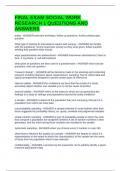
FINAL EXAM SOCIAL WORK
RESEARCH 1 QUESTIONS AND
ANSWERS
probe - ANSWER-interview technique, follow up questions, further probing type
question
What type of training do interviewers require with surveys - ANSWER-be familiar
with the questioner, record responses exactly as they were given, follow question
wording and question order exactly
ways questionnaires are administered - ANSWER-interviewer administered 1-face to
face, 2. by phone, 3. self administered
what types of questions are best used in a questionnaire - ANSWER-short concise
questions, only one question
"research design" - ANSWER-all the decisions made in the planning and conducting
research including decisions about measurement, sampling, how to collect data and
logical arrangements designed to permit certain types of inferences
internal validity - ANSWER-the confidence we have that the results of a study
accurately depict whether one variable is or is not the cause of another
external validity - ANSWER-refers to the extent to which we can generalize the
findings of a study to settings and populations beyond the study conditions
a sample - ANSWER-a subset of the population that your surveying, that part of a
population from which we have data
non-probability sampling - ANSWER-a sample selected in some fashion other than
those suggested by probability theory, ex. quota, snowball and judgmental samples
simple random sampling - ANSWER-a type of probability sample in which the units
that compose a population are assigned numbers.A set of random numbers is then
generated, and the units having those numbers are included in the sample
systematic sampling - ANSWER-when you choose every X number or every 5th
what factors influence the quality of a sample - ANSWER-the degree to which it is
representative or the extent to which the characteristics of the sample are the same
of those from the population which it was selected
confidentiality - ANSWER-a promise by the researcher not to publicly identify a given
research participant's data
RESEARCH 1 QUESTIONS AND
ANSWERS
probe - ANSWER-interview technique, follow up questions, further probing type
question
What type of training do interviewers require with surveys - ANSWER-be familiar
with the questioner, record responses exactly as they were given, follow question
wording and question order exactly
ways questionnaires are administered - ANSWER-interviewer administered 1-face to
face, 2. by phone, 3. self administered
what types of questions are best used in a questionnaire - ANSWER-short concise
questions, only one question
"research design" - ANSWER-all the decisions made in the planning and conducting
research including decisions about measurement, sampling, how to collect data and
logical arrangements designed to permit certain types of inferences
internal validity - ANSWER-the confidence we have that the results of a study
accurately depict whether one variable is or is not the cause of another
external validity - ANSWER-refers to the extent to which we can generalize the
findings of a study to settings and populations beyond the study conditions
a sample - ANSWER-a subset of the population that your surveying, that part of a
population from which we have data
non-probability sampling - ANSWER-a sample selected in some fashion other than
those suggested by probability theory, ex. quota, snowball and judgmental samples
simple random sampling - ANSWER-a type of probability sample in which the units
that compose a population are assigned numbers.A set of random numbers is then
generated, and the units having those numbers are included in the sample
systematic sampling - ANSWER-when you choose every X number or every 5th
what factors influence the quality of a sample - ANSWER-the degree to which it is
representative or the extent to which the characteristics of the sample are the same
of those from the population which it was selected
confidentiality - ANSWER-a promise by the researcher not to publicly identify a given
research participant's data