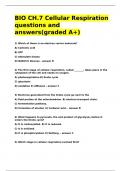
BIO CH.7 Cellular Respiration
questions and
answers(graded A+)
1) Which of these is an electron carrier molecule?
A) Carbonic acid
B) ATP
C) Adenylate kinase
D) NADH E) Glucose - answer D
2) The first stage of cellular respiration, called ________, takes place in the
cytoplasm of the cell and needs no oxygen.
A) photorespiration B) Krebs cycle
C) glycolysis
D) oxidation E) diffusion - answer C
3) Electrons generated from the Krebs cycle go next to the
A) fluid portion of the mitochondrion. B) electron transport chain.
C) fermentation pathway.
D) formation of alcohol. E) Carbonic acid. - answer B
4) What happens to pyruvate, the end product of glycolysis, before it
enters the Krebs cycle?
A) It is carboxylated. B) It is reduced.
C) It is oxidized.
D) It is phosphorylated. E) Nothing. - answer C
5) Which stage in cellular respiration evolved first?
, A) Krebs cycle
B) Electron transport chain C) Glycolysis
D) Fermentation
E) None of the answer choices are
correct - answer C
6) Select the correct sequence of chemicals and processes depicting the
breakdown of glucose during cellular respiration.
A) Glycolysis - pyruvate - acetyl - CoA - electron transport chain - Krebs
cycle
B) Glycolysis - acetyl - CoA - pyruvate - Krebs cycle - electron transport
chain
C) Glycolysis - acetyl - CoA - pyruvate - electron transport chain - Krebs
cycle
D) Glycolysis - pyruvate - acetyl - CoA - Krebs cycle - electron transport
chain
E) None of the answer choices are correct - answer D
7) When substrate-level phosphorylation occurs it means that
A) ATP is converted into ADP plus a phosphate group.
B) NADH is converted into NAD + H. C) NAD is converted into NADH.
D) AMP is converted into NAD by
adding a phosphate group.
E) ADP is converted into ATP by the
transfer of a phosphate group. - answer E
8) Under what environmental conditions do yeast carry out fermentation?
A) Low pH
B) Absence of oxygen C) High temperature
D) High osmotic pressure
E) All of the answer choices are correct. - answer B
questions and
answers(graded A+)
1) Which of these is an electron carrier molecule?
A) Carbonic acid
B) ATP
C) Adenylate kinase
D) NADH E) Glucose - answer D
2) The first stage of cellular respiration, called ________, takes place in the
cytoplasm of the cell and needs no oxygen.
A) photorespiration B) Krebs cycle
C) glycolysis
D) oxidation E) diffusion - answer C
3) Electrons generated from the Krebs cycle go next to the
A) fluid portion of the mitochondrion. B) electron transport chain.
C) fermentation pathway.
D) formation of alcohol. E) Carbonic acid. - answer B
4) What happens to pyruvate, the end product of glycolysis, before it
enters the Krebs cycle?
A) It is carboxylated. B) It is reduced.
C) It is oxidized.
D) It is phosphorylated. E) Nothing. - answer C
5) Which stage in cellular respiration evolved first?
, A) Krebs cycle
B) Electron transport chain C) Glycolysis
D) Fermentation
E) None of the answer choices are
correct - answer C
6) Select the correct sequence of chemicals and processes depicting the
breakdown of glucose during cellular respiration.
A) Glycolysis - pyruvate - acetyl - CoA - electron transport chain - Krebs
cycle
B) Glycolysis - acetyl - CoA - pyruvate - Krebs cycle - electron transport
chain
C) Glycolysis - acetyl - CoA - pyruvate - electron transport chain - Krebs
cycle
D) Glycolysis - pyruvate - acetyl - CoA - Krebs cycle - electron transport
chain
E) None of the answer choices are correct - answer D
7) When substrate-level phosphorylation occurs it means that
A) ATP is converted into ADP plus a phosphate group.
B) NADH is converted into NAD + H. C) NAD is converted into NADH.
D) AMP is converted into NAD by
adding a phosphate group.
E) ADP is converted into ATP by the
transfer of a phosphate group. - answer E
8) Under what environmental conditions do yeast carry out fermentation?
A) Low pH
B) Absence of oxygen C) High temperature
D) High osmotic pressure
E) All of the answer choices are correct. - answer B