

4/21/25, 8:39 AM Chemistry 1010 Final Exam 2025|COMPLETE EXAM TEST (questions and verified answers) FREQUENTLY MOST TESTED …
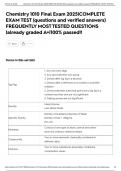
Chemistry 1010 Final Exam 2025|COMPLETE
EXAM TEST (questions and verified answers)
FREQUENTLY MOST TESTED QUESTIONS
|already graded A+|100% passed!!
Save
Terms in this set (66)
1. Any non-zero digit
2. Any zero between two sig fig
3. Zeroes after sig fig in a decimal
4. Zeroes after coefficient of a number in scientific
Sig Figs
notation
5. Zeroes between a decimal point and a sig fig in a
number less than one are not significant
6. Trailing zeroes are not significant
Mass/Volume
Density
Less dense floats
Density of Substance/Density of Water
Specific Gravity Density of h2o = 1.00g/mL
No unit
Consist of one type of atom; cannot be broken
Elements
down by ordinary chemical means.
Two or more elements chemically combined in
Compounds
defined ratios.
Two or more substances physically combined;
Mixtures
composition varies.
https://quizlet.com/1033710684/chemistry-1010-final-exam-2025complete-exam-test-questions-and-verified-answers-frequently-most-tested-ques… 1/6
, 4/21/25, 8:39 AM Chemistry 1010 Final Exam 2025|COMPLETE EXAM TEST (questions and verified answers) FREQUENTLY MOST TESTED …
Solids: definite shape and volume
States of Matter Liquids: definite volume
Gases: no definite shape or volume
Physical: color, size, shape
Properties of Matter
Chemical: flammability, reactivity
Physical: change of state
Changes in Matter
Chemical: composition changes
1) Matter is made up of small particles called atoms.
2) All atoms of the same element are identical.
3) Atoms of 2 or more elements combine to make
John Dalton Theory
compounds.
4) Chemical reaction involves chemical
rearrangement.
1. Protons p+
Subatomic Particles 2. Neutrons no
3. Electrons e-
Atomic Number # of protons = # of electrons
Mass Number # of protons + # of neutrons
Atoms of the same element that have different
Isotopes number of neutrons; therefore mass number is
different.
The "average atom" of each element's weighted
Atomic Mass average mass of all naturally occurring isotopes of
that element.
Electron Shells 2s, 6p, 10d, 14f
Decreases down a group; increases from L to R
Ionization Energy
across a period.
Alpha Particle 4/2 He; lowest energy
0/-1; fast moving electrons; little mass but great
Beta Particle
energy
Gamma Rays Highest Energy
Positron 0/+1; Positive electron
https://quizlet.com/1033710684/chemistry-1010-final-exam-2025complete-exam-test-questions-and-verified-answers-frequently-most-tested-ques… 2/6
Chemistry 1010 Final Exam 2025|COMPLETE
EXAM TEST (questions and verified answers)
FREQUENTLY MOST TESTED QUESTIONS
|already graded A+|100% passed!!
Save
Terms in this set (66)
1. Any non-zero digit
2. Any zero between two sig fig
3. Zeroes after sig fig in a decimal
4. Zeroes after coefficient of a number in scientific
Sig Figs
notation
5. Zeroes between a decimal point and a sig fig in a
number less than one are not significant
6. Trailing zeroes are not significant
Mass/Volume
Density
Less dense floats
Density of Substance/Density of Water
Specific Gravity Density of h2o = 1.00g/mL
No unit
Consist of one type of atom; cannot be broken
Elements
down by ordinary chemical means.
Two or more elements chemically combined in
Compounds
defined ratios.
Two or more substances physically combined;
Mixtures
composition varies.
https://quizlet.com/1033710684/chemistry-1010-final-exam-2025complete-exam-test-questions-and-verified-answers-frequently-most-tested-ques… 1/6
, 4/21/25, 8:39 AM Chemistry 1010 Final Exam 2025|COMPLETE EXAM TEST (questions and verified answers) FREQUENTLY MOST TESTED …
Solids: definite shape and volume
States of Matter Liquids: definite volume
Gases: no definite shape or volume
Physical: color, size, shape
Properties of Matter
Chemical: flammability, reactivity
Physical: change of state
Changes in Matter
Chemical: composition changes
1) Matter is made up of small particles called atoms.
2) All atoms of the same element are identical.
3) Atoms of 2 or more elements combine to make
John Dalton Theory
compounds.
4) Chemical reaction involves chemical
rearrangement.
1. Protons p+
Subatomic Particles 2. Neutrons no
3. Electrons e-
Atomic Number # of protons = # of electrons
Mass Number # of protons + # of neutrons
Atoms of the same element that have different
Isotopes number of neutrons; therefore mass number is
different.
The "average atom" of each element's weighted
Atomic Mass average mass of all naturally occurring isotopes of
that element.
Electron Shells 2s, 6p, 10d, 14f
Decreases down a group; increases from L to R
Ionization Energy
across a period.
Alpha Particle 4/2 He; lowest energy
0/-1; fast moving electrons; little mass but great
Beta Particle
energy
Gamma Rays Highest Energy
Positron 0/+1; Positive electron
https://quizlet.com/1033710684/chemistry-1010-final-exam-2025complete-exam-test-questions-and-verified-answers-frequently-most-tested-ques… 2/6


