

Written by students who passed Immediately available after payment Read online or as PDF Wrong document? Swap it for free 4.6 TrustPilot
logo-home
Document preview thumbnail
Preview 1 out of 3 pages
Exam (elaborations)

Spanish 103 Exam Questions With Well Elaborated Answers.

Document preview thumbnail
Preview 1 out of 3 pages

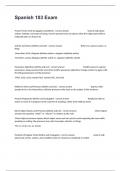
Present Tense Verb (Conjugate and Define) - correct answer -Used to talk about actions, feelings, and states of being. Use the present tense to express what the subject generally or habitually does or doesn't do Articles and Nouns (Define and List) - correct answer -Refers to a person, place, or thing -Masculine: El/Un (Singular definite article vs singular indefinite article) -Feminine: La/Una (Singular definite article vs. singular indefinite article) Possessive Adjectives (Define and List) - correct answer -Modify nouns to express possession; always proceed the noun they modify; possessive adjectives change number to agree with the things possessed, not the possessor -Mi(s), tu(s), su(s), nuestro/a(s), vuestro/a(s), and su(s) Reflexive Verbs and Pronouns (Define and List) - correct answer -Express what people do to or for themselves; reflexive pronouns refer back to the subject of the sentence Present Progressive (Define and Conjugate) - correct answer -Emphasize that an action or event is in progress at the moment of speaking, rather than habitual action Direct Object Nouns and Pronouns (Define and List) - correct answer -Direct object answers the question "what?" or "whom?" in relation to the verb -Direct object pronouns replace direct object nouns and are used to avoid repeating the noun while speaking or writing; the pronouns may refer to people, animals, or things -Me, te, lo/la, nos, os, los/las Preterite of Regular Verbs (Define and Conjugate) - correct answer -Used to talk about past events, actions, and conditions that are viewed as completed or ended Indirect Objects Nouns and Pronouns (Define and List) - correct answer -Tell "to whom" or "for whom" an action is done. In other words, who is affected by an action? -Me, te, le, nos, os, les Preterite of Reflexive Verbs and Pronouns (Define and Conjugate) - correct answer -Express what people do to/for themselves; same rules that applied to the reflexive in the present apply in the past The Imperfect (Define and Conjugate) - correct answer -Focuses on how things used to be years ago; if the sentence were talking about a specific, completed action, like something that was done yesterday, the PRETERITE would be used -Imperfect is used to express habitual or repeated actions in the past (w/out focus on the completion of the action); express an action or state that was in progress in the past; to describe characteristics and conditions in the past; express someone's ago in the past When to use the Preterite vs the Imperfect - correct answer -Preterite: express a sequence of actions completed in the past (forward movement of narrative time); talk about the beginning or ending of an event, action, or condition that occurred over a specific period of time; talk about the beginning of an event, action, or condition -Imperfect: Talk about habitual actions, events, or conditions in the past; express an ongoing part of an event, action of condition Comparisons of Inequality (Define and list) - correct answer -Use "mas... que" or "menos... que" to express comparisons of inequality. -Mas/menos [adjective] que.... Comparisons of Equality (Define and List) - correct answer -Indicares that two people, activities or things are alike in some way -Tan [adj/adv] como (as...as) -Tanto/a [noun] como (as much... as] -Tantos/as [noun] como (as many... as) -Tanto como (as much as) Present Perfect (Define and Conjugate) - correct answer -Perfect tense refers to past events, actions, and conditions -Present perfect refers to a past even, action, or condition that has some relation to the present Present Subjunctive (Define and Conjugate) - correct answer -Used to express expectations and hopes

Content preview

Spanish 103 Exam

Present Tense Verb (Conjugate and Define) - correct answer -Used to talk about
actions, feelings, and states of being. Use the present tense to express what the subject generally or
habitually does or doesn't do


Articles and Nouns (Define and List) - correct answer -Refers to a person, place, or
thing

-Masculine: El/Un (Singular definite article vs singular indefinite article)

-Feminine: La/Una (Singular definite article vs. singular indefinite article)


Possessive Adjectives (Define and List) - correct answer -Modify nouns to express
possession; always proceed the noun they modify; possessive adjectives change number to agree with
the things possessed, not the possessor

-Mi(s), tu(s), su(s), nuestro/a(s), vuestro/a(s), and su(s)


Reflexive Verbs and Pronouns (Define and List) - correct answer -Express what
people do to or for themselves; reflexive pronouns refer back to the subject of the sentence


Present Progressive (Define and Conjugate) - correct answer -Emphasize that an
action or event is in progress at the moment of speaking, rather than habitual action


Direct Object Nouns and Pronouns (Define and List) - correct answer -Direct object
answers the question "what?" or "whom?" in relation to the verb

-Direct object pronouns replace direct object nouns and are used to avoid repeating the noun while
speaking or writing; the pronouns may refer to people, animals, or things

-Me, te, lo/la, nos, os, los/las


Preterite of Regular Verbs (Define and Conjugate) - correct answer -Used to talk
about past events, actions, and conditions that are viewed as completed or ended


Document information

Uploaded on
April 21, 2025
Number of pages
3
Written in
2024/2025
Type
Exam (elaborations)
Contains
Questions & answers
$14.49

Wrong document? Swap it for free Within 14 days of purchase and before downloading, you can choose a different document. You can simply spend the amount again.
Written by students who passed
Immediately available after payment
Read online or as PDF

Seller avatar
Reputation scores are based on the amount of documents a seller has sold for a fee and the reviews they have received for those documents. There are three levels: Bronze, Silver and Gold. The better the reputation, the more your can rely on the quality of the sellers work.
RealGrades
4.0
(26)
Sold
196
Followers
52
Items
12327
Last sold
1 week ago


Why students choose Stuvia

Created by fellow students, verified by reviews

Quality you can trust: written by students who passed their tests and reviewed by others who've used these notes.

Didn't get what you expected? Choose another document

No worries! You can instantly pick a different document that better fits what you're looking for.

Pay as you like, start learning right away

No subscription, no commitments. Pay the way you're used to via credit card and download your PDF document instantly.

Student with book image

“Bought, downloaded, and aced it. It really can be that simple.”

Alisha Student

Working on your references?

Create accurate citations in APA, MLA and Harvard with our free citation generator.

Working on your references?

Frequently asked questions
