SOC 202 Final EXAM QUESTIONS AND CORRECT
ANSWERS
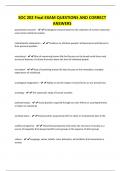
quantitative research - ✔✔Sociological research based on the collection of numeric data that
uses precise statistical analysis
individualistic explanation - ✔✔Tendency to attribute people's achievements and failures to
their personal qualities
macrolevel - ✔✔Way of examining human life that focuses on the broad social forces and
structural features of society that exist above the level of individual people
microlevel - ✔✔Way of examining human life that focuses on the immediate, everyday
experiences of individuals
sociological imagination - ✔✔Ability to see the impact of social forces on our private lives
sociology - ✔✔The systematic study of human societies
achieved status - ✔✔Social position acquired through our own efforts or accomplishments
or taken on voluntarily
ascribed status - ✔✔Social position acquired at birth or taken on involuntarily later in life
conflict perspective - ✔✔Theoretical perspective that views the structure of society as a
source of inequality that always benefits some groups at the expense of other groups
culture - ✔✔Language, values, beliefs, rules, behaviors, and artifacts that characterize a
society
,feminist perspective - ✔✔Theoretical perspective that focuses on gender as the most
important source of conflict and inequality in social life
globalization - ✔✔Process through which people's lives all around the world become
economically, politically, environmentally, and culturally interconnected
group - ✔✔Set of people who interact more or less regularly and who are conscious of their
identity as a unit
in-groups - ✔✔The groups to which we belong and toward which we feel a sense of loyalty
latent function - ✔✔Unintended, unrecognized consequences of activities that help some
part of the social system
manifest functions - ✔✔Intended, obvious consequences of activities designed to help some
part of the social system
norm - ✔✔Culturally defined standard or rule of conduct
organization - ✔✔Large, complex network of positions created for a specific purpose and
characterized by a hierarchical division of labor
out-groups - ✔✔The groups to which we don't belong and toward which we feel a certain
amount of antagonism
primary group - ✔✔Collection of individuals who are together for a relatively long period,
whose members have direct contact with and feel emotional attachment to one another
, role - ✔✔Set of expectations—rights, obligations, behaviors, duties—associated with a
particular status
role conflict - ✔✔Frustration people feel when the demands of one role they are expected to
fulfill clash with the demands of another role
role strain - ✔✔Situations in which people lack the necessary resources to fulfill the
demands of a particular role
secondary group - ✔✔Relatively impersonal collection of individuals that is established to
perform a specific task
social institution - ✔✔Stable set of roles, statuses, groups, and organizations—such as the
institution of education, family, politics, religion, health care, or the economy—that provides a
foundation for behavior in some major area of social life
society - ✔✔A population of people living in the same geographic area who share a culture
and a common identity and whose members are subject to the same political authority
status - ✔✔Any named social position that people can occupy
structural-functionalist perspective - ✔✔Theoretical perspective that posits that social
institutions are structured to maintain stability and order in society
symbol - ✔✔Something used to represent or stand for something else
symbolic interactionism - ✔✔Theoretical perspective that explains society and social
structure through an examination of the microlevel, personal, day-to-day exchanges of people
as individuals, pairs, or groups
ANSWERS
quantitative research - ✔✔Sociological research based on the collection of numeric data that
uses precise statistical analysis
individualistic explanation - ✔✔Tendency to attribute people's achievements and failures to
their personal qualities
macrolevel - ✔✔Way of examining human life that focuses on the broad social forces and
structural features of society that exist above the level of individual people
microlevel - ✔✔Way of examining human life that focuses on the immediate, everyday
experiences of individuals
sociological imagination - ✔✔Ability to see the impact of social forces on our private lives
sociology - ✔✔The systematic study of human societies
achieved status - ✔✔Social position acquired through our own efforts or accomplishments
or taken on voluntarily
ascribed status - ✔✔Social position acquired at birth or taken on involuntarily later in life
conflict perspective - ✔✔Theoretical perspective that views the structure of society as a
source of inequality that always benefits some groups at the expense of other groups
culture - ✔✔Language, values, beliefs, rules, behaviors, and artifacts that characterize a
society
,feminist perspective - ✔✔Theoretical perspective that focuses on gender as the most
important source of conflict and inequality in social life
globalization - ✔✔Process through which people's lives all around the world become
economically, politically, environmentally, and culturally interconnected
group - ✔✔Set of people who interact more or less regularly and who are conscious of their
identity as a unit
in-groups - ✔✔The groups to which we belong and toward which we feel a sense of loyalty
latent function - ✔✔Unintended, unrecognized consequences of activities that help some
part of the social system
manifest functions - ✔✔Intended, obvious consequences of activities designed to help some
part of the social system
norm - ✔✔Culturally defined standard or rule of conduct
organization - ✔✔Large, complex network of positions created for a specific purpose and
characterized by a hierarchical division of labor
out-groups - ✔✔The groups to which we don't belong and toward which we feel a certain
amount of antagonism
primary group - ✔✔Collection of individuals who are together for a relatively long period,
whose members have direct contact with and feel emotional attachment to one another
, role - ✔✔Set of expectations—rights, obligations, behaviors, duties—associated with a
particular status
role conflict - ✔✔Frustration people feel when the demands of one role they are expected to
fulfill clash with the demands of another role
role strain - ✔✔Situations in which people lack the necessary resources to fulfill the
demands of a particular role
secondary group - ✔✔Relatively impersonal collection of individuals that is established to
perform a specific task
social institution - ✔✔Stable set of roles, statuses, groups, and organizations—such as the
institution of education, family, politics, religion, health care, or the economy—that provides a
foundation for behavior in some major area of social life
society - ✔✔A population of people living in the same geographic area who share a culture
and a common identity and whose members are subject to the same political authority
status - ✔✔Any named social position that people can occupy
structural-functionalist perspective - ✔✔Theoretical perspective that posits that social
institutions are structured to maintain stability and order in society
symbol - ✔✔Something used to represent or stand for something else
symbolic interactionism - ✔✔Theoretical perspective that explains society and social
structure through an examination of the microlevel, personal, day-to-day exchanges of people
as individuals, pairs, or groups