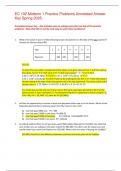
EC 102 Midterm 1 Practice Problems Annotated Answer
Key Spring 2025.
Annotated answer key – this includes note on solving some (but not all) of the practice
problems. Note that this is not the only way to solve these problems!!
1. What is the value in year 7 of the following stream of payments on the date of the last payment?
Assume an interest rate of 8%.
Year 1 2 3 4 5 6 7
Payment $20 $25 $35 $15
$119.22
To solve this, we need to compound all the values so to get a value at Year 7 and then add up
the values. So, for Yr 2, that value in Yr 7 is five years away (7−2=5). So its FV is
$ 20 × 1.085=$ 29.3866. Yr 3’s FV is $ 25 × 1.084=$ 34.0122 . Yr 5’s is
$ 35 × 1.082=$ 40.8240. You don’t have to do anything for the $15 in Yr 7 since that value is
already sitting at the date of the last payment (it is the last payment!). The value of the entire
stream, then, is $ 29.3866+ $ 34.0122+ $ 40.824 + $ 15=$ 119.22.
You could also use the top row of your calc to find each value (you will need to do it for the
values at year 2, year 3 and year 5). For example bring the Yr 2 payment to future using N = 5,
I/YR = 8%, PV = -20, PMT = 0, solve for FV (29.3866)
2. Jeff has the opportunity to receive a lump-sum payment either now or in the future. Which of the
following opportunities is the best, given that the interest rate is 4%?
A) one that pays $900 now PV = 900
B) one that pays $1080 in two years PV=998.52
C) one that pays $1350 in five years PV=1109.60 THE HIGHEST PV!!!
D) one that pays $1620 in ten years PV= 1094.42
3. An elderly relative offers to sell you their used 1958 Cadillac Eldorado for $52,000. You note that
very similar cars are selling on the open market for $87,000. You don't care for classic cars and
would rather buy a new Ford Explorer for $35,000. What is the net value of buying the Cadillac?
$35,000, since this is the difference between purchase and resale price of the Cadillac.
, 4. Whose cash flow is best described by the timeline shown below?
0 1 2 3 4
-$3500 $1000 $1000 $1000 $1000
A) Harry, who borrows $3,500, and then receives an annual payment of $1,000
B) Leo, who borrows $3,500, and then pays back the loan in four annual payments of $1,000
C) Joe, who puts down $3,500 to buy a car, and then makes annual payments of $1,000
D) Karen, who loans a friend $3,500, which friend then pays back the loan in four annual
installments of $1,000 Remember This timeline shows money leaving your pocket at Time
0, and coming back to you in all other times. Only option D matches these cash flows.
5. In a trade with the government of an oil producing nation, a manufacturer will deliver 13
Caterpillar D9 tractors, with a value of $320,000 per tractor, and receive 45,000 barrels of oil,
valued at $120 per barrel. What is the net benefit of this trade to the manufacturer?
$1,240,000 = -(13x320,000) + (45,000x120)
6. Consider the following timeline:
0 1 2 3 4 5 6
$50 $70
If the current market rate of interest is 3%, what is the combined value of the cash flows on the
timeline at year 6 (round to the nearest dollar)?
$131
Similar to #1. The Yr 2 value is 4 years away from Yr 6 and the Yr 4 value is 2 years away, so
that’s how many times we need to compound each of them.
FV =( $ 50 × 1.034 )+( $ 70 × 1.032 )=$ 130.54 (which is $131 when you round to the nearest
dollar).
If you want to use the top row, you calculate both values separately and then add them. FV for
the Yr 2 value is N = 4, I/YR = 3, PV = -50, solve for FV (result is 56.2754). Yr 4 value is N = 2, I/YR
= 3, PV = -70, solve for FV (result is 74.2630). Add them together, total is $130.54 (or $131
rounded to the nearest dollar).
Key Spring 2025.
Annotated answer key – this includes note on solving some (but not all) of the practice
problems. Note that this is not the only way to solve these problems!!
1. What is the value in year 7 of the following stream of payments on the date of the last payment?
Assume an interest rate of 8%.
Year 1 2 3 4 5 6 7
Payment $20 $25 $35 $15
$119.22
To solve this, we need to compound all the values so to get a value at Year 7 and then add up
the values. So, for Yr 2, that value in Yr 7 is five years away (7−2=5). So its FV is
$ 20 × 1.085=$ 29.3866. Yr 3’s FV is $ 25 × 1.084=$ 34.0122 . Yr 5’s is
$ 35 × 1.082=$ 40.8240. You don’t have to do anything for the $15 in Yr 7 since that value is
already sitting at the date of the last payment (it is the last payment!). The value of the entire
stream, then, is $ 29.3866+ $ 34.0122+ $ 40.824 + $ 15=$ 119.22.
You could also use the top row of your calc to find each value (you will need to do it for the
values at year 2, year 3 and year 5). For example bring the Yr 2 payment to future using N = 5,
I/YR = 8%, PV = -20, PMT = 0, solve for FV (29.3866)
2. Jeff has the opportunity to receive a lump-sum payment either now or in the future. Which of the
following opportunities is the best, given that the interest rate is 4%?
A) one that pays $900 now PV = 900
B) one that pays $1080 in two years PV=998.52
C) one that pays $1350 in five years PV=1109.60 THE HIGHEST PV!!!
D) one that pays $1620 in ten years PV= 1094.42
3. An elderly relative offers to sell you their used 1958 Cadillac Eldorado for $52,000. You note that
very similar cars are selling on the open market for $87,000. You don't care for classic cars and
would rather buy a new Ford Explorer for $35,000. What is the net value of buying the Cadillac?
$35,000, since this is the difference between purchase and resale price of the Cadillac.
, 4. Whose cash flow is best described by the timeline shown below?
0 1 2 3 4
-$3500 $1000 $1000 $1000 $1000
A) Harry, who borrows $3,500, and then receives an annual payment of $1,000
B) Leo, who borrows $3,500, and then pays back the loan in four annual payments of $1,000
C) Joe, who puts down $3,500 to buy a car, and then makes annual payments of $1,000
D) Karen, who loans a friend $3,500, which friend then pays back the loan in four annual
installments of $1,000 Remember This timeline shows money leaving your pocket at Time
0, and coming back to you in all other times. Only option D matches these cash flows.
5. In a trade with the government of an oil producing nation, a manufacturer will deliver 13
Caterpillar D9 tractors, with a value of $320,000 per tractor, and receive 45,000 barrels of oil,
valued at $120 per barrel. What is the net benefit of this trade to the manufacturer?
$1,240,000 = -(13x320,000) + (45,000x120)
6. Consider the following timeline:
0 1 2 3 4 5 6
$50 $70
If the current market rate of interest is 3%, what is the combined value of the cash flows on the
timeline at year 6 (round to the nearest dollar)?
$131
Similar to #1. The Yr 2 value is 4 years away from Yr 6 and the Yr 4 value is 2 years away, so
that’s how many times we need to compound each of them.
FV =( $ 50 × 1.034 )+( $ 70 × 1.032 )=$ 130.54 (which is $131 when you round to the nearest
dollar).
If you want to use the top row, you calculate both values separately and then add them. FV for
the Yr 2 value is N = 4, I/YR = 3, PV = -50, solve for FV (result is 56.2754). Yr 4 value is N = 2, I/YR
= 3, PV = -70, solve for FV (result is 74.2630). Add them together, total is $130.54 (or $131
rounded to the nearest dollar).