

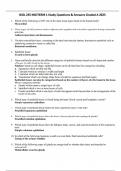
BIOL 235 MIDTERM 1 Study Questions & Answers Graded A 2025
1. Which of the following is NOT one of the main tissue types found in the human body? Myocardial 2. These types of cell junctions anchor adjacent cells together and resist their separation during contractile activities Adherent junctions and desmosomes 3. The thin extracellular layer, consisting of the basal and reticular lamina, that anchors epithelial cells to underlying connective tissue is called the… Basement membrane 4. Epithelial tissue Is used to form glands 5. Name and briefly describe the different categories of epithelial tissues based on cell shape and number of layers of cells found in the tissue Solution: based on cell shape, epithelial tissues can be divided into four categories including a. Squamous which are thin and flat b. Cuboidal which are similar in width and height c. Columnar which are taller than they are wide d. Transitional which can change shape from cuboidal to squamous and back again Epithelial tissues can also be categorized based on the number of layers of cells found in the tissue. These categories include: a. Simple which means a single layer of cells b. Stratified which is two or more layers of cells c. Pseudo stratified which is one layer of cells that appears multi-layered due to the arrangement of the nuclei in the cells. 6. Which type of epithelial tissue is found lining the heart, blood vessels and lymphatic vessels? Simple squamous epithelium 7. Which type of epithelial tissue forms the most superficial layer of the skin? Stratified squamous epithelium 8. Which type of epithelial tissue lines the ducts of sweat glands and esophageal glands? Stratified cuboidal epithelium 9. Which type of epithelial tissue lines the fallopian tubes, uterus, and some bronchioles of the respiratory tract? Simple columnar epithelium 10. In which of the following locations would you most likely find transitional epithelial cells? Lining of the urinary bladder 11. Which of the following types of glands are categorized by whether their ducts are branched or unbranched? Multicellular exocrine glands 12. Which type of multicellular exocrine gland has a branched rounded secretory part attached to a single unbranched duct and is found mainly in sebaceous glands? Simple branched acinar gland 13. Functional classification of exocrine glands is based on How the gland releases its secretory product 14. Which type of exocrine gland accumulates its secretory product in the cytosol of its cells until the cell ruptures and becomes part of the secretory product? Holocrine 15. The extracellular matrix of connective tissue consists of Protein fibers and ground substances 16. Which of the following is NOT a connective tissue? Epidermis 17. Which component of connective tissue is found between the cells and fibers, and functions to support and bind cells in the tissue together? Ground substance 18. Which of the following is a polysaccharide commonly found in the ground substance of connective tissues? Hyaluronic acid 19. Which of the following types of fibers are commonly found in the extracellular matrix of connective tissue? a. Elastic b. Reticular c. Collagen d. All of these answers are correct 20. Reticular fibers in soft organs like the spleen and liver form a supporting framework called the Stroma 21. Which of the following is classified as loose connective tissue? Areolar connective tissue 22. Which of the following is a location where adipose tissue is commonly found? Subcutaneous layer deep in the skin 23. The main function of dense regular connective tissues is Providing strong attachment between structures like muscle and bones 24. The pubic symphysis and intervertebral discs are composed of which type of connective tissue? Fibrocartilage 25. Name and briefly describe the two types of growth seen in cartilage Solution: growth of cartilage can be classified as interstitial or appositional. In interstitial growth, the cartilage increases rapidly in size due to the division of existing chondrocytes and the continuous deposition of increasing amounts of matrix by the chondrocytes. In appositional
Document information
- Uploaded on
- April 17, 2025
- Number of pages
- 6
- Written in
- 2024/2025
- Type
- Exam (elaborations)
- Contains
- Questions & answers


