NBCE Part 4 Clinical & Set-Ups
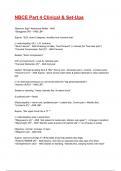
*Beever's Sign* Abdominal Reflex - ANS
\*Braggards (Pl)* - ANS LBP:
Supine, *SLR, down 5 degrees, dorsiflex foot involved side*
(+ radiculopathy) (S-1, L/S, lumbars)
\*Burn's bench* - ANS Kneeling on table, *bend forward* (+ refusal) (for "low back pain")
\*Cervical Compression Test (P)* - ANS Cervical:
Seated, *direct compression*
(IVF encroachment) - Look for radicular pain
\*Cervical Distraction (P)* - ANS Cervical:
seated, *lift head avoiding face & TMJ* (Nerve root - decrease pain), ( muscle - increase pain)
\*Hoover's (A1)* - ANS Supine, *place hands under heels & patient attempts to raise weakened
leg*
(+ no downward pressure on uninvolved side) (for "leg paresis/paralysis")
\*Kemp's (A/P2)* - ANS LBP:
Seated or standing, *rotate, laterally flex, & extend trunk*
(Localized pain = facet)
(Radiculopathy = nerve root; Ipsilateral pain = Lateral disc, Contra pain = Medial disc)
\*Lindner's (P)* - ANS LBP:
Supine, *flex upper trunk into a "C "*
(+ radiculopathy) (esp. Lateral disc)
\*Magnuson's (A)* - ANS *Ask patient to locate pain, distract, ask again* ( + change in location)
\*Mannkopf's (P)* - ANS *Monitor pulse & press into painful site* (+ no increase in pulse)
Objective, normal= increase 10 bpm
\*Milgram's (A)* - ANS SOL
Supine, raise & hold legs 3" off the table (may help patient raise legs)
\*Patrick FABERE (P)* - ANS Supine, rest heel on opposite knee (aka sign of 4) (Hip)
\*Schepelmann's (A2)* - ANS Seated or standing, *laterally flex, clasping hands over head*
,Ipsilateral pain = intercostal neuritis
Contralateral pain = pleurisy/ rnyofascitis
\*SLR (Lasegue's) (P1)* - ANS LBP:
Supine, *flex hip involved side*
(+ radiculopathy) (S-I, L/S, lumbars)
\*Soto Hall (P)* - ANS Cervical:
Supine, *cross arms on chest with passive neck flexion & sternum stabilization* (General)
\*Spinous percussion (P)* - ANS Seated or prone, *percuss SP's*
(for fracture or nerve if radiating)
\*Sternal compression (P)* - ANS Cervical:
Supine, *cross arms on chest & apply pressure on sternum* (Rib or thorax lesion)
\*Valsalva's sign (A)* - ANS SOL
Seated, take a deep breath, hold, & bear down
\*Yeoman's (P)* - ANS *Extend hip with S-I stabilization* (S-I)
\+ Graphesthesia (P2) - ANS Seated, doctor draws familiar letter/number on patient's hand (PC
& cortex)
\+ Position sense (P2) - ANS holding the sides of the digit (fingers & toes), patient attempts to
determine "up"
or "down" placement of digit (PC)
\+ Two point discrimination (P2) - ANS Apply 2 pins on skin, from far apart to closer until patient
only feels 1 point (PC)
\10. Patient seated, use lateral index contact (push) on pillar for a C3 spinous right (PR) body
left - ANS LOD: P-A & 1-S
\11. Patient seated, use thumb-index contact on olecranon for a posterior right ulna (push) -
ANS LOD: P-A
\12. Patient seated, use pisiform on mastoid (push) for a PSR occiput - ANS LOD: P-A & S-1
\13. Patient supine, use index on body for a C1 body left, spinous right - ANS LOD: P-A & I-S
\14. Patient supine, use index-thumb on double transverse for an anterior TS & posterior T6 -
ANS LOO: P-A & I-S
\15. Patient supine, use bimanual grasp on proximal femur for a left superior femur (coxofemoral
joint), long axis distraction pull - ANS LOO: S-I
\16. Patient supine, use an interlaced digit (traction) on the left superior femur (coxofemoral
joint) for a superior femur - ANS LOO: S-I
\17. Patient supine, use a bimanual grasp on the proximal tibia for a left superior tibia (long axis
distraction pull) - ANS LOD: S-I
, \18. Patient supine, use a bilateral thumb contact for a right anterior fibular head (push) - ANS
LOO: A-P
\19. Patient supine, use an index for a left posterior fibular head (pull) - ANS LOD: P-A
\2. Patient seated, use reinforced palm on the olecranon process for an anterior-inferior left
humerus - ANS LOD: A-P & 1-S
\20. Patient supine, use a bimanual grasp on the talus (reinforced phalangeal) for a left anterior
talus (long axis distraction) - ANS LOD: A-P
\21. Patient supine, use a pisiform on the mastoid for a PSL occiput - ANS LOD: P-A & S-I
\22. Patient prone, use a knife edge (bilateral hypothenar) contact on transverse processes for a
T4 body left, spinous right (PR) - ANS LOD: P-A & 1-S
\23. Patient prone, use a thumb on spinous for a C7 body right, spinous left (with head
stabilization) - ANS LOD: P-A & L-M
\24. Patient prone, use a crossed bilateral hypothenar on transverse process (push) for a T5
body right (PL) - ANS LOD: P-A & 1-S
\26. Patient prone, use a reinforced pisiform on spinous process for a L3 body right, spinous left
- ANS LOD: P-A & L-M
\27. Patient prone, use a reinforced pisiform on PSIS with left PIIN ilium - ANS LOD: P-A & 1-S
\28. Patient prone, use a double thumb contact for a right inferior right l st cuneiforn1 - ANS
LOD: 1-S
\29. Patient prone, use a double thumb contact for a right inferior cuboid (push) - ANS LOD: 1-S
\3. Patient seated, use interlaced 5th digits on the glabella for an AS/PI occiput - ANS LOD: A-P
& S-1
\30. Patient side-posture, use a pisiform on L4 - ANS LOD: P-A & 1-S
\31. Patient side-lying, use an index contact on mammillary of L3 for a body right, spinous left
(PL) - ANS LOD: P-A & 1-S
\32. Patient side-lying, use a reinforced index contact on mammillary of L2 for a body right,
spinous left (PL) - ANS LOD: P-A & 1-S
\33. Patient side-posture, use a hypothenar contact on the PSIS for a left PI ilium - ANS LOD:
P-A & 1-S
\34. Patient side-posture, use a pisiform contact on spinous for a L4 spinous left (PL), body right
- ANS LOD: P-A & 1-S
\35. Patient side-posture, use a pisiform contact on the ischium for a right AS ilium - ANS LOD:
P-A & S-1
\36. Patient side-lying, involved side down, use a pisiform on the sacral base, for a P-L sacrum -
ANS LOD: P-A & 1-S
\4. Patient seated, use web contact on distal radius, to traction superior right radial head - ANS
LOD: S-1
\5. Patient seated, use index finger (push) on spinous of CS for a body left, spinous right - ANS
LOD: P-A & L-M
\6. Patient seated, use thumb contact for a posterior left radial head (push) - ANS LOD: P-A
\7. Patient seated, use digit on articular pillar (pull)
for a C2 body right, spinous left - ANS LOD: P-A & 1-S
\8. Patient seated, use reinforced thumb for a posterior left lunate - ANS LOD: P-A
\9. Patient seated, use thumb on right Atlas TP for a Cl PR (push) - ANS LOD: P-A & L-M
*Beever's Sign* Abdominal Reflex - ANS
\*Braggards (Pl)* - ANS LBP:
Supine, *SLR, down 5 degrees, dorsiflex foot involved side*
(+ radiculopathy) (S-1, L/S, lumbars)
\*Burn's bench* - ANS Kneeling on table, *bend forward* (+ refusal) (for "low back pain")
\*Cervical Compression Test (P)* - ANS Cervical:
Seated, *direct compression*
(IVF encroachment) - Look for radicular pain
\*Cervical Distraction (P)* - ANS Cervical:
seated, *lift head avoiding face & TMJ* (Nerve root - decrease pain), ( muscle - increase pain)
\*Hoover's (A1)* - ANS Supine, *place hands under heels & patient attempts to raise weakened
leg*
(+ no downward pressure on uninvolved side) (for "leg paresis/paralysis")
\*Kemp's (A/P2)* - ANS LBP:
Seated or standing, *rotate, laterally flex, & extend trunk*
(Localized pain = facet)
(Radiculopathy = nerve root; Ipsilateral pain = Lateral disc, Contra pain = Medial disc)
\*Lindner's (P)* - ANS LBP:
Supine, *flex upper trunk into a "C "*
(+ radiculopathy) (esp. Lateral disc)
\*Magnuson's (A)* - ANS *Ask patient to locate pain, distract, ask again* ( + change in location)
\*Mannkopf's (P)* - ANS *Monitor pulse & press into painful site* (+ no increase in pulse)
Objective, normal= increase 10 bpm
\*Milgram's (A)* - ANS SOL
Supine, raise & hold legs 3" off the table (may help patient raise legs)
\*Patrick FABERE (P)* - ANS Supine, rest heel on opposite knee (aka sign of 4) (Hip)
\*Schepelmann's (A2)* - ANS Seated or standing, *laterally flex, clasping hands over head*
,Ipsilateral pain = intercostal neuritis
Contralateral pain = pleurisy/ rnyofascitis
\*SLR (Lasegue's) (P1)* - ANS LBP:
Supine, *flex hip involved side*
(+ radiculopathy) (S-I, L/S, lumbars)
\*Soto Hall (P)* - ANS Cervical:
Supine, *cross arms on chest with passive neck flexion & sternum stabilization* (General)
\*Spinous percussion (P)* - ANS Seated or prone, *percuss SP's*
(for fracture or nerve if radiating)
\*Sternal compression (P)* - ANS Cervical:
Supine, *cross arms on chest & apply pressure on sternum* (Rib or thorax lesion)
\*Valsalva's sign (A)* - ANS SOL
Seated, take a deep breath, hold, & bear down
\*Yeoman's (P)* - ANS *Extend hip with S-I stabilization* (S-I)
\+ Graphesthesia (P2) - ANS Seated, doctor draws familiar letter/number on patient's hand (PC
& cortex)
\+ Position sense (P2) - ANS holding the sides of the digit (fingers & toes), patient attempts to
determine "up"
or "down" placement of digit (PC)
\+ Two point discrimination (P2) - ANS Apply 2 pins on skin, from far apart to closer until patient
only feels 1 point (PC)
\10. Patient seated, use lateral index contact (push) on pillar for a C3 spinous right (PR) body
left - ANS LOD: P-A & 1-S
\11. Patient seated, use thumb-index contact on olecranon for a posterior right ulna (push) -
ANS LOD: P-A
\12. Patient seated, use pisiform on mastoid (push) for a PSR occiput - ANS LOD: P-A & S-1
\13. Patient supine, use index on body for a C1 body left, spinous right - ANS LOD: P-A & I-S
\14. Patient supine, use index-thumb on double transverse for an anterior TS & posterior T6 -
ANS LOO: P-A & I-S
\15. Patient supine, use bimanual grasp on proximal femur for a left superior femur (coxofemoral
joint), long axis distraction pull - ANS LOO: S-I
\16. Patient supine, use an interlaced digit (traction) on the left superior femur (coxofemoral
joint) for a superior femur - ANS LOO: S-I
\17. Patient supine, use a bimanual grasp on the proximal tibia for a left superior tibia (long axis
distraction pull) - ANS LOD: S-I
, \18. Patient supine, use a bilateral thumb contact for a right anterior fibular head (push) - ANS
LOO: A-P
\19. Patient supine, use an index for a left posterior fibular head (pull) - ANS LOD: P-A
\2. Patient seated, use reinforced palm on the olecranon process for an anterior-inferior left
humerus - ANS LOD: A-P & 1-S
\20. Patient supine, use a bimanual grasp on the talus (reinforced phalangeal) for a left anterior
talus (long axis distraction) - ANS LOD: A-P
\21. Patient supine, use a pisiform on the mastoid for a PSL occiput - ANS LOD: P-A & S-I
\22. Patient prone, use a knife edge (bilateral hypothenar) contact on transverse processes for a
T4 body left, spinous right (PR) - ANS LOD: P-A & 1-S
\23. Patient prone, use a thumb on spinous for a C7 body right, spinous left (with head
stabilization) - ANS LOD: P-A & L-M
\24. Patient prone, use a crossed bilateral hypothenar on transverse process (push) for a T5
body right (PL) - ANS LOD: P-A & 1-S
\26. Patient prone, use a reinforced pisiform on spinous process for a L3 body right, spinous left
- ANS LOD: P-A & L-M
\27. Patient prone, use a reinforced pisiform on PSIS with left PIIN ilium - ANS LOD: P-A & 1-S
\28. Patient prone, use a double thumb contact for a right inferior right l st cuneiforn1 - ANS
LOD: 1-S
\29. Patient prone, use a double thumb contact for a right inferior cuboid (push) - ANS LOD: 1-S
\3. Patient seated, use interlaced 5th digits on the glabella for an AS/PI occiput - ANS LOD: A-P
& S-1
\30. Patient side-posture, use a pisiform on L4 - ANS LOD: P-A & 1-S
\31. Patient side-lying, use an index contact on mammillary of L3 for a body right, spinous left
(PL) - ANS LOD: P-A & 1-S
\32. Patient side-lying, use a reinforced index contact on mammillary of L2 for a body right,
spinous left (PL) - ANS LOD: P-A & 1-S
\33. Patient side-posture, use a hypothenar contact on the PSIS for a left PI ilium - ANS LOD:
P-A & 1-S
\34. Patient side-posture, use a pisiform contact on spinous for a L4 spinous left (PL), body right
- ANS LOD: P-A & 1-S
\35. Patient side-posture, use a pisiform contact on the ischium for a right AS ilium - ANS LOD:
P-A & S-1
\36. Patient side-lying, involved side down, use a pisiform on the sacral base, for a P-L sacrum -
ANS LOD: P-A & 1-S
\4. Patient seated, use web contact on distal radius, to traction superior right radial head - ANS
LOD: S-1
\5. Patient seated, use index finger (push) on spinous of CS for a body left, spinous right - ANS
LOD: P-A & L-M
\6. Patient seated, use thumb contact for a posterior left radial head (push) - ANS LOD: P-A
\7. Patient seated, use digit on articular pillar (pull)
for a C2 body right, spinous left - ANS LOD: P-A & 1-S
\8. Patient seated, use reinforced thumb for a posterior left lunate - ANS LOD: P-A
\9. Patient seated, use thumb on right Atlas TP for a Cl PR (push) - ANS LOD: P-A & L-M