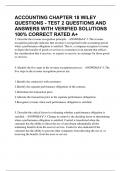
ACCOUNTING CHAPTER 18 WILEY
QUESTIONS - TEST 2 QUESTIONS AND
ANSWERS WITH VERIFIED SOLUTIONS
100% CORRECT RATED A+
3. Describe the revenue recognition principle. - ANSWER✔✔ 3. The revenue
recognition principle indicates that revenue is recognized in the accounting period
when a performance obligation is satisfied. That is, a company recognizes revenue
to depict the transfer of goods or services to customers in an amount that reflects
the consideration that it receives, or expects to receive, in exchange for those goods
or services.
4. Identify the five steps in the revenue recognition process. - ANSWER✔✔ 4. The
five steps in the revenue recognition process are:
1.Identify the contract(s) with customers.
2.Identify the separate performance obligations in the contract.
3.Determine the transaction price.
4.Allocate the transaction price to the separate performance obligations.
5.Recognize revenue when each performance obligation is satisfied.
5. Describe the critical factor in evaluating whether a performance obligation is
satisfied. - ANSWER✔✔ 5. Change in control is the deciding factor in determining
when a performance obligation is satisfied. Control is transferred when the
customer has the ability to direct the use of and obtain substantially all the
remaining benefits from the asset or service. Control is also indicated if the
customer has the ability to prevent other companies from directing the use of, or
receiving the benefit, from the asset or service.
, 9. What is a performance obligation? Under what conditions does a performance
obligation exist? - ANSWER✔✔ 9. A performance obligation is a promise in a
contract to provide a product or service to a customer. This promise may be
explicit, implicit, or possibly based on customary business practice. To determine
whether a performance obligation exists, the company must determine whether the
customer can benefit from the good or service on its own or together with other
readily available resources.
20. When does a company satisfy a performance obligation? Identify the indicators
of satisfaction of a performance obligation. - ANSWER✔✔ 20. A company
satisfies its performance obligation when the customer obtains control of the good
or service. Indications that the customer has obtained control are:
1.The company has a right to payment for the asset.
2.The company transferred legal title to the asset.
3.The company transferred physical possession of the asset.
4.The customer has significant risks and rewards of ownership.
5.The customer has accepted the asset.
21. Under what conditions does a company recognize revenue over a period of
time? - ANSWER✔✔ 21.Companies satisfy performance obligations either at a
point in time or over a period of time. Companies recognize revenue over a period
of time if one of the following three criteria is met:
1.The customer receives and consumes the benefits as the seller performs.
2.The customer controls the asset as it is created or enhanced (e.g., a builder
constructs a building on a customer's property).
QUESTIONS - TEST 2 QUESTIONS AND
ANSWERS WITH VERIFIED SOLUTIONS
100% CORRECT RATED A+
3. Describe the revenue recognition principle. - ANSWER✔✔ 3. The revenue
recognition principle indicates that revenue is recognized in the accounting period
when a performance obligation is satisfied. That is, a company recognizes revenue
to depict the transfer of goods or services to customers in an amount that reflects
the consideration that it receives, or expects to receive, in exchange for those goods
or services.
4. Identify the five steps in the revenue recognition process. - ANSWER✔✔ 4. The
five steps in the revenue recognition process are:
1.Identify the contract(s) with customers.
2.Identify the separate performance obligations in the contract.
3.Determine the transaction price.
4.Allocate the transaction price to the separate performance obligations.
5.Recognize revenue when each performance obligation is satisfied.
5. Describe the critical factor in evaluating whether a performance obligation is
satisfied. - ANSWER✔✔ 5. Change in control is the deciding factor in determining
when a performance obligation is satisfied. Control is transferred when the
customer has the ability to direct the use of and obtain substantially all the
remaining benefits from the asset or service. Control is also indicated if the
customer has the ability to prevent other companies from directing the use of, or
receiving the benefit, from the asset or service.
, 9. What is a performance obligation? Under what conditions does a performance
obligation exist? - ANSWER✔✔ 9. A performance obligation is a promise in a
contract to provide a product or service to a customer. This promise may be
explicit, implicit, or possibly based on customary business practice. To determine
whether a performance obligation exists, the company must determine whether the
customer can benefit from the good or service on its own or together with other
readily available resources.
20. When does a company satisfy a performance obligation? Identify the indicators
of satisfaction of a performance obligation. - ANSWER✔✔ 20. A company
satisfies its performance obligation when the customer obtains control of the good
or service. Indications that the customer has obtained control are:
1.The company has a right to payment for the asset.
2.The company transferred legal title to the asset.
3.The company transferred physical possession of the asset.
4.The customer has significant risks and rewards of ownership.
5.The customer has accepted the asset.
21. Under what conditions does a company recognize revenue over a period of
time? - ANSWER✔✔ 21.Companies satisfy performance obligations either at a
point in time or over a period of time. Companies recognize revenue over a period
of time if one of the following three criteria is met:
1.The customer receives and consumes the benefits as the seller performs.
2.The customer controls the asset as it is created or enhanced (e.g., a builder
constructs a building on a customer's property).