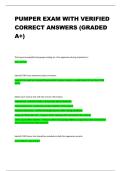
PUMPER EXAM WITH VERIFIED
CORRECT ANSWERS (GRADED
A+)
The lowest acceptable fuel gauge reading on a fire apparatus during inspection is:
least 3/4-full.
Identify TWO true statements about inverters.
Inverters are quiet as compared to generators Inverters output is usually limited to less than 1,500
watts.
Match each service test with the correct information.
Vacuum test - checks for leaks in the primary device and pump
Pump capacity test - checks the overall condotions of the engine
Pressure control test - verifies discharge pressure under varying conditions
Gauge and flowmeter test - conpares meter readings with actual pilot tube readings
Tank to pump flow rate test - measures wether the piping between an apparatus water tank and fire
pump meet minimum flow standards
ldentify TWO items that should be included on daily fire apparatus records.
tire condition coolant levels
,Traveling at high speeds on a curvy road may cause your fire apparatus to:
leave the road surface and roll over.
Identify THREE exceptions to the rule that all personnel should be seated and wearing seatbelts before
an emergency vehicle begins moving.
Providing patient care in the back of an ambulance
Loading the hose back onto the fire apparatus Performing training for personnel learning to drive the
tiller portion of a tractor-drawn aerial apparatus.
Identify the THREE steps for changing to the left lane on a limited access highway.
Activate the turn signal Check the left side view m irror Movethe apparatus safelyto the , left lane
When driving through intersections that require a stop, you must perform all of the following steps
EXCEPT:
turn on the flashers to indicate y are crossing.
You should have a spotter under all of the following conditions EXCEPT:
traveling forward on straight roads.
When performing the serpentine exercise, you:
should only travel in one direction, without striking the obstructions
,NFPA Standard 1002 requires that driverloperators operate a fire apparatus over a predetermined route
on a public roadway that incorporates all of the following EXCEPT
two through-intersections and one intersection that requires you to stop.
Identify FOUR skills demonstrated during the alley dock exercise.
Operating the fire apparatus safely.
Using side view mirrors
Moving the fire apparatus backward within a restricted area.
Interpreting spotter signals
The term specific heat refers to the:
ability of any substance to absorb heat.
Match each type of pressure with its correct description.
Head pressure - pressure caused by the height of a water supply above the discharge point
Static pressure - available pressure at a discharge point wothout water flowing
Flow pressure - the forward velocity of water at the discharge point
Residual pressure - water pressure in a distribution system that is still available when a hydrant is
flowing
Normal operating pressure - water pressure in a distribution system during regular consumption
When using private potable or nonpotable water supplies in conjunction with a municipal system, it's
important to avoid backflow of:
private nonpotable water into the municipal system
, The special purpose nozzle that is often driven through building walls is the:
piercing nozzle.
For safety reasons, hand lines with solid stream nozzles should not be operated above:
65 psi
Most flowmeters in use have a design based on:
spring probe.
All of the following statements about static water sources are true EXCEPT:
the static water source that is closest to the incident should always be used first
The best type of strainer to use in a shallow stream is a:
floating strainer.
Hard suction hoses are best used
for drafting from static water sources.
When hooking up to a hydrant and additional lines are anticipated, it is best to install a:
gate valve on the smaller hydrant discharge
An important consideration when determining the position of a fire apparatus is the:
CORRECT ANSWERS (GRADED
A+)
The lowest acceptable fuel gauge reading on a fire apparatus during inspection is:
least 3/4-full.
Identify TWO true statements about inverters.
Inverters are quiet as compared to generators Inverters output is usually limited to less than 1,500
watts.
Match each service test with the correct information.
Vacuum test - checks for leaks in the primary device and pump
Pump capacity test - checks the overall condotions of the engine
Pressure control test - verifies discharge pressure under varying conditions
Gauge and flowmeter test - conpares meter readings with actual pilot tube readings
Tank to pump flow rate test - measures wether the piping between an apparatus water tank and fire
pump meet minimum flow standards
ldentify TWO items that should be included on daily fire apparatus records.
tire condition coolant levels
,Traveling at high speeds on a curvy road may cause your fire apparatus to:
leave the road surface and roll over.
Identify THREE exceptions to the rule that all personnel should be seated and wearing seatbelts before
an emergency vehicle begins moving.
Providing patient care in the back of an ambulance
Loading the hose back onto the fire apparatus Performing training for personnel learning to drive the
tiller portion of a tractor-drawn aerial apparatus.
Identify the THREE steps for changing to the left lane on a limited access highway.
Activate the turn signal Check the left side view m irror Movethe apparatus safelyto the , left lane
When driving through intersections that require a stop, you must perform all of the following steps
EXCEPT:
turn on the flashers to indicate y are crossing.
You should have a spotter under all of the following conditions EXCEPT:
traveling forward on straight roads.
When performing the serpentine exercise, you:
should only travel in one direction, without striking the obstructions
,NFPA Standard 1002 requires that driverloperators operate a fire apparatus over a predetermined route
on a public roadway that incorporates all of the following EXCEPT
two through-intersections and one intersection that requires you to stop.
Identify FOUR skills demonstrated during the alley dock exercise.
Operating the fire apparatus safely.
Using side view mirrors
Moving the fire apparatus backward within a restricted area.
Interpreting spotter signals
The term specific heat refers to the:
ability of any substance to absorb heat.
Match each type of pressure with its correct description.
Head pressure - pressure caused by the height of a water supply above the discharge point
Static pressure - available pressure at a discharge point wothout water flowing
Flow pressure - the forward velocity of water at the discharge point
Residual pressure - water pressure in a distribution system that is still available when a hydrant is
flowing
Normal operating pressure - water pressure in a distribution system during regular consumption
When using private potable or nonpotable water supplies in conjunction with a municipal system, it's
important to avoid backflow of:
private nonpotable water into the municipal system
, The special purpose nozzle that is often driven through building walls is the:
piercing nozzle.
For safety reasons, hand lines with solid stream nozzles should not be operated above:
65 psi
Most flowmeters in use have a design based on:
spring probe.
All of the following statements about static water sources are true EXCEPT:
the static water source that is closest to the incident should always be used first
The best type of strainer to use in a shallow stream is a:
floating strainer.
Hard suction hoses are best used
for drafting from static water sources.
When hooking up to a hydrant and additional lines are anticipated, it is best to install a:
gate valve on the smaller hydrant discharge
An important consideration when determining the position of a fire apparatus is the: