Touch part 2
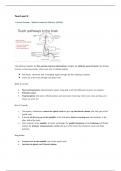
1. Dorsal Column - Medial Lemniscal Pathway (DCML)
This pathway handles the fine, precise sensory information. Imagine the delicate sense of touch, like feeling
textures or knowing exactly where your arm is without looking.
Fine touch, vibrations that is changing signal through the fast adapting receptors
Comes up to the brain through the spinal cord
What it carries:
• Fine touch/pressure (discriminative touch; being able to tell the difference between two points)
• Vibration sense
• Proprioception (the sense of limb position and movement—knowing where your arms and legs are) -
where our arms are
How it travels:
1. The sensory information enters the spinal cord and goes up the dorsal column (the back part of the
spinal cord).
2. It travels all the way up to the medulla in the brainstem before crossing over (decussating) to the
other side of the body.
3. After crossing in the medulla, it travels up through the medial lemniscus to the thalamus and finally
reaches the primary somatosensory cortex (the part of the brain that interprets touch and body
position).
Key points:
• Crosses over in the medulla (not in the spinal cord)
• Location in spinal cord: Dorsal column
, • Important for precise movement and fine touch discrimination
2. Anterolateral System (Spinothalamic Tract)
This pathway carries pain and temperature, along with crude touch (not as fine or detailed).
What it carries:
• Pain
• Temperature
• Crude touch (basic, less refined touch sensation)
• Development of reflexes that move away from the body the source of pain using muscles in the opposite
side of the body as wel
How it travels:
1. Sensory information enters the spinal cord and immediately crosses over (decussates) in the spinal
cord itself, near where it enters.
2. After crossing, it travels up the anterolateral column (front-side part of the spinal cord).
3. It ascends to the thalamus, then moves on to the somatosensory cortex and limbic system (for the
emotional aspect of pain).
Key points:
• Crosses over in the spinal cord (right away)
• Location in spinal cord: Anterolateral column
• Carries signals important for protection and survival, like pain and temperature.
1. Dorsal Column - Medial Lemniscal Pathway (DCML)
This pathway handles the fine, precise sensory information. Imagine the delicate sense of touch, like feeling
textures or knowing exactly where your arm is without looking.
Fine touch, vibrations that is changing signal through the fast adapting receptors
Comes up to the brain through the spinal cord
What it carries:
• Fine touch/pressure (discriminative touch; being able to tell the difference between two points)
• Vibration sense
• Proprioception (the sense of limb position and movement—knowing where your arms and legs are) -
where our arms are
How it travels:
1. The sensory information enters the spinal cord and goes up the dorsal column (the back part of the
spinal cord).
2. It travels all the way up to the medulla in the brainstem before crossing over (decussating) to the
other side of the body.
3. After crossing in the medulla, it travels up through the medial lemniscus to the thalamus and finally
reaches the primary somatosensory cortex (the part of the brain that interprets touch and body
position).
Key points:
• Crosses over in the medulla (not in the spinal cord)
• Location in spinal cord: Dorsal column
, • Important for precise movement and fine touch discrimination
2. Anterolateral System (Spinothalamic Tract)
This pathway carries pain and temperature, along with crude touch (not as fine or detailed).
What it carries:
• Pain
• Temperature
• Crude touch (basic, less refined touch sensation)
• Development of reflexes that move away from the body the source of pain using muscles in the opposite
side of the body as wel
How it travels:
1. Sensory information enters the spinal cord and immediately crosses over (decussates) in the spinal
cord itself, near where it enters.
2. After crossing, it travels up the anterolateral column (front-side part of the spinal cord).
3. It ascends to the thalamus, then moves on to the somatosensory cortex and limbic system (for the
emotional aspect of pain).
Key points:
• Crosses over in the spinal cord (right away)
• Location in spinal cord: Anterolateral column
• Carries signals important for protection and survival, like pain and temperature.