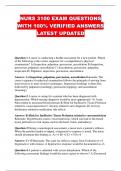
Question 1 A nurse is conducting a health assessment for a new patient. Which
of the following is the correct sequence for a comprehensive physical
examination? A) Inspection, palpation, percussion, auscultation B) Inspection,
percussion, palpation, auscultation C) Auscultation, percussion, palpation,
inspection D) Palpation, inspection, percussion, auscultation
Answer: A) Inspection, palpation, percussion, auscultation Rationale: The
correct sequence for physical examination follows the principle of moving from
least invasive to more invasive techniques. Inspection (looking) is done first,
followed by palpation (touching), percussion (tapping), and auscultation
(listening).
Question 2 A nurse is caring for a patient who has been diagnosed with
hypertension. Which nursing diagnosis would be most appropriate? A) Acute
Pain related to increased blood pressure B) Risk for Ineffective Tissue Perfusion
related to vasoconstriction C) Anxiety related to new diagnosis D) Activity
Intolerance related to medication side effects
Answer: B) Risk for Ineffective Tissue Perfusion related to vasoconstriction
Rationale: Hypertension causes vasoconstriction, which can lead to decreased
tissue perfusion in vital organs such as the heart, brain, and kidneys.
Question 3 During a neurological assessment, a nurse tests a patient's reflexes.
When the patellar tendon is tapped, a hyperactive response is noted. The nurse
should document this finding as: A) +1 B) +2 C) +3 D) +4
Answer: C) +3 Rationale: The scale for reflexes ranges from 0 (absent) to +4
(hyperactive with clonus). A hyperactive response would be documented as +3.
Question 4 A patient is admitted with severe dehydration. Which of the
following assessment findings would the nurse expect to observe? A) Decreased
,urine specific gravity B) Moist mucous membranes C) Poor skin turgor D)
Excessive salivation
Answer: C) Poor skin turgor Rationale: Poor skin turgor (skin that remains
tented when pinched) is a classic sign of dehydration due to decreased
interstitial fluid.
Question 5 The nurse is caring for a patient with a nasogastric tube. Before
administering medication through the tube, the nurse should: A) Check tube
placement by injecting 30 ml of air while auscultating over the epigastrium B)
Flush the tube with carbonated beverage to clear it C) Place the patient in a
supine position D) Administer medications without crushing them
Answer: A) Check tube placement by injecting 30 ml of air while
auscultating over the epigastrium Rationale: Verifying proper placement of
the NG tube is essential before administration of any substance to prevent
aspiration.
Question 6 A nurse is providing discharge teaching to a patient prescribed
warfarin (Coumadin). Which statement by the patient indicates understanding of
the teaching? A) "I should take aspirin if I get a headache." B) "I will notify my
healthcare provider if I notice unusual bruising." C) "I should eat more green
leafy vegetables to stay healthy." D) "I can drink alcohol occasionally without
any problems."
Answer: B) "I will notify my healthcare provider if I notice unusual
bruising." Rationale: Unusual bruising may indicate excessive anticoagulation
and should be reported immediately.
Question 7 The nurse is caring for a patient with diabetes who has been
prescribed an insulin sliding scale. The patient's blood glucose is 250 mg/dL.
According to the sliding scale below, how many units of regular insulin should
the nurse administer?
• Blood glucose 150-200 mg/dL: 2 units
• Blood glucose 201-250 mg/dL: 4 units
• Blood glucose 251-300 mg/dL: 6 units
• Blood glucose 301-350 mg/dL: 8 units
A) 2 units B) 4 units C) 6 units D) 8 units
Answer: B) 4 units Rationale: According to the sliding scale, blood glucose of
201-250 mg/dL requires 4 units of regular insulin.
, Question 8 A patient is admitted with a diagnosis of heart failure. Which
nursing intervention has the highest priority? A) Administering prescribed
diuretics B) Monitoring daily weight C) Assessing respiratory status D) Placing
the patient in semi-Fowler's position
Answer: C) Assessing respiratory status Rationale: Respiratory distress is the
most immediate life-threatening complication of heart failure and must be
assessed first.
Question 9 The nurse is caring for a patient who has just returned from surgery
with a Jackson-Pratt drain. Which intervention is appropriate for drain
management? A) Milk the tubing every hour B) Empty the drain when it is
completely full C) Keep the drain positioned above the surgical site D) Empty
the drain and record the drainage when it is 1/2 to 3/4 full
Answer: D) Empty the drain and record the drainage when it is 1/2 to 3/4
full Rationale: The drain should be emptied when it's 1/2 to 3/4 full to maintain
suction and prevent backup of drainage.
Question 10 A patient is receiving a blood transfusion. After 15 minutes, the
patient develops chills, fever, and back pain. The nurse's first action should be
to: A) Administer the prescribed PRN antipyretic B) Slow the transfusion rate
C) Stop the transfusion immediately D) Notify the charge nurse
Answer: C) Stop the transfusion immediately Rationale: These symptoms
indicate a potential transfusion reaction. The transfusion must be stopped
immediately to prevent further complications.
Question 11 A patient has a history of COPD. The nurse should prioritize
which assessment? A) Abdominal assessment B) Cardiovascular assessment C)
Neurological assessment D) Respiratory assessment
Answer: D) Respiratory assessment Rationale: For a patient with COPD,
respiratory assessment is the priority because respiratory function is primarily
affected by this disease.
Question 12 When implementing standard precautions, the nurse understands
that: A) Gloves must be worn for contact with all patients B) Hand hygiene is
necessary only after direct patient contact C) Hand hygiene is performed before
and after patient contact D) Masks are required for all patient interactions
Answer: C) Hand hygiene is performed before and after patient contact
Rationale: Standard precautions include hand hygiene before and after patient
contact, regardless of whether gloves are worn.
of the following is the correct sequence for a comprehensive physical
examination? A) Inspection, palpation, percussion, auscultation B) Inspection,
percussion, palpation, auscultation C) Auscultation, percussion, palpation,
inspection D) Palpation, inspection, percussion, auscultation
Answer: A) Inspection, palpation, percussion, auscultation Rationale: The
correct sequence for physical examination follows the principle of moving from
least invasive to more invasive techniques. Inspection (looking) is done first,
followed by palpation (touching), percussion (tapping), and auscultation
(listening).
Question 2 A nurse is caring for a patient who has been diagnosed with
hypertension. Which nursing diagnosis would be most appropriate? A) Acute
Pain related to increased blood pressure B) Risk for Ineffective Tissue Perfusion
related to vasoconstriction C) Anxiety related to new diagnosis D) Activity
Intolerance related to medication side effects
Answer: B) Risk for Ineffective Tissue Perfusion related to vasoconstriction
Rationale: Hypertension causes vasoconstriction, which can lead to decreased
tissue perfusion in vital organs such as the heart, brain, and kidneys.
Question 3 During a neurological assessment, a nurse tests a patient's reflexes.
When the patellar tendon is tapped, a hyperactive response is noted. The nurse
should document this finding as: A) +1 B) +2 C) +3 D) +4
Answer: C) +3 Rationale: The scale for reflexes ranges from 0 (absent) to +4
(hyperactive with clonus). A hyperactive response would be documented as +3.
Question 4 A patient is admitted with severe dehydration. Which of the
following assessment findings would the nurse expect to observe? A) Decreased
,urine specific gravity B) Moist mucous membranes C) Poor skin turgor D)
Excessive salivation
Answer: C) Poor skin turgor Rationale: Poor skin turgor (skin that remains
tented when pinched) is a classic sign of dehydration due to decreased
interstitial fluid.
Question 5 The nurse is caring for a patient with a nasogastric tube. Before
administering medication through the tube, the nurse should: A) Check tube
placement by injecting 30 ml of air while auscultating over the epigastrium B)
Flush the tube with carbonated beverage to clear it C) Place the patient in a
supine position D) Administer medications without crushing them
Answer: A) Check tube placement by injecting 30 ml of air while
auscultating over the epigastrium Rationale: Verifying proper placement of
the NG tube is essential before administration of any substance to prevent
aspiration.
Question 6 A nurse is providing discharge teaching to a patient prescribed
warfarin (Coumadin). Which statement by the patient indicates understanding of
the teaching? A) "I should take aspirin if I get a headache." B) "I will notify my
healthcare provider if I notice unusual bruising." C) "I should eat more green
leafy vegetables to stay healthy." D) "I can drink alcohol occasionally without
any problems."
Answer: B) "I will notify my healthcare provider if I notice unusual
bruising." Rationale: Unusual bruising may indicate excessive anticoagulation
and should be reported immediately.
Question 7 The nurse is caring for a patient with diabetes who has been
prescribed an insulin sliding scale. The patient's blood glucose is 250 mg/dL.
According to the sliding scale below, how many units of regular insulin should
the nurse administer?
• Blood glucose 150-200 mg/dL: 2 units
• Blood glucose 201-250 mg/dL: 4 units
• Blood glucose 251-300 mg/dL: 6 units
• Blood glucose 301-350 mg/dL: 8 units
A) 2 units B) 4 units C) 6 units D) 8 units
Answer: B) 4 units Rationale: According to the sliding scale, blood glucose of
201-250 mg/dL requires 4 units of regular insulin.
, Question 8 A patient is admitted with a diagnosis of heart failure. Which
nursing intervention has the highest priority? A) Administering prescribed
diuretics B) Monitoring daily weight C) Assessing respiratory status D) Placing
the patient in semi-Fowler's position
Answer: C) Assessing respiratory status Rationale: Respiratory distress is the
most immediate life-threatening complication of heart failure and must be
assessed first.
Question 9 The nurse is caring for a patient who has just returned from surgery
with a Jackson-Pratt drain. Which intervention is appropriate for drain
management? A) Milk the tubing every hour B) Empty the drain when it is
completely full C) Keep the drain positioned above the surgical site D) Empty
the drain and record the drainage when it is 1/2 to 3/4 full
Answer: D) Empty the drain and record the drainage when it is 1/2 to 3/4
full Rationale: The drain should be emptied when it's 1/2 to 3/4 full to maintain
suction and prevent backup of drainage.
Question 10 A patient is receiving a blood transfusion. After 15 minutes, the
patient develops chills, fever, and back pain. The nurse's first action should be
to: A) Administer the prescribed PRN antipyretic B) Slow the transfusion rate
C) Stop the transfusion immediately D) Notify the charge nurse
Answer: C) Stop the transfusion immediately Rationale: These symptoms
indicate a potential transfusion reaction. The transfusion must be stopped
immediately to prevent further complications.
Question 11 A patient has a history of COPD. The nurse should prioritize
which assessment? A) Abdominal assessment B) Cardiovascular assessment C)
Neurological assessment D) Respiratory assessment
Answer: D) Respiratory assessment Rationale: For a patient with COPD,
respiratory assessment is the priority because respiratory function is primarily
affected by this disease.
Question 12 When implementing standard precautions, the nurse understands
that: A) Gloves must be worn for contact with all patients B) Hand hygiene is
necessary only after direct patient contact C) Hand hygiene is performed before
and after patient contact D) Masks are required for all patient interactions
Answer: C) Hand hygiene is performed before and after patient contact
Rationale: Standard precautions include hand hygiene before and after patient
contact, regardless of whether gloves are worn.