

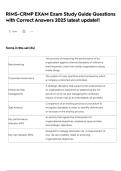
RIMS-CRMP EXAM Exam Study Guide Questions
with Correct Answers 2025 latest update!!
Save
Terms in this set (34)
The process of measuring the performance of an
organization against external standards of reference
Benchmarking
that frequently come from similar organizations doing
similar things.
The system of rules, practices and processes by which
Corporate Governance
a company is directed and controlled.
A strategic discipline that supports the achievement of
Enterprise Risk an organization's objectives by addressing the full
Management spectrum of its risk and managing the combined
impact of those risks as an interrelated risk portfolio.
Comparison of an existing process or procedure to
Gap Analysis recognize standards in order to identify deficiencies
or excesses in the existing process.
As activity that signals the achievement of
Key performance
organizational objectives, emphasize opportunities
indicator (KPI)
and strategic objectives.
designed to manage downside risk. A measurement of
Key risk indicator (KRI) how risk and volatility relate to achieving
organizational objectives,
, PESTLE is an acronym for Political, Economic, Social,
Technology, Legal and Environmental and identifies
PESTLE Analysis the categories utilized to analyze internal and
external environments. Other forms of the acronym
include "PEST" and "PESTEL."
Risk The effect of uncertainty on objectives.
The total exposed amount that an organization wishes
Risk Appetite to undertake on the basis of risk return trade-offs for
one or more desired and expected outcomes
An organization's or individuals' view/perspective of
the perceived qualitative and quantitative value that
Risk Attitude
may be gained in comparison to the related potential
loss or losses.
The beliefs, values, norms and traditions of behavior
of individuals and groups within an organization that
Risk Culture determine the way in which they identify, understand,
discuss and act on the risk(s) the organization
confronts and takes.
Any person in an organization who is a leader and
Risk Champion influences peers regarding the value that risk
management adds to the organization.
The architecture within which risk management
Risk governance
operates in a company
The process of making and implementing decisions
Risk Management that will minimize the adverse effects of accidental
losses on an organization.
An individual accountable for the identification,
Risk Owner assessment, treatment and monitoring of risks in a
specific environment
A complete collection and range of uncertainties that
Risk Portfolio
affect an organization's future.
with Correct Answers 2025 latest update!!
Save
Terms in this set (34)
The process of measuring the performance of an
organization against external standards of reference
Benchmarking
that frequently come from similar organizations doing
similar things.
The system of rules, practices and processes by which
Corporate Governance
a company is directed and controlled.
A strategic discipline that supports the achievement of
Enterprise Risk an organization's objectives by addressing the full
Management spectrum of its risk and managing the combined
impact of those risks as an interrelated risk portfolio.
Comparison of an existing process or procedure to
Gap Analysis recognize standards in order to identify deficiencies
or excesses in the existing process.
As activity that signals the achievement of
Key performance
organizational objectives, emphasize opportunities
indicator (KPI)
and strategic objectives.
designed to manage downside risk. A measurement of
Key risk indicator (KRI) how risk and volatility relate to achieving
organizational objectives,
, PESTLE is an acronym for Political, Economic, Social,
Technology, Legal and Environmental and identifies
PESTLE Analysis the categories utilized to analyze internal and
external environments. Other forms of the acronym
include "PEST" and "PESTEL."
Risk The effect of uncertainty on objectives.
The total exposed amount that an organization wishes
Risk Appetite to undertake on the basis of risk return trade-offs for
one or more desired and expected outcomes
An organization's or individuals' view/perspective of
the perceived qualitative and quantitative value that
Risk Attitude
may be gained in comparison to the related potential
loss or losses.
The beliefs, values, norms and traditions of behavior
of individuals and groups within an organization that
Risk Culture determine the way in which they identify, understand,
discuss and act on the risk(s) the organization
confronts and takes.
Any person in an organization who is a leader and
Risk Champion influences peers regarding the value that risk
management adds to the organization.
The architecture within which risk management
Risk governance
operates in a company
The process of making and implementing decisions
Risk Management that will minimize the adverse effects of accidental
losses on an organization.
An individual accountable for the identification,
Risk Owner assessment, treatment and monitoring of risks in a
specific environment
A complete collection and range of uncertainties that
Risk Portfolio
affect an organization's future.


