Human Anatomy & Physiology, 8e (Marieb/Hoehn)
Chapter 14 The Autonomic Nervous System
Matching Questions
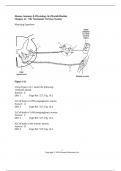
Figure 14.1
Using Figure 14.1, match the following:
1) Myelin sheath.
Answer: E
Diff: 1 Page Ref: 527; Fig. 14.2
2) Cell body of ANS preganglionic neuron.
Answer: A
Diff: 2 Page Ref: 527; Fig. 14.2
3) Cell body of ANS postganglionic neuron.
Answer: C
Diff: 2 Page Ref: 527; Fig. 14.2
4) Cell body of the somatic neuron.
Answer: D
Diff: 2 Page Ref: 527; Fig. 14.2
1
Copyright © 2010 Pearson Education, Inc.
,Match the following:
A) Parasympathetic
B) Sympathetic
5) Short preganglionic, long postganglionic fibers.
Diff: 1 Page Ref: 529; Fig. 14.2
6) Collateral ganglia.
Diff: 1 Page Ref: 530; Fig. 14.5
7) Active after you have eaten a meal.
Diff: 1 Page Ref: 538; Tbl. 14.4
8) Decreases heart rate.
Diff: 1 Page Ref: 538; Tbl. 14.4
9) Causes erection of the penis.
Diff: 1 Page Ref: 538; Tbl. 14.4
10) Stimulates ciliary muscles of the eye.
Diff: 1 Page Ref: 538; Tbl. 14.4
11) Increases blood pressure.
Diff: 1 Page Ref: 538; Tbl. 14.4
Answers: 5) B 6) B 7) A 8) A 9) A 10) A 11) B
2
Copyright © 2010 Pearson Education, Inc.
, Match the following:
A) Norepinephrine (NE)
B) Acetylcholine (ACh)
12) Preganglionic sympathetic.
Diff: 1 Page Ref: 536; Tbl. 14.2
13) Preganglionic parasympathetic.
Diff: 1 Page Ref: 536; Tbl. 14.2
14) Postganglionic sympathetic to sweat glands.
Diff: 2 Page Ref: 536; Tbl. 14.2
15) Postganglionic parasympathetic.
Diff: 1 Page Ref: 536; Tbl. 14.2
16) Most postganglionic sympathetic.
Diff: 1 Page Ref: 536; Tbl. 14.2
Answers: 12) B 13) B 14) B 15) B 16) A
True/False Questions
1) Because the ANS is a visceral motor system, afferent pathways are of no importance and
actually are rarely found.
Answer: FALSE
Diff: 2 Page Ref: 527
2) The rami communicantes are associated only with the sympathetic division of the ANS.
Answer: TRUE
Diff: 2 Page Ref: 530
3) The gray rami communicantes consist of myelinated postganglionic fibers.
Answer: FALSE
Diff: 1 Page Ref: 532
4) Splanchnic nerves are mixed motor and sensory nerves.
Answer: FALSE
Diff: 1 Page Ref: 532
5) The autonomic nervous system may cause activation or inhibition, depending on the division
that is active and the target that is affected.
Answer: TRUE
Diff: 2 Page Ref: 527
3
Copyright © 2010 Pearson Education, Inc.
Chapter 14 The Autonomic Nervous System
Matching Questions
Figure 14.1
Using Figure 14.1, match the following:
1) Myelin sheath.
Answer: E
Diff: 1 Page Ref: 527; Fig. 14.2
2) Cell body of ANS preganglionic neuron.
Answer: A
Diff: 2 Page Ref: 527; Fig. 14.2
3) Cell body of ANS postganglionic neuron.
Answer: C
Diff: 2 Page Ref: 527; Fig. 14.2
4) Cell body of the somatic neuron.
Answer: D
Diff: 2 Page Ref: 527; Fig. 14.2
1
Copyright © 2010 Pearson Education, Inc.
,Match the following:
A) Parasympathetic
B) Sympathetic
5) Short preganglionic, long postganglionic fibers.
Diff: 1 Page Ref: 529; Fig. 14.2
6) Collateral ganglia.
Diff: 1 Page Ref: 530; Fig. 14.5
7) Active after you have eaten a meal.
Diff: 1 Page Ref: 538; Tbl. 14.4
8) Decreases heart rate.
Diff: 1 Page Ref: 538; Tbl. 14.4
9) Causes erection of the penis.
Diff: 1 Page Ref: 538; Tbl. 14.4
10) Stimulates ciliary muscles of the eye.
Diff: 1 Page Ref: 538; Tbl. 14.4
11) Increases blood pressure.
Diff: 1 Page Ref: 538; Tbl. 14.4
Answers: 5) B 6) B 7) A 8) A 9) A 10) A 11) B
2
Copyright © 2010 Pearson Education, Inc.
, Match the following:
A) Norepinephrine (NE)
B) Acetylcholine (ACh)
12) Preganglionic sympathetic.
Diff: 1 Page Ref: 536; Tbl. 14.2
13) Preganglionic parasympathetic.
Diff: 1 Page Ref: 536; Tbl. 14.2
14) Postganglionic sympathetic to sweat glands.
Diff: 2 Page Ref: 536; Tbl. 14.2
15) Postganglionic parasympathetic.
Diff: 1 Page Ref: 536; Tbl. 14.2
16) Most postganglionic sympathetic.
Diff: 1 Page Ref: 536; Tbl. 14.2
Answers: 12) B 13) B 14) B 15) B 16) A
True/False Questions
1) Because the ANS is a visceral motor system, afferent pathways are of no importance and
actually are rarely found.
Answer: FALSE
Diff: 2 Page Ref: 527
2) The rami communicantes are associated only with the sympathetic division of the ANS.
Answer: TRUE
Diff: 2 Page Ref: 530
3) The gray rami communicantes consist of myelinated postganglionic fibers.
Answer: FALSE
Diff: 1 Page Ref: 532
4) Splanchnic nerves are mixed motor and sensory nerves.
Answer: FALSE
Diff: 1 Page Ref: 532
5) The autonomic nervous system may cause activation or inhibition, depending on the division
that is active and the target that is affected.
Answer: TRUE
Diff: 2 Page Ref: 527
3
Copyright © 2010 Pearson Education, Inc.