BIOL 1406 8 week Spring 2025
Chapter 2 notes
Part 1
Matter and Energy
Everything is matter and you matter!!!
Matter- measurable and takes up space, has mass
Energy
o Energy is the ability to do work these notes take too much energy
o Energy does not have mass nor take up space, puts matter into
motion
o Kinetic energy: moving energy
o Potential energy: stored energy
Types of Matter
o Elements: a substance that cannot be broken any further than
individual atoms, makes up all matter
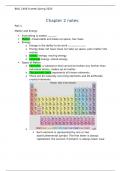
o The periodic table represents all known elements
o There are 92 naturally occurring elements and 20 artificially
created elements
o
Each element is represented by one or two
atomic/elemental symbol The first letter is always
capitalized, the second, if present, is always lower case
, BIOL 1406 8 week Spring 2025
o Most common elements of life: CHNOPS (Carbon, Hydrogen,
Nitrogen, Oxygen, Phosphorus, Sulfur)
Your Turn! Technically my turn
Mg= Magnesium
Cl= Chlorine
Na= Sodium
Fe= Iron
N= Nitrogen
S= Sulfur
K= potassium that’s bananas
H= Hydrogen
Structure of Atoms
Elements are made of atoms
Atoms- building blocks of elements, tiny particles that can’t be broken
down without being changed or losing their original properties
The atoms that make up each element differ from those of other elements
Subatomic particles= the particles that make up atoms:
o protons (+), 1 amu, (p+)
o neutrons (0), 1 amu
o electrons (-), mass is negligible 0 amu, (e-)
o The nucleus is made up from protons and neutrons
o An electron cloud surrounds the nucleus, is made of electrons flying
around in orbitals
Opposites Attract
o Opposite charges attract, like charges repel
o Electrically stable atoms (neutral charge) have the same number of
protons and electrons
o The periodic table presents elements as electrically stable
o Your turn:
this table gave me the hardest time to paste on here bruh
Chapter 2 notes
Part 1
Matter and Energy
Everything is matter and you matter!!!
Matter- measurable and takes up space, has mass
Energy
o Energy is the ability to do work these notes take too much energy
o Energy does not have mass nor take up space, puts matter into
motion
o Kinetic energy: moving energy
o Potential energy: stored energy
Types of Matter
o Elements: a substance that cannot be broken any further than
individual atoms, makes up all matter
o The periodic table represents all known elements
o There are 92 naturally occurring elements and 20 artificially
created elements
o
Each element is represented by one or two
atomic/elemental symbol The first letter is always
capitalized, the second, if present, is always lower case
, BIOL 1406 8 week Spring 2025
o Most common elements of life: CHNOPS (Carbon, Hydrogen,
Nitrogen, Oxygen, Phosphorus, Sulfur)
Your Turn! Technically my turn
Mg= Magnesium
Cl= Chlorine
Na= Sodium
Fe= Iron
N= Nitrogen
S= Sulfur
K= potassium that’s bananas
H= Hydrogen
Structure of Atoms
Elements are made of atoms
Atoms- building blocks of elements, tiny particles that can’t be broken
down without being changed or losing their original properties
The atoms that make up each element differ from those of other elements
Subatomic particles= the particles that make up atoms:
o protons (+), 1 amu, (p+)
o neutrons (0), 1 amu
o electrons (-), mass is negligible 0 amu, (e-)
o The nucleus is made up from protons and neutrons
o An electron cloud surrounds the nucleus, is made of electrons flying
around in orbitals
Opposites Attract
o Opposite charges attract, like charges repel
o Electrically stable atoms (neutral charge) have the same number of
protons and electrons
o The periodic table presents elements as electrically stable
o Your turn:
this table gave me the hardest time to paste on here bruh