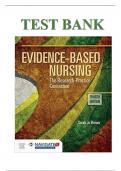
,Test Bank For Evidence-Based Nursing: The Research Practice Connection 4th Edition by
Sarah Jo Brown
ISBN-10:1284099431
ISBN-13:9781284099430
Table of Contents
Chapter 1 The Research-Practice Connection
Chapter 2 Research Evidence
Chapter 3 Reading Research Articles
Chapter 4 Qualitative Research
Chapter 5 Quantitative Descriptive Research
Chapter 6 Correlational Research
Chapter 7 Experimental Research
Chapter 8 Cohort Research Wrap-Up
Chapter 9 Systematic Reviews
Chapter 10 Evidence-Based Clinical Practice Guidelines
Chapter 11 Asking Clinical Questions
Chapter 12 Searching for Research Evidence
Chapter 13 Appraising Research Evidence
Chapter 14 Appraising Recommendations of Clinical Practice Guidelines
Chapter 15 Appraising Conclusions of Systematic Reviews with Narrative Synthesis
Chapter 16 Appraising Findings of Original Studies
Chapter 17 Evidence-Based Practice Strategies
Chapter 18 Evidence-Based Practice Participation
Chapter 19 Point-of-Care Adaptations
, Evidence-Based Nursing: The Research Practice Connection: The Research Practice
Connection 4th Edition Test Bank
Chapter 1 The Research-Practice Connection
MULTIPLE CHOICE
• Which best describes evidence-based-practice (EBP)?
a.A combination of best research evidence, clinical expertise, and the needs
and values of patients.
b.A determination of the factors necessary to control patient
responses to care. c.The development of population care guidelines
applicable to all patients.
d.The utilization of quantitative and qualitative studies to enhance patient outcomes.
ANS: A
Feedback
AEvidence-based practice evolves from the integration of the best research
evidence with clinical expertise and patient needs and values.
BStudies that attempt to find determinants of patient outcomes are generally
experimental or quasi-experimental. They may be used to guide EBP but do not
completely define it.
CEBP is a combination of guidelines and specific patient needs and values.
DQuantitative and qualitative studies applied to the evaluation of patient
outcomes are part of EBP but do not completely define EBP.
PTS: 1 DIF: Cognitive level: Remembering
(Knowledge) REF: dm. 3
• The nurse is collecting data about the sleep patterns of breastfed babies as
part of a larger research study. Which research method will the nurse use
when collecting data for this study?
a.Co
ntrol
b.De
scrip
tion
c.Ex
plan
atio
n
d.Pr
edict
ion
ANS: B
, Feedback
AControl can be described as the ability to write a prescription to produce the desired outcome.
B Description involves identifying and understanding the nature of nursing
phenomena and the relationships among these phenomena.
C Explanation clarifies the relationships among phenomena and identifies why
certain events occur.
D Through prediction, the probability of a specific outcome can be estimated in a given situation.
PTS: 1 DIF: Cognitive level: Understanding (Comprehension)
REF: dm. 6
• The nurse is participating in a study and is collecting data identifying the
number of obese adults whose parents were also obese or overweight. Which
research method is being used in this study?
a.Co
ntrol
b.De
scrip
tion
c.Ex
plan
atio
n
d.Pr
edict
ion
ANS: D
Feedback
AControl indicates the ability to use a prescribed intervention to produce a desired outcome.
BDescription involves identifying and understanding the nature of nursing
phenomena and the relationships among these phenomena.
CExplanation clarifies the relationships among phenomena and identifies why
certain events occur.
DThrough prediction the probability of a specific outcome can be estimated in a
given situation. By knowing the percentage of parents of obese adults who were
obese, the probability of predicting this may be calculated.
PTS:1DIF:Cognitive level: Applying
(Application) REF: pp. 7-8
• The nurse reviews a study in which adherence to an asthma action plan is
compared among groups of adolescents who received different asthma
education. Which research method does this represent?
Sarah Jo Brown
ISBN-10:1284099431
ISBN-13:9781284099430
Table of Contents
Chapter 1 The Research-Practice Connection
Chapter 2 Research Evidence
Chapter 3 Reading Research Articles
Chapter 4 Qualitative Research
Chapter 5 Quantitative Descriptive Research
Chapter 6 Correlational Research
Chapter 7 Experimental Research
Chapter 8 Cohort Research Wrap-Up
Chapter 9 Systematic Reviews
Chapter 10 Evidence-Based Clinical Practice Guidelines
Chapter 11 Asking Clinical Questions
Chapter 12 Searching for Research Evidence
Chapter 13 Appraising Research Evidence
Chapter 14 Appraising Recommendations of Clinical Practice Guidelines
Chapter 15 Appraising Conclusions of Systematic Reviews with Narrative Synthesis
Chapter 16 Appraising Findings of Original Studies
Chapter 17 Evidence-Based Practice Strategies
Chapter 18 Evidence-Based Practice Participation
Chapter 19 Point-of-Care Adaptations
, Evidence-Based Nursing: The Research Practice Connection: The Research Practice
Connection 4th Edition Test Bank
Chapter 1 The Research-Practice Connection
MULTIPLE CHOICE
• Which best describes evidence-based-practice (EBP)?
a.A combination of best research evidence, clinical expertise, and the needs
and values of patients.
b.A determination of the factors necessary to control patient
responses to care. c.The development of population care guidelines
applicable to all patients.
d.The utilization of quantitative and qualitative studies to enhance patient outcomes.
ANS: A
Feedback
AEvidence-based practice evolves from the integration of the best research
evidence with clinical expertise and patient needs and values.
BStudies that attempt to find determinants of patient outcomes are generally
experimental or quasi-experimental. They may be used to guide EBP but do not
completely define it.
CEBP is a combination of guidelines and specific patient needs and values.
DQuantitative and qualitative studies applied to the evaluation of patient
outcomes are part of EBP but do not completely define EBP.
PTS: 1 DIF: Cognitive level: Remembering
(Knowledge) REF: dm. 3
• The nurse is collecting data about the sleep patterns of breastfed babies as
part of a larger research study. Which research method will the nurse use
when collecting data for this study?
a.Co
ntrol
b.De
scrip
tion
c.Ex
plan
atio
n
d.Pr
edict
ion
ANS: B
, Feedback
AControl can be described as the ability to write a prescription to produce the desired outcome.
B Description involves identifying and understanding the nature of nursing
phenomena and the relationships among these phenomena.
C Explanation clarifies the relationships among phenomena and identifies why
certain events occur.
D Through prediction, the probability of a specific outcome can be estimated in a given situation.
PTS: 1 DIF: Cognitive level: Understanding (Comprehension)
REF: dm. 6
• The nurse is participating in a study and is collecting data identifying the
number of obese adults whose parents were also obese or overweight. Which
research method is being used in this study?
a.Co
ntrol
b.De
scrip
tion
c.Ex
plan
atio
n
d.Pr
edict
ion
ANS: D
Feedback
AControl indicates the ability to use a prescribed intervention to produce a desired outcome.
BDescription involves identifying and understanding the nature of nursing
phenomena and the relationships among these phenomena.
CExplanation clarifies the relationships among phenomena and identifies why
certain events occur.
DThrough prediction the probability of a specific outcome can be estimated in a
given situation. By knowing the percentage of parents of obese adults who were
obese, the probability of predicting this may be calculated.
PTS:1DIF:Cognitive level: Applying
(Application) REF: pp. 7-8
• The nurse reviews a study in which adherence to an asthma action plan is
compared among groups of adolescents who received different asthma
education. Which research method does this represent?