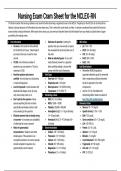
Nursing Exam Cram Sheet for the NCLEX-RN
The final mountain that nursing students must summit before becoming a registered nurse is the NCLEX. Preparing for the NCLEX can be stressful as
taking in colossal amounts of information has never been easy. This is where this cram sheet can help-- it contains condensed facts about the licensure
exam and key nursing information. When exam time comes, you can write and transfer these vital information from your head to a blank sheet of paper
provided by the testing center.
1. Test Information Rephrase the question—putting the 5. ABG Values
Six hours—the maximum time allotted question into your own words can pluck pH: 7.36—7.45
for the NCLEX is 6 hours. Take breaks if the unneeded info and reveal the core of HCO3: 24—26 mEq/L
you need a time out or need to move the stem. CO2: 35—45 mEq/L
around. Make an educated guess—if you can’t PaO2: 80%—100%
75/265—the minimum number of make the best answer for a question SaO2: >95%
questions you can answer is 75 and a after carefully reading it, choose the 6. Acid-Base Balance
maximum of 265. answer with the most information. Remember ROME (respiratory
Read the question and answers 2. Vital Signs opposite/metabolic equal) to remember
carefully—do not jump into conclusions Heart rate: 80—100 bpm that in respiratory acid/base disorders
or make wild guesses. Respiratory rate: 12-20 rpm the pH is opposite to the other
Look for keywords—Avoid answers with Blood pressure: 110-120/60 mmHg components.
absolutes like always, never, all, every, Temperature: 37 °C (98.6 °F) Use the Tic-Tac-Toe Method for
only, must, except, none, or no. 3. Hematology values interpreting ABGs. Read more about it
Don’t read into the question—Never RBCs: 4.5—5.0 million here (http://bit.ly/abgtictactoe).
assume anything that has not been WBCs: 5,000—10,000 7. Chemistry Values
specifically mentioned and don’t add Platelets: 200,000—400,000 Glucose: 70—110 mg/dL
extra meaning to the question. Hemoglobin (Hgb): 12—16 gm (female); Specific Gravity: 1.010—1.030
Eliminate answers that are clearly wrong 14—18 gm (male). BUN: 7-22 mg/dL
or incorrect—to increase your probability Hematocrit (Hct): 37—47 (female); 40— Serum creatinine: 0.6—1.35 mg/dL
of selecting the correct answer! 54 (male) LDH: 100-190 U/L
Watch for grammatical 4. Serum electrolytes Protein: 6.2—8.1 g/dL
inconsistencies—Subjects and verbs Sodium: 135—145 mEq/L Albumin: 3.4—5.0 g/dL
should agree. If the question is an Potassium: 3.5—5.5 mEq/L Bilirubin: <1.0 mg/dL
incomplete sentence, the correct answer Calcium: 8.5—10.9 mEq/L Total Cholesterol: 130—200 mg/dL
should complete the question in a Chloride: 95—105 mEq/L Triglyceride: 40—50 mg/dL
grammatically correct manner. Magnesium: 1.5—2.5 mEq/L Uric acid: 3.5—7.5 mg/dL
Phosphorus: 2.5—4.5 mEq/L CPK: 21-232 U/L
, 8. Therapeutic Drug Levels 1 gram (g) = 1,000 mg Category C—Risk not ruled out.
Carbamazepine (Tegretol): 4—10 1 kilogram (kg) = 2.2 lbs Examples: Rifampicin (Rifampin),
mcg/ml 1 lb = 16 oz Theophylline (Theolair).
Digoxin (Lanoxin): 0.8—2.0 ng/ml Convert C to F: C+40 multiply by 9/5 and Category D—Positive evidence of risk.
Gentamycin (Garamycin): 5—10 mcg/ml subtract 40 Examples: Phenytoin, Tetracycline.
(peak), <2.0 mcg/ml (valley) Convert F to C: F+40 multiply by 5/9 and Category X—Contraindicated in
Lithium (Eskalith): 0.8—1.5 mEq/L subtract 40 Pregnancy. Examples: Isotretinoin
Phenobarbital (Solfoton): 15—40 11. Maternity Normal Values (Accutane), Thalidomide (Immunoprin),
mcg/mL Fetal Heart Rate: 120—160 bpm etc.
Phenytoin (Dilantin): 10—20 mcg/dL Variability: 6—10 bpm Pregnancy Category N—Not yet
Theophylline (Aminophylline): 10—20 Amniotic fluid: 500—1200 ml classified
mcg/dL Contractions: 2—5 minutes apart with 14. Drug Schedules
Tobramycin (Tobrex): 5—10 mcg/mL duration of < 90 seconds and intensity Schedule I—no currently accepted
(peak), 0.5—2.0 mcg/mL (valley) of <100 mmHg. medical use and for research use only
Valproic Acid (Depakene): 50—100 APGAR Scoring: Appearance, Pulses, (e.g., heroin, LSD, MDMA).
mcg/ml Grimace, Activity, Reflex Irritability. Done Schedule II—drugs with high potential
Vancomycin (Vancocin): 20—40 mcg/ml at 1 and 5 minutes with a score of 0 for for abuse and requires written
(peak), 5 to 15 mcg/ml (trough) absent, 1 for decreased, and 2 for prescription (e.g., Ritalin,
9. Anticoagulant therapy strongly positive. Scores 7 and above hydromorphone (Dilaudid), meperidine
Sodium warfarin (Coumadin) PT: 10—12 are generally normal, 4 to 6 fairly low, (Demerol), and fentanyl).
seconds (control). The antidote is and 3 and below are generally regarded Schedule III—requires new prescription
Vitamin K. as critically low. after six months or five refills (e.g.,
INR (Coumadin): 0.9—1.2 AVA: The umbilical cord has two arteries codeine, testosterone, ketamine).
Heparin PTT: 30—45 seconds (control). and one vein. Schedule IV—requires new prescription
The antidote is protamine sulfate. 12. STOP—Treatment for maternal hypotension after six months (e.g., Darvon, Xanax,
APTT: 23.3—31.9 seconds after an epidural anesthesia: Soma, and Valium).
Fibrinogen level: 203—377 mg/dL Stop infusion of Pitocin. Schedule V—dispensed as any other
10. Conversions Turn the client on her left side. prescription or without prescription
1 teaspoon (t) = 5 ml Administer oxygen. (e.g., cough preparations, Lomotil,
1 tablespoon (T) = 3 t = 15 ml If hypovolemia is present, push IV fluids. Motofen).
1 oz = 30 ml 13. Pregnancy Category of Drugs 15. Medication Classifications
1 cup = 8 oz Category A—No risk in controlled human Antacids—reduces hydrochloric acid in
1 quart = 2 pints studies the stomach.
1 pint = 2 cups Category B—No risk in other studies. Antianemics—increases blood cell
1 grain (gr) = 60 mg Examples: Amoxicillin, Cefotaxime. production.
The final mountain that nursing students must summit before becoming a registered nurse is the NCLEX. Preparing for the NCLEX can be stressful as
taking in colossal amounts of information has never been easy. This is where this cram sheet can help-- it contains condensed facts about the licensure
exam and key nursing information. When exam time comes, you can write and transfer these vital information from your head to a blank sheet of paper
provided by the testing center.
1. Test Information Rephrase the question—putting the 5. ABG Values
Six hours—the maximum time allotted question into your own words can pluck pH: 7.36—7.45
for the NCLEX is 6 hours. Take breaks if the unneeded info and reveal the core of HCO3: 24—26 mEq/L
you need a time out or need to move the stem. CO2: 35—45 mEq/L
around. Make an educated guess—if you can’t PaO2: 80%—100%
75/265—the minimum number of make the best answer for a question SaO2: >95%
questions you can answer is 75 and a after carefully reading it, choose the 6. Acid-Base Balance
maximum of 265. answer with the most information. Remember ROME (respiratory
Read the question and answers 2. Vital Signs opposite/metabolic equal) to remember
carefully—do not jump into conclusions Heart rate: 80—100 bpm that in respiratory acid/base disorders
or make wild guesses. Respiratory rate: 12-20 rpm the pH is opposite to the other
Look for keywords—Avoid answers with Blood pressure: 110-120/60 mmHg components.
absolutes like always, never, all, every, Temperature: 37 °C (98.6 °F) Use the Tic-Tac-Toe Method for
only, must, except, none, or no. 3. Hematology values interpreting ABGs. Read more about it
Don’t read into the question—Never RBCs: 4.5—5.0 million here (http://bit.ly/abgtictactoe).
assume anything that has not been WBCs: 5,000—10,000 7. Chemistry Values
specifically mentioned and don’t add Platelets: 200,000—400,000 Glucose: 70—110 mg/dL
extra meaning to the question. Hemoglobin (Hgb): 12—16 gm (female); Specific Gravity: 1.010—1.030
Eliminate answers that are clearly wrong 14—18 gm (male). BUN: 7-22 mg/dL
or incorrect—to increase your probability Hematocrit (Hct): 37—47 (female); 40— Serum creatinine: 0.6—1.35 mg/dL
of selecting the correct answer! 54 (male) LDH: 100-190 U/L
Watch for grammatical 4. Serum electrolytes Protein: 6.2—8.1 g/dL
inconsistencies—Subjects and verbs Sodium: 135—145 mEq/L Albumin: 3.4—5.0 g/dL
should agree. If the question is an Potassium: 3.5—5.5 mEq/L Bilirubin: <1.0 mg/dL
incomplete sentence, the correct answer Calcium: 8.5—10.9 mEq/L Total Cholesterol: 130—200 mg/dL
should complete the question in a Chloride: 95—105 mEq/L Triglyceride: 40—50 mg/dL
grammatically correct manner. Magnesium: 1.5—2.5 mEq/L Uric acid: 3.5—7.5 mg/dL
Phosphorus: 2.5—4.5 mEq/L CPK: 21-232 U/L
, 8. Therapeutic Drug Levels 1 gram (g) = 1,000 mg Category C—Risk not ruled out.
Carbamazepine (Tegretol): 4—10 1 kilogram (kg) = 2.2 lbs Examples: Rifampicin (Rifampin),
mcg/ml 1 lb = 16 oz Theophylline (Theolair).
Digoxin (Lanoxin): 0.8—2.0 ng/ml Convert C to F: C+40 multiply by 9/5 and Category D—Positive evidence of risk.
Gentamycin (Garamycin): 5—10 mcg/ml subtract 40 Examples: Phenytoin, Tetracycline.
(peak), <2.0 mcg/ml (valley) Convert F to C: F+40 multiply by 5/9 and Category X—Contraindicated in
Lithium (Eskalith): 0.8—1.5 mEq/L subtract 40 Pregnancy. Examples: Isotretinoin
Phenobarbital (Solfoton): 15—40 11. Maternity Normal Values (Accutane), Thalidomide (Immunoprin),
mcg/mL Fetal Heart Rate: 120—160 bpm etc.
Phenytoin (Dilantin): 10—20 mcg/dL Variability: 6—10 bpm Pregnancy Category N—Not yet
Theophylline (Aminophylline): 10—20 Amniotic fluid: 500—1200 ml classified
mcg/dL Contractions: 2—5 minutes apart with 14. Drug Schedules
Tobramycin (Tobrex): 5—10 mcg/mL duration of < 90 seconds and intensity Schedule I—no currently accepted
(peak), 0.5—2.0 mcg/mL (valley) of <100 mmHg. medical use and for research use only
Valproic Acid (Depakene): 50—100 APGAR Scoring: Appearance, Pulses, (e.g., heroin, LSD, MDMA).
mcg/ml Grimace, Activity, Reflex Irritability. Done Schedule II—drugs with high potential
Vancomycin (Vancocin): 20—40 mcg/ml at 1 and 5 minutes with a score of 0 for for abuse and requires written
(peak), 5 to 15 mcg/ml (trough) absent, 1 for decreased, and 2 for prescription (e.g., Ritalin,
9. Anticoagulant therapy strongly positive. Scores 7 and above hydromorphone (Dilaudid), meperidine
Sodium warfarin (Coumadin) PT: 10—12 are generally normal, 4 to 6 fairly low, (Demerol), and fentanyl).
seconds (control). The antidote is and 3 and below are generally regarded Schedule III—requires new prescription
Vitamin K. as critically low. after six months or five refills (e.g.,
INR (Coumadin): 0.9—1.2 AVA: The umbilical cord has two arteries codeine, testosterone, ketamine).
Heparin PTT: 30—45 seconds (control). and one vein. Schedule IV—requires new prescription
The antidote is protamine sulfate. 12. STOP—Treatment for maternal hypotension after six months (e.g., Darvon, Xanax,
APTT: 23.3—31.9 seconds after an epidural anesthesia: Soma, and Valium).
Fibrinogen level: 203—377 mg/dL Stop infusion of Pitocin. Schedule V—dispensed as any other
10. Conversions Turn the client on her left side. prescription or without prescription
1 teaspoon (t) = 5 ml Administer oxygen. (e.g., cough preparations, Lomotil,
1 tablespoon (T) = 3 t = 15 ml If hypovolemia is present, push IV fluids. Motofen).
1 oz = 30 ml 13. Pregnancy Category of Drugs 15. Medication Classifications
1 cup = 8 oz Category A—No risk in controlled human Antacids—reduces hydrochloric acid in
1 quart = 2 pints studies the stomach.
1 pint = 2 cups Category B—No risk in other studies. Antianemics—increases blood cell
1 grain (gr) = 60 mg Examples: Amoxicillin, Cefotaxime. production.