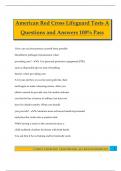
American Red Cross Lifeguard Tests A
Questions and Answers 100% Pass
How can you best protect yourself from possible
bloodborne pathogen transmission when
providing care? - ✔✔d. Use personal protective equipment (PPE),
such as disposable gloves and a breathing
barrier, when providing care.
A 12-year-old boy at a swim meet grabs his chest
and begins to make wheezing noises. After you
obtain consent to provide care, his mother informs
you that he has a history of asthma, but does not
have his inhaler nearby. What care should
you provide? - ✔✔b. Summon more advanced medical personnel
and place the victim into a position that
While having a snack in the concession area, a
child suddenly clutches his throat with both hands.
You ask him if he is choking and he frantically nods
© EMILY CHARLENE YEAR 2025-2026, ALL RIGHTS RESERVED 1
, yes. You activate your facility's emergency action
plan (EAP). You identify yourself as a lifeguard and
obtain consent from the parents. What should you
do next? - ✔✔d. Stand or kneel behind the victim and give
5 back blows and 5 abdominal thrusts.
You and another lifeguard find an unconscious
adult on the floor in the locker room. You activate
your facility's EAP, size-up the scene and perform
a primary assessment. You find the victim is not
moving or breathing, but has a pulse. You should
summon EMS personnel, then: - ✔✔a. Give 1 rescue breath about every 5 seconds.
You come upon a scene where a patron appears to
be injured. Before approaching the victim, which of
the following will you not do as you size-up
the scene? - ✔✔c. Begin the primary assessment.
When providing care during an emergency, which
of the following should you do first? - ✔✔c. Size-up the scene.
As the first lifeguard on the scene, you are
performing CPR on an adult. When performing
chest compressions, how deeply should you
© EMILY CHARLENE YEAR 2025-2026, ALL RIGHTS RESERVED 2
Questions and Answers 100% Pass
How can you best protect yourself from possible
bloodborne pathogen transmission when
providing care? - ✔✔d. Use personal protective equipment (PPE),
such as disposable gloves and a breathing
barrier, when providing care.
A 12-year-old boy at a swim meet grabs his chest
and begins to make wheezing noises. After you
obtain consent to provide care, his mother informs
you that he has a history of asthma, but does not
have his inhaler nearby. What care should
you provide? - ✔✔b. Summon more advanced medical personnel
and place the victim into a position that
While having a snack in the concession area, a
child suddenly clutches his throat with both hands.
You ask him if he is choking and he frantically nods
© EMILY CHARLENE YEAR 2025-2026, ALL RIGHTS RESERVED 1
, yes. You activate your facility's emergency action
plan (EAP). You identify yourself as a lifeguard and
obtain consent from the parents. What should you
do next? - ✔✔d. Stand or kneel behind the victim and give
5 back blows and 5 abdominal thrusts.
You and another lifeguard find an unconscious
adult on the floor in the locker room. You activate
your facility's EAP, size-up the scene and perform
a primary assessment. You find the victim is not
moving or breathing, but has a pulse. You should
summon EMS personnel, then: - ✔✔a. Give 1 rescue breath about every 5 seconds.
You come upon a scene where a patron appears to
be injured. Before approaching the victim, which of
the following will you not do as you size-up
the scene? - ✔✔c. Begin the primary assessment.
When providing care during an emergency, which
of the following should you do first? - ✔✔c. Size-up the scene.
As the first lifeguard on the scene, you are
performing CPR on an adult. When performing
chest compressions, how deeply should you
© EMILY CHARLENE YEAR 2025-2026, ALL RIGHTS RESERVED 2