100% satisfaction guarantee Immediately available after payment Both online and in PDF No strings attached 4.6 TrustPilot
logo-home
Exam (elaborations)

NSCA CPSS Training Load Model Questions and Complete Solutions Graded A+.

Rating
-
Sold
-
Pages
5
Grade
A+
Uploaded on
26-03-2025
Written in
2024/2025

NSCA CPSS Training Load Model Questions and Complete Solutions Graded A+ Primary reason for monitoring athletes - Answer: info obtained can guide decisions about future training Supercompensation - Answer: performance enhancement if body is allowed to adapt Selye's general adaptation syndrome - Answer: training stress, acute fatigue response, adaptation, new level of homeostasis/performance Fitness-fatigue model - Answer: model in which performance is function of positive and negative fitness effects both fitness and fatigue decay exponentially over time but a different rates (fatigue decays 2x the rate of fitness) dose-response effect - Answer: higher volume and intensity of training/comp = larger acute fatigue response training system - Answer: all factors important to performance includes those that 1. directly influence system (training/testing, load/fatigue monitoring) 2. support the system (training facilities/equipment) key factors for successful training system - Answer: System aims Short and long-term planning Search for continuous improvement Assessment of progress Adherence to fundamental aspects of training Program adjustments Continual manipulation of program variables on micro and macro level External load - Answer: What athlete has done (distance and speed of running, kilograms lifted) Internal load - Answer: How athlete responds to given external load, both physiological and perceptual (HR, blood lactate, RPE) What drives the training outcome - Answer: the internal response to a given external load What is performance a function of - Answer: difference between fitness and fatigue Readiness - Answer: condition where athlete has no impairment of performance, no mental fatigue or excessive psychological distress What constitutes fatigue - Answer: failure to produce/maintain required force/power Sites that contribute to fatigue - Answer: Activation of motor command (in brain) Propagation of AP through descending motor pathway Myofilament excitation-contraction coupling Status of intracellular milieu Psychobiological model for fatigue - Answer: Effort required exceeds max effort athlete is willing to exert Invisible monitoring - Answer: Assessing fatigue through protocols that occur within normal training and competition process Mental fatigue - Answer: Psychobiological state caused by prolonged periods of demanding cognitive activity shown to negatively influence physical performance Fundamental requirement of good monitoring system - Answer: Noninvasive as possible Physiological external load measures - Answer: Kinetic energy (distance and speed thresholds) Metabolic power (+Accelerations) Physiological internal load measures - Answer: VO2 CV demand (HR, blood lactate) Perceived effort (RPE) Biomechanical external load measures - Answer: Whole body loads (GRFs) Accel/decel (magnitude and frequency) Rate of accel (PlayerLoad) Biomechanical internal load measures - Answer: Joint load (joint contact forces) Muscle load (muscle-tendon forces) Perceived tissue damage (soreness) Perceived effort (RPE) Physiological failure examples - Answer: Immunodeficiency Energy depletion Physiological overload examples - Answer: Cardiac hypertrophy Physiological homeostasis examples - Answer: Cardiac adaptation Metabolic adaptation Physiological underload examples - Answer: Adipose tissue deposit Muscle atrophy Biomechanical failure examples - Answer: Muscle or tendon tear Bone fracture Biomechanical overload examples - Answer: Meniscal damage Muscle strain Biomechanical homeostasis examples - Answer: increased tendon stiffness Cartilage regeneration Biomechanical underload examples - Answer: Decreased tendon stiffness Cartilage degeneration Ecological validity - Answer: Impact of variable on training process Coefficient of variation (CV%) - Answer: Variability of test-retest scores Change in mean score between repeated trials Measures reliability Smallest worthwhile change (SWC) - Answer: Smallest change in a metric for athlete that is likely to be of practical importance Also called Minimal Difference (MD) "Unclear" magnitude of change in CV% and SWC - Answer: potential for change to be simultaneously positive and negative "Trivial" magnitude of change in CV% and SWC - Answer: change is too small to be practically important "Positive or negative" magnitude of change in CV% and SWC - Answer: change exceeds CV% and SWC in one direction or other Goal of quantifying internal and external load of training/competition - Answer: Optimize stimulus applied to athlete

Show more Read less
Institution
NSCA CPSS
Course
NSCA CPSS


Whoops! We can’t load your doc right now. Try again or contact support.

Written for

Institution
NSCA CPSS
Course
NSCA CPSS

Document information

Uploaded on
March 26, 2025
Number of pages
5
Written in
2024/2025
Type
Exam (elaborations)
Contains
Questions & answers

Subjects

Content preview

NSCA CPSS Training Load Model
Questions and Complete Solutions
Graded A+
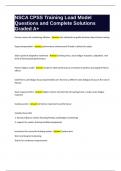
Primary reason for monitoring athletes - Answer: info obtained can guide decisions about future training


Supercompensation - Answer: performance enhancement if body is allowed to adapt


Selye's general adaptation syndrome - Answer: training stress, acute fatigue response, adaptation, new
level of homeostasis/performance


Fitness-fatigue model - Answer: model in which performance is function of positive and negative fitness
effects


both fitness and fatigue decay exponentially over time but a different rates (fatigue decays 2x the rate of
fitness)


dose-response effect - Answer: higher volume and intensity of training/comp = larger acute fatigue
response


training system - Answer: all factors important to performance


includes those that

1. directly influence system (training/testing, load/fatigue monitoring)

2. support the system (training facilities/equipment)


key factors for successful training system - Answer: System aims

Short and long-term planning

Search for continuous improvement

, Assessment of progress

Adherence to fundamental aspects of training

Program adjustments

Continual manipulation of program variables on micro and macro level


External load - Answer: What athlete has done (distance and speed of running, kilograms lifted)


Internal load - Answer: How athlete responds to given external load, both physiological and perceptual
(HR, blood lactate, RPE)


What drives the training outcome - Answer: the internal response to a given external load


What is performance a function of - Answer: difference between fitness and fatigue


Readiness - Answer: condition where athlete has no impairment of performance, no mental fatigue or
excessive psychological distress


What constitutes fatigue - Answer: failure to produce/maintain required force/power


Sites that contribute to fatigue - Answer: Activation of motor command (in brain)

Propagation of AP through descending motor pathway

Myofilament excitation-contraction coupling

Status of intracellular milieu


Psychobiological model for fatigue - Answer: Effort required exceeds max effort athlete is willing to exert


Invisible monitoring - Answer: Assessing fatigue through protocols that occur within normal training and
competition process

Get to know the seller

Seller avatar
Reputation scores are based on the amount of documents a seller has sold for a fee and the reviews they have received for those documents. There are three levels: Bronze, Silver and Gold. The better the reputation, the more your can rely on the quality of the sellers work.
YourExamplug Grand Canyon University
View profile
Follow You need to be logged in order to follow users or courses
Sold
173
Member since
1 year
Number of followers
26
Documents
14429
Last sold
3 weeks ago
Your Exm Plug

Assignments, Case Studies, Research, Essay writing service, Questions and Answers, Discussions etc. for students who want to see results twice as fast. I have done papers of various topics and complexities. I am punctual and always submit work on-deadline. I write engaging and informative content on all subjects. Send me your research papers, case studies, psychology papers, etc, and I’ll do them to the best of my abilities. Writing is my passion when it comes to academic work. I’ve got a good sense of structure and enjoy finding interesting ways to deliver information in any given paper. I love impressing clients with my work, and I am very punctual about deadlines. Send me your assignment and I’ll take it to the next level. I strive for my content to be of the highest quality. Your wishes come first— send me your requirements and I’ll make a piece of work with fresh ideas, consistent structure, and following the academic formatting rules. For every student you refer to me with an order that is completed and paid transparently, I will do one assignment for you, free of charge!!!!!!!!!!!!

Read more Read less
4.3

67 reviews

5
38
4
16
3
7
2
4
1
2

Recently viewed by you

Why students choose Stuvia

Created by fellow students, verified by reviews

Quality you can trust: written by students who passed their tests and reviewed by others who've used these notes.

Didn't get what you expected? Choose another document

No worries! You can instantly pick a different document that better fits what you're looking for.

Pay as you like, start learning right away

No subscription, no commitments. Pay the way you're used to via credit card and download your PDF document instantly.

Student with book image

“Bought, downloaded, and aced it. It really can be that simple.”

Alisha Student

Frequently asked questions