MBA702 Module 4
Study online at https://quizlet.com/_f7siiz
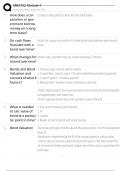
1. How does a cor- Issuing or selling debt securities that are called bonds.
poration or gov-
ernment borrow
money on a long
term basis?
2. Do cash flows No bcs the coupon rate and the FV is fixed by the bond indenture when bond is
fluctuate with a issues
bond over time?
3. What changes for Interest rates, and when they rise, bonds remaining CF declines
a bond over time?
4. Bonds and Bond 1. Par(face) value- Amount paid at maturity
Valuation and 2. Coupon Rate - annual coupon / Par value (determines periodical payments)
consists of what 4 3. Coupon Payment - Periodical payment
factors? 4. Maturity Date - Number of years until bond is paid back
-Yield to maturity date is the required market int rate on the bond. Interchangeable
w/required return, and market rate.
-Bond is typically interest only so the principal is paid at the end.
5. What is needed 1. # of periods remaining until maturity
to calc value of 2. FV
bond at a particu- 3. Coupon
lar point in time? 4. Market int rate for bonds with similar features
6. Bond Valuation The primary principle is that the value of financial securities = the PV of all expected
future CF
-Bond value is determined by the PV of the coupon payments and par value
-interest rates are inversely related to the present values of the bond since if the
int increases the lender would want a higher rate of return since it would lower the
bond value
, MBA702 Module 4
Study online at https://quizlet.com/_f7siiz
-The value of a bond is the PV of expected CF discounted at the market rate of
interest
-Yield to maturity is the required market rate or return that makes the discounted
CF of a bond =to the bond's market price
7. CF from a bond Coupons and Face value
are what 2
things?
8. 4 Key Takeaways 1. Higher Coupon payment= higher bond value
from the Bond 2. Higher interest= lower BV
Pricing Equation 3.More years to maturity = lower BV
4. Higher FV = Higher BV
9. Premium Bond Bond that sells for more than PV. The case when YTM is less than coupon rate. High
demand bond.
10. Discount Bond Bond that sells for less than its PV. The case when YTM is greater than the coupon
rate. Not a bond in high demand so investors want a higher return rate. As coupon
rate inc the BV dec
11. Bond key con- 1. bond prices and market int rates move in opposite directions.
cepts 2. when coupon rate = YTM, price =PV
3. When Coupon rate> YTM, price> PV (Premium bond)
4.When Coupon rate<YTM, price<PV (Discount bond)
12. Interest Rate 1. Price Risk - (determined by the maturity and coupon rate) Price changes bcs
Risks of int rate changes. Longterm bonds are more sensitive. Low coupon rate bonds
Study online at https://quizlet.com/_f7siiz
1. How does a cor- Issuing or selling debt securities that are called bonds.
poration or gov-
ernment borrow
money on a long
term basis?
2. Do cash flows No bcs the coupon rate and the FV is fixed by the bond indenture when bond is
fluctuate with a issues
bond over time?
3. What changes for Interest rates, and when they rise, bonds remaining CF declines
a bond over time?
4. Bonds and Bond 1. Par(face) value- Amount paid at maturity
Valuation and 2. Coupon Rate - annual coupon / Par value (determines periodical payments)
consists of what 4 3. Coupon Payment - Periodical payment
factors? 4. Maturity Date - Number of years until bond is paid back
-Yield to maturity date is the required market int rate on the bond. Interchangeable
w/required return, and market rate.
-Bond is typically interest only so the principal is paid at the end.
5. What is needed 1. # of periods remaining until maturity
to calc value of 2. FV
bond at a particu- 3. Coupon
lar point in time? 4. Market int rate for bonds with similar features
6. Bond Valuation The primary principle is that the value of financial securities = the PV of all expected
future CF
-Bond value is determined by the PV of the coupon payments and par value
-interest rates are inversely related to the present values of the bond since if the
int increases the lender would want a higher rate of return since it would lower the
bond value
, MBA702 Module 4
Study online at https://quizlet.com/_f7siiz
-The value of a bond is the PV of expected CF discounted at the market rate of
interest
-Yield to maturity is the required market rate or return that makes the discounted
CF of a bond =to the bond's market price
7. CF from a bond Coupons and Face value
are what 2
things?
8. 4 Key Takeaways 1. Higher Coupon payment= higher bond value
from the Bond 2. Higher interest= lower BV
Pricing Equation 3.More years to maturity = lower BV
4. Higher FV = Higher BV
9. Premium Bond Bond that sells for more than PV. The case when YTM is less than coupon rate. High
demand bond.
10. Discount Bond Bond that sells for less than its PV. The case when YTM is greater than the coupon
rate. Not a bond in high demand so investors want a higher return rate. As coupon
rate inc the BV dec
11. Bond key con- 1. bond prices and market int rates move in opposite directions.
cepts 2. when coupon rate = YTM, price =PV
3. When Coupon rate> YTM, price> PV (Premium bond)
4.When Coupon rate<YTM, price<PV (Discount bond)
12. Interest Rate 1. Price Risk - (determined by the maturity and coupon rate) Price changes bcs
Risks of int rate changes. Longterm bonds are more sensitive. Low coupon rate bonds