

1|Page
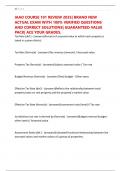
IAAO COURSE 101 REVIEW 2025| BRAND NEW
ACTUAL EXAM WITH 100% VERIFIED QUESTIONS
AND CORRECT SOLUTIONS| GUARANTEED VALUE
PACK| ACE YOUR GRADES.
Tax Rate (def.) - (answers)Percent of assessed value at which each property is
taxed in a given district.
Tax Rate (formula) - (answers)Tax revenue (amount) / Assessed value
Property Tax (formula) - (answers)Subject assessed value / Tax rate
Budget Revenue (formula) - (answers)Total budget - Other taxes
Effective Tax Rate (def.) - (answers)Reflects the relationship between total
property taxes on real property and the property's market value.
Effective Tax Rate (formula) - (answers)Assessment ratio (level) X Tax rate
Jurisdictions tax rate is derived by (formula) - (answers)Budget revenue (budget -
other taxes) / Assessed value
Assessment Ratio (def.) - (answers)Estimated fractional relationship between the
assessed values and market values of a group of properties.
,2|Page
Assessment Ratio (formula) - (answers)Assessed value / Market value
Neighborhood Life Cycle - (answers)Growth, Stability, Decline & Revitalization
Principle of Conformity - (answers)Value of a property depends on its relationship
to its surroundings; maximum market value is achieved when reasonable
similarity among improvements in the neighborhood.
Principle of Competition - (answers)Created by the potential for profits;
availability must be in harmony with demand; if one or the other is in excess
prices will decrease or increase.
Principle of Balance - (answers)Applied to an individual property; maximum value
is obtained when the four agents of production are balanced - land, labor, capital
and management.
Principle of Change - (answers)Market value is never constant; estimate of market
value is only valid as of a specific date & changes in the market will impact future
value estimates.
Principle of Anticipation - (answers)Value created by the expected future benefits
from the property; related to the Principle of Change.
, 3|Page
Principle of Consistent Use - (answers)Property must be valued with a single use
for the entire property; land cannot be valued with one use and improvements
with another.
Principle of Contribution - (answers)Value of component depends on its
contribution to the whole; basis for adjustments in the sales comparison
approach.
Principle of Supply - (answers)Amount of product producers are willing to sell
under various conditions during a given period.
Principle of Demand - (answers)Amount of product producers are willing and able
to buy during a given period; given the choices available.
Principle of Increasing & Decreasing Returns - (answers)Addition of successive
increments of one agent of production will decrease future incomes or amenities;
or additions of successive increments of one agent of productions added, future
income or amenities will increase to a point.
Principle of Progression - (answers)Association with better properties of the same
type increase value of a lower priced property.
Principle of Regression - (answers)Association with lower quality properties of the
same area decrease the value of a better quality property.
IAAO COURSE 101 REVIEW 2025| BRAND NEW
ACTUAL EXAM WITH 100% VERIFIED QUESTIONS
AND CORRECT SOLUTIONS| GUARANTEED VALUE
PACK| ACE YOUR GRADES.
Tax Rate (def.) - (answers)Percent of assessed value at which each property is
taxed in a given district.
Tax Rate (formula) - (answers)Tax revenue (amount) / Assessed value
Property Tax (formula) - (answers)Subject assessed value / Tax rate
Budget Revenue (formula) - (answers)Total budget - Other taxes
Effective Tax Rate (def.) - (answers)Reflects the relationship between total
property taxes on real property and the property's market value.
Effective Tax Rate (formula) - (answers)Assessment ratio (level) X Tax rate
Jurisdictions tax rate is derived by (formula) - (answers)Budget revenue (budget -
other taxes) / Assessed value
Assessment Ratio (def.) - (answers)Estimated fractional relationship between the
assessed values and market values of a group of properties.
,2|Page
Assessment Ratio (formula) - (answers)Assessed value / Market value
Neighborhood Life Cycle - (answers)Growth, Stability, Decline & Revitalization
Principle of Conformity - (answers)Value of a property depends on its relationship
to its surroundings; maximum market value is achieved when reasonable
similarity among improvements in the neighborhood.
Principle of Competition - (answers)Created by the potential for profits;
availability must be in harmony with demand; if one or the other is in excess
prices will decrease or increase.
Principle of Balance - (answers)Applied to an individual property; maximum value
is obtained when the four agents of production are balanced - land, labor, capital
and management.
Principle of Change - (answers)Market value is never constant; estimate of market
value is only valid as of a specific date & changes in the market will impact future
value estimates.
Principle of Anticipation - (answers)Value created by the expected future benefits
from the property; related to the Principle of Change.
, 3|Page
Principle of Consistent Use - (answers)Property must be valued with a single use
for the entire property; land cannot be valued with one use and improvements
with another.
Principle of Contribution - (answers)Value of component depends on its
contribution to the whole; basis for adjustments in the sales comparison
approach.
Principle of Supply - (answers)Amount of product producers are willing to sell
under various conditions during a given period.
Principle of Demand - (answers)Amount of product producers are willing and able
to buy during a given period; given the choices available.
Principle of Increasing & Decreasing Returns - (answers)Addition of successive
increments of one agent of production will decrease future incomes or amenities;
or additions of successive increments of one agent of productions added, future
income or amenities will increase to a point.
Principle of Progression - (answers)Association with better properties of the same
type increase value of a lower priced property.
Principle of Regression - (answers)Association with lower quality properties of the
same area decrease the value of a better quality property.


