

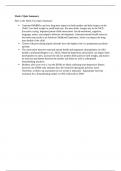
Week 2 Quiz Summary
Here is the Week Two Quiz Summary:
Untreated MMHDs can have long-term impact on both mother and baby Impact on the
Child. Low birth weight or small head size. Pre-term birth. Longer stay in the NICU.
Excessive crying. Impaired parent-child interactions. Social-emotional, cognitive,
language, motor, and adaptive behavior development. Untreated mental health issues in
the home may result in an Adverse Childhood Experience, which can impact the long-
term health of the child.
Clients with preexisting bipolar disorder have the highest risk of a postpartum psychotic
episode.
The association between maternal mental health and epigenetic dysregulation in child
health is profound (Rogers et al., 2022). Maternal depression and anxiety can impact fetal
development in utero, increase the risk for preterm birth and low birth weight, and lead to
an insecure attachment between the mother and infant as well as suboptimal
breastfeeding practices.
Mothers who score over 13 on the EPDS are likely suffering from depressive illness;
however, the EPDS only indicates how the client felt during the previous week.
Therefore, a follow-up assessment in two weeks is indicated. Appropriate first line
treatment for a breastfeeding mother is CBT, followed by SSRI
Here is the Week Two Quiz Summary:
Untreated MMHDs can have long-term impact on both mother and baby Impact on the
Child. Low birth weight or small head size. Pre-term birth. Longer stay in the NICU.
Excessive crying. Impaired parent-child interactions. Social-emotional, cognitive,
language, motor, and adaptive behavior development. Untreated mental health issues in
the home may result in an Adverse Childhood Experience, which can impact the long-
term health of the child.
Clients with preexisting bipolar disorder have the highest risk of a postpartum psychotic
episode.
The association between maternal mental health and epigenetic dysregulation in child
health is profound (Rogers et al., 2022). Maternal depression and anxiety can impact fetal
development in utero, increase the risk for preterm birth and low birth weight, and lead to
an insecure attachment between the mother and infant as well as suboptimal
breastfeeding practices.
Mothers who score over 13 on the EPDS are likely suffering from depressive illness;
however, the EPDS only indicates how the client felt during the previous week.
Therefore, a follow-up assessment in two weeks is indicated. Appropriate first line
treatment for a breastfeeding mother is CBT, followed by SSRI


