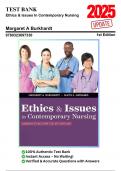
TEST BANK
Ethics & Issues In Contemporary Nursing
Margaret A Burkhardt
9780323697330 1st Edition
100% Authentic Test Bank
Instant Access – No Waiting!
Verified & Accurate Questions with Answers
,Table of content
Chapter 1: Social, philosophical, and other historical forces influencing the
development of nursing
Chapter 2: Ethical theory
Chapter 3: Ethical principles
Chapter 4: Values clarification
Chapter 5: Values development
Chapter 6: Ethics and professional nursing
Chapter 7: Ethical decision making
Chapter 8: Legal issues
Chapter 9: Professional relationship issues
Chapter 10: Practice issues related to technology
Chapter 11: Practice issues related to patient self-determination
Chapter 12: Scholarship issues
Chapter 13: Global consciousness in the 21st century
Chapter 14: Health policy issues
Chapter 15: Economic issues
Chapter 16: Social issues
Chapter 17: Gender issues
Chapter 18: Transcultural and spiritual issues
Chapter 19: Empowerment for nurses
Chapter 20: Facilitating patient empowerment
, Test Bank - Ethics and Issues In Contemporary Nursing, 1st Edition (Burkhardt, 2020)
______________________________________________________________________________________________
Chapter 1 Social, Philosophical, and Other Historical Forces Influencing the
Development of Nursing
MULTIPLE CHOICE
1. Nursing practice is influenced by:
a. history.
b. spiritual beliefs.
c. religious practice.
d. philosophical influences.
e. all of the above.
ANS: E PTS: 1
2. Empathy is a motive for:
a. meeting the needs of others.
b. moral reasoning and action.
c. becoming a nurse.
d. determining right from wrong.
ANS: B PTS: 1
3. Professions exist to meet the:
a. needs of employers.
b. needs of individuals.
c. needs of society.
d. needs of families.
ANS: C PTS: 1
4. Florence Nightingale was a:
a. model for all nurses.
b. nurse.
c. statistician.
d. social reformer.
e. all of the above.
ANS: E PTS: 1
5. Helping professionals find their origin in:
a. inhumane actions.
b. perceived social need.
c. accepted moral needs.
d. individual values.
e. All except a.
f. b and c only.
ANS: E PTS: 1
6. The overarching belief system of a culture that deals with the culture’s beliefs about the nature
of the universe is termed:
______________________________________________________________________________________________
1|Page
: Examsonline | Want to earn $1.236
extra per year?
, Test Bank - Ethics and Issues In Contemporary Nursing, 1st Edition (Burkhardt, 2020)
______________________________________________________________________________________________
a. cosmology.
b. religion.
c. values.
d. astrology.
ANS: A PTS: 1
7. During the Middle Ages:
a. religions and church-sanctioned secular nursing orders afforded the only legitimate
avenue for women who wished to become nurses.
b. there was an upsurge in the respect afforded to nursing and midwifery, and nurses
began to practice autonomously.
c. healing arts in Denmark and Greece were performed in sacred ceremonies by
priests, priestesses, or shamans.
d. most nurses were women of high social status.
ANS: A PTS: 1
8. The “Dark Period of Nursing” when convalescent patients, prostitutes, prisoners, and
drunkards provided hospital nursing care occurred during the:
a. Reformation.
b. Crusades.
c. Middle Ages.
d. Early Christian era.
ANS: A PTS: 1
9. The concept of social need is important to the ethical foundations of the nursing professional
because:
a. nurses must determine the health needs of society.
b. nursing finds its origin, purpose, and meaning within the context of perceived
social need.
c. theories of sociology are utilized by nursing scholars, many of whom view them as
conceptual frameworks for nursing practice.
d. social need determines the boundaries of the ethical principles of distributive
justice, beneficence, and nonmaleficence.
ANS: B PTS: 1
10. The social status of women affects the status of the nursing profession because:
a. nursing has traditionally been a profession of women.
b. throughout history, nurses have been afforded higher social status.
c. women of higher social status rarely become nurses.
d. women are more skilled than men at nurturing others.
ANS: A PTS: 1
11. Philosophers of the Early Christian era included:
a. Plato.
b. St. Paul.
c. Aristotle.
d. St. Augustine.
______________________________________________________________________________________________
2|Page
: Examsonline | Want to earn $1.236
extra per year?
Ethics & Issues In Contemporary Nursing
Margaret A Burkhardt
9780323697330 1st Edition
100% Authentic Test Bank
Instant Access – No Waiting!
Verified & Accurate Questions with Answers
,Table of content
Chapter 1: Social, philosophical, and other historical forces influencing the
development of nursing
Chapter 2: Ethical theory
Chapter 3: Ethical principles
Chapter 4: Values clarification
Chapter 5: Values development
Chapter 6: Ethics and professional nursing
Chapter 7: Ethical decision making
Chapter 8: Legal issues
Chapter 9: Professional relationship issues
Chapter 10: Practice issues related to technology
Chapter 11: Practice issues related to patient self-determination
Chapter 12: Scholarship issues
Chapter 13: Global consciousness in the 21st century
Chapter 14: Health policy issues
Chapter 15: Economic issues
Chapter 16: Social issues
Chapter 17: Gender issues
Chapter 18: Transcultural and spiritual issues
Chapter 19: Empowerment for nurses
Chapter 20: Facilitating patient empowerment
, Test Bank - Ethics and Issues In Contemporary Nursing, 1st Edition (Burkhardt, 2020)
______________________________________________________________________________________________
Chapter 1 Social, Philosophical, and Other Historical Forces Influencing the
Development of Nursing
MULTIPLE CHOICE
1. Nursing practice is influenced by:
a. history.
b. spiritual beliefs.
c. religious practice.
d. philosophical influences.
e. all of the above.
ANS: E PTS: 1
2. Empathy is a motive for:
a. meeting the needs of others.
b. moral reasoning and action.
c. becoming a nurse.
d. determining right from wrong.
ANS: B PTS: 1
3. Professions exist to meet the:
a. needs of employers.
b. needs of individuals.
c. needs of society.
d. needs of families.
ANS: C PTS: 1
4. Florence Nightingale was a:
a. model for all nurses.
b. nurse.
c. statistician.
d. social reformer.
e. all of the above.
ANS: E PTS: 1
5. Helping professionals find their origin in:
a. inhumane actions.
b. perceived social need.
c. accepted moral needs.
d. individual values.
e. All except a.
f. b and c only.
ANS: E PTS: 1
6. The overarching belief system of a culture that deals with the culture’s beliefs about the nature
of the universe is termed:
______________________________________________________________________________________________
1|Page
: Examsonline | Want to earn $1.236
extra per year?
, Test Bank - Ethics and Issues In Contemporary Nursing, 1st Edition (Burkhardt, 2020)
______________________________________________________________________________________________
a. cosmology.
b. religion.
c. values.
d. astrology.
ANS: A PTS: 1
7. During the Middle Ages:
a. religions and church-sanctioned secular nursing orders afforded the only legitimate
avenue for women who wished to become nurses.
b. there was an upsurge in the respect afforded to nursing and midwifery, and nurses
began to practice autonomously.
c. healing arts in Denmark and Greece were performed in sacred ceremonies by
priests, priestesses, or shamans.
d. most nurses were women of high social status.
ANS: A PTS: 1
8. The “Dark Period of Nursing” when convalescent patients, prostitutes, prisoners, and
drunkards provided hospital nursing care occurred during the:
a. Reformation.
b. Crusades.
c. Middle Ages.
d. Early Christian era.
ANS: A PTS: 1
9. The concept of social need is important to the ethical foundations of the nursing professional
because:
a. nurses must determine the health needs of society.
b. nursing finds its origin, purpose, and meaning within the context of perceived
social need.
c. theories of sociology are utilized by nursing scholars, many of whom view them as
conceptual frameworks for nursing practice.
d. social need determines the boundaries of the ethical principles of distributive
justice, beneficence, and nonmaleficence.
ANS: B PTS: 1
10. The social status of women affects the status of the nursing profession because:
a. nursing has traditionally been a profession of women.
b. throughout history, nurses have been afforded higher social status.
c. women of higher social status rarely become nurses.
d. women are more skilled than men at nurturing others.
ANS: A PTS: 1
11. Philosophers of the Early Christian era included:
a. Plato.
b. St. Paul.
c. Aristotle.
d. St. Augustine.
______________________________________________________________________________________________
2|Page
: Examsonline | Want to earn $1.236
extra per year?