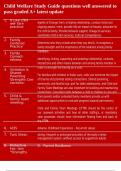
Child Welfare Study Guide questions well answered to
pass graded A+ latest update
1. 9 core child
wel- fare Agents of Change, form a helping relationship, conduct initial and
practice: ongoing assess- ment, provide info on impact of trauma, advocate for
the child & family, Provide behavior support, linkage to services,
coordinate child & fam services, Cultural Competence.
2. Family
Centered Determine who they include when they say family. It recognizes a
Practice family strength and the importance of the relations among family
members.
3. Family
Connect-
edness: Identifying, linking, supporting and enabling relationship, contacts,
interactions and other means between and among family member in
order to strength the family as a unit.
4. Visitation &
Shared
Parenting For families with children in foster care, visits can minimize the impact
Strengths Con- of trauma and promote lasting connections. Shared parenting,
nections: community and familial sup- port for older adolescents, and Child and
Family Team Meetings are also important for building and maintaining
connections. Consistent visits between a child or children in care and
5. Child & their parents and/or extended family members provide us with
family team additional opportunities to evaluate progress towards permanency.
meeting:
Child and Family Team Meetings (CFTM) should be the center of
our casework activities and how all other staflng's, or mandatory
case processes should have information flowing from and back to
the CFTM.
6. ACES Adverse Childhood Experience - Recurrent abuse
7. Toxic Stress: strong, frequent or prolonged activation of the body's stress
management system, without access to supportive adults
8. Protective 9. Parent Resilience
Fac- tors
"Strengths
,Child Welfare Study Guide questions well answered to
pass graded A+ latest update
existing strengths of a
family. Assist families to
overcome the stressors or
diflculties that potentially
can lead to abuse or
neglect.
, Child Welfare Study Guide questions well answered to
pass graded A+ latest update
Be strong and flexible. The critical ability when faced with problems or
stressors. Resiliency is the process of adapting well in the face of
adversity, trauma and tragedy
10. Strength Families usually come to the attention of the child welfare system
Based because some- thing bad has happened and needs to be corrected
Practice
allegation
11. The mission
of DCFS is Protect children who are reported to be abused or neglected and to
increase their families' capacity to safely care for them. Provide for the
12. Federal law well-being of children in our care.
(run by DCFS)
enacted by Congress. Bills that are passed by the House of
13. State law (run Representatives and the Senate and signed by the President become
by DCFS) federal legislation.
14. Social
Security Act DCFS is an agency in the executive branch of Illinois state government.
Title IV-E The Director is appointed by the Governor with the advice and consent
of the state Senate.
15. Indian Child
Wel- fare Act
Reasonable ettorts must be made to prevent a child from entering foster
16. Inter-Ethnic care, and to reunify a child with the child's family.
Placement
Act (IEPA): ICWA identified federal requirements regarding the removal and
placement of Indian children in foster or adoptive homes and allows
17. Abused & ne-
glected child the child's tribe to intervene.
re- porting act
(AN- CRA): prohibits any consideration of children's race or ethnicity as a factor
in deciding which permanent placement will be in their best interest.
requires the Department to receive reports of abused and neglected
children, to investigate these reports, and to provide services necessary
to prevent further harm to children.
pass graded A+ latest update
1. 9 core child
wel- fare Agents of Change, form a helping relationship, conduct initial and
practice: ongoing assess- ment, provide info on impact of trauma, advocate for
the child & family, Provide behavior support, linkage to services,
coordinate child & fam services, Cultural Competence.
2. Family
Centered Determine who they include when they say family. It recognizes a
Practice family strength and the importance of the relations among family
members.
3. Family
Connect-
edness: Identifying, linking, supporting and enabling relationship, contacts,
interactions and other means between and among family member in
order to strength the family as a unit.
4. Visitation &
Shared
Parenting For families with children in foster care, visits can minimize the impact
Strengths Con- of trauma and promote lasting connections. Shared parenting,
nections: community and familial sup- port for older adolescents, and Child and
Family Team Meetings are also important for building and maintaining
connections. Consistent visits between a child or children in care and
5. Child & their parents and/or extended family members provide us with
family team additional opportunities to evaluate progress towards permanency.
meeting:
Child and Family Team Meetings (CFTM) should be the center of
our casework activities and how all other staflng's, or mandatory
case processes should have information flowing from and back to
the CFTM.
6. ACES Adverse Childhood Experience - Recurrent abuse
7. Toxic Stress: strong, frequent or prolonged activation of the body's stress
management system, without access to supportive adults
8. Protective 9. Parent Resilience
Fac- tors
"Strengths
,Child Welfare Study Guide questions well answered to
pass graded A+ latest update
existing strengths of a
family. Assist families to
overcome the stressors or
diflculties that potentially
can lead to abuse or
neglect.
, Child Welfare Study Guide questions well answered to
pass graded A+ latest update
Be strong and flexible. The critical ability when faced with problems or
stressors. Resiliency is the process of adapting well in the face of
adversity, trauma and tragedy
10. Strength Families usually come to the attention of the child welfare system
Based because some- thing bad has happened and needs to be corrected
Practice
allegation
11. The mission
of DCFS is Protect children who are reported to be abused or neglected and to
increase their families' capacity to safely care for them. Provide for the
12. Federal law well-being of children in our care.
(run by DCFS)
enacted by Congress. Bills that are passed by the House of
13. State law (run Representatives and the Senate and signed by the President become
by DCFS) federal legislation.
14. Social
Security Act DCFS is an agency in the executive branch of Illinois state government.
Title IV-E The Director is appointed by the Governor with the advice and consent
of the state Senate.
15. Indian Child
Wel- fare Act
Reasonable ettorts must be made to prevent a child from entering foster
16. Inter-Ethnic care, and to reunify a child with the child's family.
Placement
Act (IEPA): ICWA identified federal requirements regarding the removal and
placement of Indian children in foster or adoptive homes and allows
17. Abused & ne-
glected child the child's tribe to intervene.
re- porting act
(AN- CRA): prohibits any consideration of children's race or ethnicity as a factor
in deciding which permanent placement will be in their best interest.
requires the Department to receive reports of abused and neglected
children, to investigate these reports, and to provide services necessary
to prevent further harm to children.