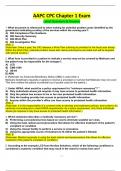
AAPC CPC Chapter 1 Exam
Latest Questions & Answers
1. What document is referenced to when looking for potential problem areas identified by the
government indicating scrutiny of the services within the coming year?:
A) OIG Compliance Plan Guidance
B) OIG Security Summary
C) OIG Work Plan
D) OIG Investigation Plan
ANS: C
(Rationale: Twice a year, the OIG releases a Work Plan outlining its priorities for the fiscal year ahead.
Within the Work Plan, potential problem areas with claims submissions are listed and will be targeted
with special scrutiny.)
2. What form is provided to a patient to indicate a service may not be covered by Medicare and
the patient may be responsible for the charges?:
A) LCD
B) CMS-1500
C) UB-04
D) ABN
D (Rationale: An Advanced Beneficiary Notice (ABN) is used when a
Medicare beneficiary requests or agrees to receive a procedure or service that Medicare may not cover.
This form notifies the patient of potential out of pocket costs for the patient.)
3. Under HIPAA, what would be a policy requirement for "minimum necessary"? "
A) Only individuals whose job requires it may have access to protected health information.
B) Only the patient has access to his or her own protected health information.
C) Only the treating provider has access to protected health information.
D) Anyone within the provider's office can have access to protected health information
ANS: A
(Rationale: It is the responsibility of a covered entity to develop and implement policies, best suited to its
particular circumstances to meet HIPAA requirements. As a policy requirement, only those individuals
whose job requires it may have access to protected health information.)
4. Which statement describes a medically necessary service? :
A) Performing a procedure/service based on cost to eliminate wasteful ser-vices.
B) Using the least radical service/procedure that allows for effective treatment of the patient's
complaint or condition.
C) Using the closest facility to perform a service or procedure.
D) Using the appropriate course of treatment to fit within the patient's lifestyle
ANS: B
(Rationale: Medical necessity is using the least radical services/procedure that allows for effective
treatment of the patient's complaint or condition.)
5. According to the example LCD from Novitas Solutions, which of the following conditions is
considered a systemic condition that may result in the need for routine foot care? :
1/8
, A) arthritis
B) chronic venous insufficiency
C) hypertension
D) muscle weakness
ANS: C
(Rationale: According to the LCD, Chronic venous insufficiency is a systemic condition that may result in
the need for routine foot care.)
6. When presenting a cost estimate on an ABN for a potentially noncovered service, the cost
estimate should be within what range of the actual cost?
A) $25 or 10 percent
B) $100 or 10 percent
C) $100 or 25 percent
D) An exact amount
ANS: C
(Rationale: CMS instructions stipulate, "Notifiers must make a good faith effort to insert a reasonable
estimate...the estimate should be within $100 or 25 percent of the actual costs, whichever is greater.")
7. Which act was enacted as part of the American Recovery and Reinvestment Act of 2009
(ARRA) and affected privacy and security? :
A) HIPAA
B) HITECH
C) SSA
D) PPACA
ANS: B
8. What document assists provider offices with the development of Compliance Manuals?
A) OIG Compliance Plan Guidance
B) OIG Work Plan
C) OIG Suggested Rules and Regulations
D) OIG Internal Compliance Plan
ANS: A
(Rationale: The OIG has offered compliance program guidance to form the basis of a voluntary
compliance program for physician offices. Although this was released in October 2000, it is still
considered as active compliance guidance today.)
9. Select the TRUE statement regarding ABNs.
A) ABNs may not be recognized by non-Medicare payers.
B) ABNs must be signed for emergency or urgent care.
C) ABNs are not required to include an estimate cost for the service.
D) ABNs should be routinely signed by Medicare Beneficiaries in case Medicare doesn't cover a
service
ANS: A
(Rationale: ABNs may not be recognized by non-Medicare payers. Providers should review their
contracts to determine which payers will accept an ABN for services not covered.)
10. Who would NOT be considered a covered entity under HIPAA?
2/8
Latest Questions & Answers
1. What document is referenced to when looking for potential problem areas identified by the
government indicating scrutiny of the services within the coming year?:
A) OIG Compliance Plan Guidance
B) OIG Security Summary
C) OIG Work Plan
D) OIG Investigation Plan
ANS: C
(Rationale: Twice a year, the OIG releases a Work Plan outlining its priorities for the fiscal year ahead.
Within the Work Plan, potential problem areas with claims submissions are listed and will be targeted
with special scrutiny.)
2. What form is provided to a patient to indicate a service may not be covered by Medicare and
the patient may be responsible for the charges?:
A) LCD
B) CMS-1500
C) UB-04
D) ABN
D (Rationale: An Advanced Beneficiary Notice (ABN) is used when a
Medicare beneficiary requests or agrees to receive a procedure or service that Medicare may not cover.
This form notifies the patient of potential out of pocket costs for the patient.)
3. Under HIPAA, what would be a policy requirement for "minimum necessary"? "
A) Only individuals whose job requires it may have access to protected health information.
B) Only the patient has access to his or her own protected health information.
C) Only the treating provider has access to protected health information.
D) Anyone within the provider's office can have access to protected health information
ANS: A
(Rationale: It is the responsibility of a covered entity to develop and implement policies, best suited to its
particular circumstances to meet HIPAA requirements. As a policy requirement, only those individuals
whose job requires it may have access to protected health information.)
4. Which statement describes a medically necessary service? :
A) Performing a procedure/service based on cost to eliminate wasteful ser-vices.
B) Using the least radical service/procedure that allows for effective treatment of the patient's
complaint or condition.
C) Using the closest facility to perform a service or procedure.
D) Using the appropriate course of treatment to fit within the patient's lifestyle
ANS: B
(Rationale: Medical necessity is using the least radical services/procedure that allows for effective
treatment of the patient's complaint or condition.)
5. According to the example LCD from Novitas Solutions, which of the following conditions is
considered a systemic condition that may result in the need for routine foot care? :
1/8
, A) arthritis
B) chronic venous insufficiency
C) hypertension
D) muscle weakness
ANS: C
(Rationale: According to the LCD, Chronic venous insufficiency is a systemic condition that may result in
the need for routine foot care.)
6. When presenting a cost estimate on an ABN for a potentially noncovered service, the cost
estimate should be within what range of the actual cost?
A) $25 or 10 percent
B) $100 or 10 percent
C) $100 or 25 percent
D) An exact amount
ANS: C
(Rationale: CMS instructions stipulate, "Notifiers must make a good faith effort to insert a reasonable
estimate...the estimate should be within $100 or 25 percent of the actual costs, whichever is greater.")
7. Which act was enacted as part of the American Recovery and Reinvestment Act of 2009
(ARRA) and affected privacy and security? :
A) HIPAA
B) HITECH
C) SSA
D) PPACA
ANS: B
8. What document assists provider offices with the development of Compliance Manuals?
A) OIG Compliance Plan Guidance
B) OIG Work Plan
C) OIG Suggested Rules and Regulations
D) OIG Internal Compliance Plan
ANS: A
(Rationale: The OIG has offered compliance program guidance to form the basis of a voluntary
compliance program for physician offices. Although this was released in October 2000, it is still
considered as active compliance guidance today.)
9. Select the TRUE statement regarding ABNs.
A) ABNs may not be recognized by non-Medicare payers.
B) ABNs must be signed for emergency or urgent care.
C) ABNs are not required to include an estimate cost for the service.
D) ABNs should be routinely signed by Medicare Beneficiaries in case Medicare doesn't cover a
service
ANS: A
(Rationale: ABNs may not be recognized by non-Medicare payers. Providers should review their
contracts to determine which payers will accept an ABN for services not covered.)
10. Who would NOT be considered a covered entity under HIPAA?
2/8