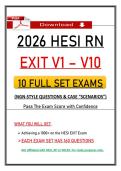
2026 HESI RN
EXIT V1 – V10
10 FULL SET EXAMS
(NGN-STYLE QUESTIONS & CASE “SCENARIOS”)
Pass The Exam Score with Confidence
WHAT YOU WILL GET:
➢ Achieving a 1000+ on the HESI EXIT Exam
➢EACH EXAM SET HAS 160 QUESTIONS
Not affiliated with HESI, ATI or NCLEX. For study purposes only.
,Table of Contents
HESI EXIT V1 ................................................................................. 3
HESI EXIT V2 ............................................................................... 76
HESI EXIT V3 ............................................................................. 182
HESI EXIT V4 ............................................................................. 252
HESI EXIT V5 ............................................................................. 328
HESI EXIT V6 ............................................................................. 415
HESI EXIT V7 ............................................................................. 495
HESI EXIT V8 ............................................................................. 565
HESI EXIT V9 ............................................................................. 641
HESI EXIT V10 ........................................................................... 738
, HESI EXIT V1
QUESTION 1
When preparing to administer a prescribed medication to a homeless client at a
community psychiatric clinic, the client tells the nurse that the usual dosage
taken is different from the dose the nurse is giving. Which action should the
nurse take?
A. Inform the client that he may refuse the medication and document whether or not the
client takes it.
B. Withhold the medication until the dosage can be confirmed.
C. Explain to the client that the dosage has been changed.
D. Tell the client to take the medication, then verify the dosage at the next healthcare
team meeting.
CORRECT ANSWER: B. Withhold the medication until the dosage can be
confirmed.
Rationale: Before administering a medication when a discrepancy is noted—especially
if the client states their "usual dose" does not match the current prescription—nurses
must verify the correctness of the order. Holding the dose ensures client safety and
prevents potential adverse effects or medication errors. Option A does not address the
potential error in the order; the best practice is confirming correct medication and dose
before giving or clarifying with the provider. Option C might be premature until you truly
confirm with the healthcare provider that a change has been made. Option D could
endanger the client if the prescription was a real error.
QUESTION 2
The charge nurse is making assignments for one Practical Nurse (PN) and three
Registered Nurses (RNs) who are caring for neurologically compromised clients.
Which client with which change in status is best to assign to the PN?
,A. A subdural hematoma client whose blood pressure changed from 150/80 to 170/60.
B. A viral meningitis client whose temperature changed from 101.5°F to 102°F.
C. A diabetic ketoacidosis client whose Glasgow Coma Scale (GCS) score changed
from 10 to 7.
D. A myxedema client whose blood pressure changed from 80/50 to 70/40.
CORRECT ANSWER: B. A viral meningitis client whose temperature changed
from 101.5°F to 102°F.
Rationale: A PN can safely monitor a temperature increase in viral meningitis,
continuing routine care and reporting further deviations. Clients with major changes in
neurological status or hemodynamic instability (such as sharp drops in blood pressure
or a drop in GCS) typically require the RN's higher-level critical assessment and
intervention skills. A GCS drop from 10 to 7 is concerning for significant neurological
decline → best handled by an RN. Subdural hematoma with a big blood pressure shift
or a myxedema client with severe hypotension should remain under direct RN
supervision because these changes can be life-threatening.
QUESTION 3
The nurse is caring for a client with pneumonia who now develops initial signs of
septic shock and multi-organ failure. The healthcare provider prescribes a sepsis
protocol. Which intervention is most important for the nurse to include in the plan
of care?
A. Maintain strict intake and output.
B. Keep head of bed raised at 45°.
C. Assess warmth of extremities.
D. Monitor blood glucose.
CORRECT ANSWER: A. Maintain strict intake and output.
Rationale: In septic shock and multi-organ dysfunction, close monitoring of fluid
balance is critical to detect perfusion problems and kidney function changes. While
other interventions such as head-of-bed elevation (to decrease aspiration risk) and
monitoring blood glucose are important, strict I&O is key for guiding fluid resuscitation
and evaluating renal perfusion. Measuring I&O helps assess for both under-
resuscitation or fluid overload, common in sepsis.
QUESTION 4
,An adolescent client is admitted to the hospital because of writing a suicide note.
On the second day of hospitalization, the nurse asks the client to meet with the
treatment team. After the team meeting, the client leaves in tears and goes to their
room. Which nursing intervention is best?
A. Let the client rest quietly in the room for a while.
B. Explore the client's goals and desires for treatment.
C. Ask the treatment team about the client's behavior.
D. Go to the client's room and ask what happened.
CORRECT ANSWER: D. Go to the client's room and ask what happened.
Rationale: When a client abruptly leaves in tears after a meeting, the therapeutic
approach is to immediately engage, show concern, and assess emotional status.
Promptly exploring the situation fosters trust and therapeutic alliance. Waiting or
delegating to another team member misses the chance for timely therapeutic
intervention and can increase risk in a suicidal adolescent. Therapeutic communication
should be direct, caring, and immediate.
QUESTION 5 (NGN-Style: Prioritizing Client Goals)
Nurse's Notes:
• 0400: Client is awake, alert but restless. States, "I am feeling extremely anxious."
Decreased breath sounds in the left lower lobe, dry mucous membranes,
productive cough with thick yellow secretions, capillary refill of 4 seconds. Vital
signs: HR 101 bpm, SpO2 90% (on 3L nasal cannula), BP 145/89, Temp 100.2°F,
RR 28.
• 0500: Client placed in semi-Fowler's. No improvement in oxygen saturation on 3L
nasal cannula.
Which are the three MOST important goals? (Select all that apply)
A. The client will remain free of skin breakdown.
B. The client will have quit smoking.
C. The client will be afebrile for 24 hours.
D. The client will maintain oxygen saturation of 96% without supplemental oxygen.
E. The client will report pain less than 3/10.
CORRECT ANSWER: B, C, E
Table
, Goal Rationale
B. Quit Smoking cessation is included in many protocols and is an
smoking essential long-term goal for lung health, especially given the
client's chest issues.
C. Afebrile for Being afebrile for 24 hours indicates infection management
24 hours success.
E. Pain <3/10 Pain control is essential for respiratory effort, rest, and overall
comfort.
Rationale: While maintaining good oxygen saturation is important, the stated realistic
goal for an acute respiratory situation might be to improve oxygenation with or without
supplemental oxygen, but typically we focus on more immediate measurable outcomes
like controlling fever and pain. Smoking cessation is included in many protocols and is
an essential long-term goal for lung health, especially given the client's chest issues.
Being afebrile for 24 hours indicates infection management success. Pain control is
essential for respiratory effort, rest, and overall comfort.
QUESTION 6 (NGN-Style: Oxygen Administration via Facemask)
Orders (0330):
• Place the client on a cardiopulmonary monitor, NPO, sputum culture, start a
peripheral IV, start O2 at 3L NC, run Normal Saline at 150 mL/hr, acetaminophen
350mg PO q6h for T>101°F, chest X-ray.
Orders (0500):
• Increase oxygen to 8L via simple facemask; titrate to SpO2 >94%.
Indicate whether each statement by the new graduate nurse indicates
"UNDERSTANDING" or "NOT UNDERSTANDING" about using a simple facemask:
Table
, Statement UNDERSTANDING NOT
UNDERSTANDING
1) "I should clean the facemask once ✓
per shift."
2) "The client should take a 1-to 2- ✓
minute break from the facemask each
hour."
3) "I should put gauze under the ✓
elastic straps over the ears."
4) "I can adjust the oxygen level on ✓
the flowmeter to keep the client's
oxygen saturation >94%."
5) "The mask should cover only the ✓
mouth and leave the nose open for
expiration."
6) "I should place the mask first over ✓
the nose and then cover the mouth."
Rationale:
• Cleaning the mask – daily or per facility protocol – is correct.
• A "break" from the mask is not standard practice unless clinically indicated for
other reasons.
• Soft gauze or foam products over bony prominences or behind ears can be done
to prevent skin breakdown (this may be context-dependent: some facilities do
place padding behind ears).
• The nurse can indeed adjust the flowmeter to maintain the prescribed oxygen
saturation target.
• The mask must cover both nose and mouth for effective oxygenation.
, • Placing it over the nose first is a correct method to ensure a proper seal.
QUESTION 7
The healthcare provider prescribes dalteparin 200 units/kg subcut once a day for
a client who weighs 154 pounds. The medication is supplied as 25,000 units/mL.
How many milliliters should the nurse administer? (Round to the nearest tenth if
needed.)
A. 0.4 mL
B. 0.6 mL
C. 0.8 mL
D. 1.0 mL
CORRECT ANSWER: B. 0.6 mL
Rationale:
• Step 1: Convert 154 lb to kg: 154 ÷ 2.2 ≈ 70 kg.
• Step 2: Dose = 200 units × 70 kg = 14,000 units.
• Step 3: Available: 25,000 units per mL, so 14,000/25,000 = 0.56 mL → 0.6 mL
(rounded to the nearest tenth).
QUESTION 8 (NGN-Style: Prioritizing Initial Prescription Implementations)
The client is 49 years old with four days of flu-like symptoms, fever, and chest
congestion, now increased difficulty breathing. History of ½-pack/day smoking
for 20 years, no surgical history.
Orders:
• Sputum culture
• Start oxygen 3L/min via nasal cannula
• Place client on a cardiopulmonary monitor
• Chest X-ray
• Acetaminophen 350mg PO q6h for fever
• Run 0.9% NS IV at 150 mL/hr
• Start peripheral IV
, • NPO
Which two orders should the nurse complete FIRST?
A. Sputum culture
B. Start O2 3L/min NC
C. Place on a cardio-respiratory monitor
D. Chest X-ray
E. Acetaminophen 350mg PO q6h
F. IV fluids at 150 mL/hr
G. Start peripheral IV
H. NPO
CORRECT ANSWER: B and C
• Start oxygen 3L/min NC
• Place on a cardio-respiratory monitor
Rationale: In respiratory compromise, ensure airway and oxygenation first (oxygen
therapy) and monitor vital status (cardiac/respiratory monitor). Although sputum culture
and IV start are also important, the immediate priority is supporting oxygenation and
monitoring for potential deterioration.
QUESTION 9 (NGN-Style: Oxygen Delivery Equipment)
Orders at 0330:
• Cardio-respiratory monitor, NPO, sputum culture, start a PIV, O2 at 3L/min NC,
normal saline at 150 mL/hr, acetaminophen 350mg q6h, chest X-ray.
To start the client on oxygen as ordered, which items should the nurse collect
from the supply room? (Select all that apply)
A. Humidifier bottle
B. Suction canister
C. Sterile water
D. Nasal cannula
E. Flow meter
F. Lamb's wool
G. Tape
CORRECT ANSWER: D and E
• Nasal cannula
, • Flow meter
Rationale: The fundamental equipment for nasal cannula oxygen therapy is the NC
tubing and the flowmeter device. Humidification may be required at higher flow rates
depending on policy, but typically not mandatory at 2-3L/min unless dryness is a
concern.
QUESTION 10 (NGN-Style: Recognizing Signs of Hypoxia)
Client data: Anxious, decreased breath sounds LLL, dry mucous membranes, thick
yellow sputum, capillary refill 4 seconds, T 100.2°F, HR 101, RR 28, BP 145/89, SpO2
90% on room air.
For each body system, specify the assessment finding that indicates hypoxia:
Table
Body System Findings Finding Indicating Hypoxia
Cardiovascular Heart rate 100 bpm; Cap Capillary refill 4 seconds (a sign
refill 4 seconds; BP 145/89 of poor perfusion)
Neurological Anxious; Awake and alert; Anxious, restless (signs of
Restless hypoxia)
Respiratory SpO2 90% on room air; SpO2 90% on room air, RR
RR 28 bpm; Productive 28 (both indicate respiratory
cough compromise)
Rationale: Capillary refill of 4 seconds indicates poor perfusion. Anxiousness and
restlessness are early neurological signs of hypoxia. SpO2 of 90% on room air and
respiratory rate of 28 bpm both indicate respiratory compromise and hypoxia.
QUESTION 11 (NGN-Style Case Study Context)
A 49-year-old male, ½ pack/day smoker, difficulty breathing, pneumonia-like
symptoms. The nurse should place the client in a __________ position to promote
__________.
EXIT V1 – V10
10 FULL SET EXAMS
(NGN-STYLE QUESTIONS & CASE “SCENARIOS”)
Pass The Exam Score with Confidence
WHAT YOU WILL GET:
➢ Achieving a 1000+ on the HESI EXIT Exam
➢EACH EXAM SET HAS 160 QUESTIONS
Not affiliated with HESI, ATI or NCLEX. For study purposes only.
,Table of Contents
HESI EXIT V1 ................................................................................. 3
HESI EXIT V2 ............................................................................... 76
HESI EXIT V3 ............................................................................. 182
HESI EXIT V4 ............................................................................. 252
HESI EXIT V5 ............................................................................. 328
HESI EXIT V6 ............................................................................. 415
HESI EXIT V7 ............................................................................. 495
HESI EXIT V8 ............................................................................. 565
HESI EXIT V9 ............................................................................. 641
HESI EXIT V10 ........................................................................... 738
, HESI EXIT V1
QUESTION 1
When preparing to administer a prescribed medication to a homeless client at a
community psychiatric clinic, the client tells the nurse that the usual dosage
taken is different from the dose the nurse is giving. Which action should the
nurse take?
A. Inform the client that he may refuse the medication and document whether or not the
client takes it.
B. Withhold the medication until the dosage can be confirmed.
C. Explain to the client that the dosage has been changed.
D. Tell the client to take the medication, then verify the dosage at the next healthcare
team meeting.
CORRECT ANSWER: B. Withhold the medication until the dosage can be
confirmed.
Rationale: Before administering a medication when a discrepancy is noted—especially
if the client states their "usual dose" does not match the current prescription—nurses
must verify the correctness of the order. Holding the dose ensures client safety and
prevents potential adverse effects or medication errors. Option A does not address the
potential error in the order; the best practice is confirming correct medication and dose
before giving or clarifying with the provider. Option C might be premature until you truly
confirm with the healthcare provider that a change has been made. Option D could
endanger the client if the prescription was a real error.
QUESTION 2
The charge nurse is making assignments for one Practical Nurse (PN) and three
Registered Nurses (RNs) who are caring for neurologically compromised clients.
Which client with which change in status is best to assign to the PN?
,A. A subdural hematoma client whose blood pressure changed from 150/80 to 170/60.
B. A viral meningitis client whose temperature changed from 101.5°F to 102°F.
C. A diabetic ketoacidosis client whose Glasgow Coma Scale (GCS) score changed
from 10 to 7.
D. A myxedema client whose blood pressure changed from 80/50 to 70/40.
CORRECT ANSWER: B. A viral meningitis client whose temperature changed
from 101.5°F to 102°F.
Rationale: A PN can safely monitor a temperature increase in viral meningitis,
continuing routine care and reporting further deviations. Clients with major changes in
neurological status or hemodynamic instability (such as sharp drops in blood pressure
or a drop in GCS) typically require the RN's higher-level critical assessment and
intervention skills. A GCS drop from 10 to 7 is concerning for significant neurological
decline → best handled by an RN. Subdural hematoma with a big blood pressure shift
or a myxedema client with severe hypotension should remain under direct RN
supervision because these changes can be life-threatening.
QUESTION 3
The nurse is caring for a client with pneumonia who now develops initial signs of
septic shock and multi-organ failure. The healthcare provider prescribes a sepsis
protocol. Which intervention is most important for the nurse to include in the plan
of care?
A. Maintain strict intake and output.
B. Keep head of bed raised at 45°.
C. Assess warmth of extremities.
D. Monitor blood glucose.
CORRECT ANSWER: A. Maintain strict intake and output.
Rationale: In septic shock and multi-organ dysfunction, close monitoring of fluid
balance is critical to detect perfusion problems and kidney function changes. While
other interventions such as head-of-bed elevation (to decrease aspiration risk) and
monitoring blood glucose are important, strict I&O is key for guiding fluid resuscitation
and evaluating renal perfusion. Measuring I&O helps assess for both under-
resuscitation or fluid overload, common in sepsis.
QUESTION 4
,An adolescent client is admitted to the hospital because of writing a suicide note.
On the second day of hospitalization, the nurse asks the client to meet with the
treatment team. After the team meeting, the client leaves in tears and goes to their
room. Which nursing intervention is best?
A. Let the client rest quietly in the room for a while.
B. Explore the client's goals and desires for treatment.
C. Ask the treatment team about the client's behavior.
D. Go to the client's room and ask what happened.
CORRECT ANSWER: D. Go to the client's room and ask what happened.
Rationale: When a client abruptly leaves in tears after a meeting, the therapeutic
approach is to immediately engage, show concern, and assess emotional status.
Promptly exploring the situation fosters trust and therapeutic alliance. Waiting or
delegating to another team member misses the chance for timely therapeutic
intervention and can increase risk in a suicidal adolescent. Therapeutic communication
should be direct, caring, and immediate.
QUESTION 5 (NGN-Style: Prioritizing Client Goals)
Nurse's Notes:
• 0400: Client is awake, alert but restless. States, "I am feeling extremely anxious."
Decreased breath sounds in the left lower lobe, dry mucous membranes,
productive cough with thick yellow secretions, capillary refill of 4 seconds. Vital
signs: HR 101 bpm, SpO2 90% (on 3L nasal cannula), BP 145/89, Temp 100.2°F,
RR 28.
• 0500: Client placed in semi-Fowler's. No improvement in oxygen saturation on 3L
nasal cannula.
Which are the three MOST important goals? (Select all that apply)
A. The client will remain free of skin breakdown.
B. The client will have quit smoking.
C. The client will be afebrile for 24 hours.
D. The client will maintain oxygen saturation of 96% without supplemental oxygen.
E. The client will report pain less than 3/10.
CORRECT ANSWER: B, C, E
Table
, Goal Rationale
B. Quit Smoking cessation is included in many protocols and is an
smoking essential long-term goal for lung health, especially given the
client's chest issues.
C. Afebrile for Being afebrile for 24 hours indicates infection management
24 hours success.
E. Pain <3/10 Pain control is essential for respiratory effort, rest, and overall
comfort.
Rationale: While maintaining good oxygen saturation is important, the stated realistic
goal for an acute respiratory situation might be to improve oxygenation with or without
supplemental oxygen, but typically we focus on more immediate measurable outcomes
like controlling fever and pain. Smoking cessation is included in many protocols and is
an essential long-term goal for lung health, especially given the client's chest issues.
Being afebrile for 24 hours indicates infection management success. Pain control is
essential for respiratory effort, rest, and overall comfort.
QUESTION 6 (NGN-Style: Oxygen Administration via Facemask)
Orders (0330):
• Place the client on a cardiopulmonary monitor, NPO, sputum culture, start a
peripheral IV, start O2 at 3L NC, run Normal Saline at 150 mL/hr, acetaminophen
350mg PO q6h for T>101°F, chest X-ray.
Orders (0500):
• Increase oxygen to 8L via simple facemask; titrate to SpO2 >94%.
Indicate whether each statement by the new graduate nurse indicates
"UNDERSTANDING" or "NOT UNDERSTANDING" about using a simple facemask:
Table
, Statement UNDERSTANDING NOT
UNDERSTANDING
1) "I should clean the facemask once ✓
per shift."
2) "The client should take a 1-to 2- ✓
minute break from the facemask each
hour."
3) "I should put gauze under the ✓
elastic straps over the ears."
4) "I can adjust the oxygen level on ✓
the flowmeter to keep the client's
oxygen saturation >94%."
5) "The mask should cover only the ✓
mouth and leave the nose open for
expiration."
6) "I should place the mask first over ✓
the nose and then cover the mouth."
Rationale:
• Cleaning the mask – daily or per facility protocol – is correct.
• A "break" from the mask is not standard practice unless clinically indicated for
other reasons.
• Soft gauze or foam products over bony prominences or behind ears can be done
to prevent skin breakdown (this may be context-dependent: some facilities do
place padding behind ears).
• The nurse can indeed adjust the flowmeter to maintain the prescribed oxygen
saturation target.
• The mask must cover both nose and mouth for effective oxygenation.
, • Placing it over the nose first is a correct method to ensure a proper seal.
QUESTION 7
The healthcare provider prescribes dalteparin 200 units/kg subcut once a day for
a client who weighs 154 pounds. The medication is supplied as 25,000 units/mL.
How many milliliters should the nurse administer? (Round to the nearest tenth if
needed.)
A. 0.4 mL
B. 0.6 mL
C. 0.8 mL
D. 1.0 mL
CORRECT ANSWER: B. 0.6 mL
Rationale:
• Step 1: Convert 154 lb to kg: 154 ÷ 2.2 ≈ 70 kg.
• Step 2: Dose = 200 units × 70 kg = 14,000 units.
• Step 3: Available: 25,000 units per mL, so 14,000/25,000 = 0.56 mL → 0.6 mL
(rounded to the nearest tenth).
QUESTION 8 (NGN-Style: Prioritizing Initial Prescription Implementations)
The client is 49 years old with four days of flu-like symptoms, fever, and chest
congestion, now increased difficulty breathing. History of ½-pack/day smoking
for 20 years, no surgical history.
Orders:
• Sputum culture
• Start oxygen 3L/min via nasal cannula
• Place client on a cardiopulmonary monitor
• Chest X-ray
• Acetaminophen 350mg PO q6h for fever
• Run 0.9% NS IV at 150 mL/hr
• Start peripheral IV
, • NPO
Which two orders should the nurse complete FIRST?
A. Sputum culture
B. Start O2 3L/min NC
C. Place on a cardio-respiratory monitor
D. Chest X-ray
E. Acetaminophen 350mg PO q6h
F. IV fluids at 150 mL/hr
G. Start peripheral IV
H. NPO
CORRECT ANSWER: B and C
• Start oxygen 3L/min NC
• Place on a cardio-respiratory monitor
Rationale: In respiratory compromise, ensure airway and oxygenation first (oxygen
therapy) and monitor vital status (cardiac/respiratory monitor). Although sputum culture
and IV start are also important, the immediate priority is supporting oxygenation and
monitoring for potential deterioration.
QUESTION 9 (NGN-Style: Oxygen Delivery Equipment)
Orders at 0330:
• Cardio-respiratory monitor, NPO, sputum culture, start a PIV, O2 at 3L/min NC,
normal saline at 150 mL/hr, acetaminophen 350mg q6h, chest X-ray.
To start the client on oxygen as ordered, which items should the nurse collect
from the supply room? (Select all that apply)
A. Humidifier bottle
B. Suction canister
C. Sterile water
D. Nasal cannula
E. Flow meter
F. Lamb's wool
G. Tape
CORRECT ANSWER: D and E
• Nasal cannula
, • Flow meter
Rationale: The fundamental equipment for nasal cannula oxygen therapy is the NC
tubing and the flowmeter device. Humidification may be required at higher flow rates
depending on policy, but typically not mandatory at 2-3L/min unless dryness is a
concern.
QUESTION 10 (NGN-Style: Recognizing Signs of Hypoxia)
Client data: Anxious, decreased breath sounds LLL, dry mucous membranes, thick
yellow sputum, capillary refill 4 seconds, T 100.2°F, HR 101, RR 28, BP 145/89, SpO2
90% on room air.
For each body system, specify the assessment finding that indicates hypoxia:
Table
Body System Findings Finding Indicating Hypoxia
Cardiovascular Heart rate 100 bpm; Cap Capillary refill 4 seconds (a sign
refill 4 seconds; BP 145/89 of poor perfusion)
Neurological Anxious; Awake and alert; Anxious, restless (signs of
Restless hypoxia)
Respiratory SpO2 90% on room air; SpO2 90% on room air, RR
RR 28 bpm; Productive 28 (both indicate respiratory
cough compromise)
Rationale: Capillary refill of 4 seconds indicates poor perfusion. Anxiousness and
restlessness are early neurological signs of hypoxia. SpO2 of 90% on room air and
respiratory rate of 28 bpm both indicate respiratory compromise and hypoxia.
QUESTION 11 (NGN-Style Case Study Context)
A 49-year-old male, ½ pack/day smoker, difficulty breathing, pneumonia-like
symptoms. The nurse should place the client in a __________ position to promote
__________.