B.Com. III Year Subject- Income Tax for Business
B.Com. III Year
Syllabus
Subject – Income Tax for Business
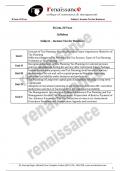
Concept of Tax Planning: Meaning Features Scope. Importance Objective of
Tax Planning
Unit I
Difference Between Tax Planning and Tax Evasion. Types of Tax Planning
Problems in Tax Planning
Recognized methods of Tax Planning Tax Planning for salaried persons
Unit II
prior to appointment during the service, after retirement Salary Package.
Income from house property and Tax Planning Avail benefit of various
Unit III deductions of let out and self occupied property Measures regarding
minimize tax liability under business and profession
Tax Planning of Long term capital gains Exemptions relating to long term
capital gain
Unit IV
Adoption of investment planning to get benefit of deduction 80 c and other
deductions selection of business form for minimum tax liability
Tax Management: Introduction. Difference between Tax Planning and Tax
Management Areas of Tax Management. Preparation of Return. Payment of
Unit V
Tax. Advance Payment of Tax Tax Deduction at source etc. Assessment.
Procedure Penalties and Prosecutions Appeals and revisions
45, Anurag Nagar, Behind Press Complex, Indore (M.P.) Ph.: 4262100, www.rccmindore.com
1
,B.Com. III Year Subject- Income Tax for Business
UNIT-I
Tax Planning , Tax Avoidance and Tax Evasion
Meaning of Tax Planning
INTRODUCTION
The main goal of every taxpayer is to minimize his Tax Liability. To achieve this objective
taxpayer may resort to following Three Methods :
o Tax Planning
o Tax Avoidance
o Tax Evasion
It is well said that “Taxpayer is not expected to arrange his affairs in a such manner to pay
maximum tax “ . So, the assessee shall arrange the affairs in a manner to reduce tax. But
the question what method he opts for ? Tax Planning, Tax Avoidance, Tax Evasion !
Let us see its meaning and their difference.
MEANINNG OF TAX PLANNING
Tax Planning involves planning in order to avail all exemptions, deductions and rebates
provided in Act. The Income Tax law itself provides for various methods for Tax Planning,
Generally it is provided under exemptions u/s 10, deductions u/s 80C to 80U and rebates
and relief’s. Some of the provisions are enumerated below :
• Investment in securities provided u/s 10(15) . Interest on such securities is fully
exempt from tax.
• Exemptions u/s 10A, 10B, and 10BA
• Residential Status of the person
• Choice of accounting system
• Choice of organization.
For availing benefits, one should resort to bonafide means by complying with the
provisions of law in letter and in spirit.
Where a person buys a machinery instead of hiring it, he is availing the benefit of
depreciation. If is his exclusive right either to buy or lease it . In the same manner to choice
the form of organization, capital structure, buy or make products are the assesse’s
exclusive right. One may look for various tax incentives in the above said transactions
provided in this Act, for reduction of tax liability. All this transaction involves tax planning.
45, Anurag Nagar, Behind Press Complex, Indore (M.P.) Ph.: 4262100, www.rccmindore.com
2
,B.Com. III Year Subject- Income Tax for Business
Objective of Tax Planningves of tax planning:
Tax planning is a pivotal part of financial planning. Through effective tax planning all
elements of the financial plan falls in place in the most efficient manner. This results in
channelization of taxable income to different investment avenues thus relieving the
individual of tax liability. The investment amount post lock-in can be utilized for
fulfilling needs and act as the retirement corpus in most cases. All in all, the objective of
tax planning is to reduce tax liability and attain economic stability.
Why Every Person Needs Tax Planning ?
Tax Planning is resorted to maximize the cash inflow and minimize the cash outflow. Since
Tax is kind of cast, the reduction of cost shall increase the profitability. Every prudence
person, to maximize the Return, shall increase the profits by resorting to a tool known as a
Tax Planning.
How is Tool of Tax Planning Exercised ?
Tax Planning should be done by keeping in mine following factors :
• The Planning should be done before the accrual of income. Any planning done after
the accrual income is known as Application of Income an it may lead to a conclusion
of that there is a fraud.
• Tax Planning should be resorted at the source of income.
• The Choice of an organization, i.e. Taxable Entity. Business may be done through a
Proprietorship concern or Firm or through a Company.
• The choice of location of business , undertaking, or division also play a very
important role.
• Residential Status of a person. Therefore, a person should arranged his stay in India
such a way that he is treated as NR in India.
• Choice to Buy or Lease the Assets. Where the assets are bought, depreciation is
allowed and when asset is leased, lease rental is allowed as deduction.
• Capital Structure decision also plays a major role. Mixture of debt and equity fund
should be balanced, to maximize the return on capital and minimize the tax liability.
Interest on debt is allowed as deduction whereas dividend on equity fund is not
allowed as deduction
Methods Of Tax Planning
Various methods of Tax Planning may be classified as follows :
45, Anurag Nagar, Behind Press Complex, Indore (M.P.) Ph.: 4262100, www.rccmindore.com
3
, B.Com. III Year Subject- Income Tax for Business
1. Short Term Tax Planning : Short range Tax Planning means the planning
thought of and executed at the end of the income year to reduce taxable income in a legal
way.
Example : Suppose , at the end of the income year, an assessee finds his taxes have been too
high in comparison with last year and he intends to reduce it. Now, he may do that, to a great
extent by making proper arrangements to get the maximum tax rebate u/s 88. Such plan
does not involve any long term commitment, yet it results in substantial savings in tax.
2. Long Term Tax Planning : Long range tax planning means a plan chaled out at
the beginning or the income year to be followed around the year. This type of planning
does not help immediately as in the case of short range planning but is likely to help in the
long run ;
e.g. If an assessee transferred shares held by him to his minor son or spouse, though the
income from such transferred shares will be clubbed with his income u/s 64, yet is the income
is invested by the son or spouse, then the income from such investment will be treaded as
income of the son or spouse. Moreover, if the company issue any bonus shards for the shares
transferred , that will also be treated as income in the hands of the son or spouse.
3. Permissive Tax Planning : Permissive Tax Planning means making plans which
are permissible under different provisions of the law, such as planning of earning income
covered by Sec.10, specially by Sec. 10(1) , Planning of taking advantage of different
incentives and deductions, planning for availing different tax concessions etc.
4. Purposive Tax Planning : It means making plans with specific purpose to
ensure the availability of maximum benefits to the assessee through correct selection of
investment, making suitable programme for replacement of assets, varying the residential
status and diversifying business activities and income etc.
Tax Avoidance
It is an act of dodging tax without breaking the Law. It means when a taxpayer arranges
his financial activities in such a manner that although it is within the four corner of tax law
but takes advantages of loopholes which exists in the Tax Law for reduction of tax a
liability. In other words though he has complied the letter of law but not the sprit behind
the law.
Following transactions are held as Tax Avoidance which are :
1. Where tax law is complied with by using colorable devices which means that use o
dubious method or a method which is unfair for reduction of tax liability.
2. Where the fact of the case is presented in a false manner.
3. Where the sprit behind the law is avoided.
45, Anurag Nagar, Behind Press Complex, Indore (M.P.) Ph.: 4262100, www.rccmindore.com
4
B.Com. III Year
Syllabus
Subject – Income Tax for Business
Concept of Tax Planning: Meaning Features Scope. Importance Objective of
Tax Planning
Unit I
Difference Between Tax Planning and Tax Evasion. Types of Tax Planning
Problems in Tax Planning
Recognized methods of Tax Planning Tax Planning for salaried persons
Unit II
prior to appointment during the service, after retirement Salary Package.
Income from house property and Tax Planning Avail benefit of various
Unit III deductions of let out and self occupied property Measures regarding
minimize tax liability under business and profession
Tax Planning of Long term capital gains Exemptions relating to long term
capital gain
Unit IV
Adoption of investment planning to get benefit of deduction 80 c and other
deductions selection of business form for minimum tax liability
Tax Management: Introduction. Difference between Tax Planning and Tax
Management Areas of Tax Management. Preparation of Return. Payment of
Unit V
Tax. Advance Payment of Tax Tax Deduction at source etc. Assessment.
Procedure Penalties and Prosecutions Appeals and revisions
45, Anurag Nagar, Behind Press Complex, Indore (M.P.) Ph.: 4262100, www.rccmindore.com
1
,B.Com. III Year Subject- Income Tax for Business
UNIT-I
Tax Planning , Tax Avoidance and Tax Evasion
Meaning of Tax Planning
INTRODUCTION
The main goal of every taxpayer is to minimize his Tax Liability. To achieve this objective
taxpayer may resort to following Three Methods :
o Tax Planning
o Tax Avoidance
o Tax Evasion
It is well said that “Taxpayer is not expected to arrange his affairs in a such manner to pay
maximum tax “ . So, the assessee shall arrange the affairs in a manner to reduce tax. But
the question what method he opts for ? Tax Planning, Tax Avoidance, Tax Evasion !
Let us see its meaning and their difference.
MEANINNG OF TAX PLANNING
Tax Planning involves planning in order to avail all exemptions, deductions and rebates
provided in Act. The Income Tax law itself provides for various methods for Tax Planning,
Generally it is provided under exemptions u/s 10, deductions u/s 80C to 80U and rebates
and relief’s. Some of the provisions are enumerated below :
• Investment in securities provided u/s 10(15) . Interest on such securities is fully
exempt from tax.
• Exemptions u/s 10A, 10B, and 10BA
• Residential Status of the person
• Choice of accounting system
• Choice of organization.
For availing benefits, one should resort to bonafide means by complying with the
provisions of law in letter and in spirit.
Where a person buys a machinery instead of hiring it, he is availing the benefit of
depreciation. If is his exclusive right either to buy or lease it . In the same manner to choice
the form of organization, capital structure, buy or make products are the assesse’s
exclusive right. One may look for various tax incentives in the above said transactions
provided in this Act, for reduction of tax liability. All this transaction involves tax planning.
45, Anurag Nagar, Behind Press Complex, Indore (M.P.) Ph.: 4262100, www.rccmindore.com
2
,B.Com. III Year Subject- Income Tax for Business
Objective of Tax Planningves of tax planning:
Tax planning is a pivotal part of financial planning. Through effective tax planning all
elements of the financial plan falls in place in the most efficient manner. This results in
channelization of taxable income to different investment avenues thus relieving the
individual of tax liability. The investment amount post lock-in can be utilized for
fulfilling needs and act as the retirement corpus in most cases. All in all, the objective of
tax planning is to reduce tax liability and attain economic stability.
Why Every Person Needs Tax Planning ?
Tax Planning is resorted to maximize the cash inflow and minimize the cash outflow. Since
Tax is kind of cast, the reduction of cost shall increase the profitability. Every prudence
person, to maximize the Return, shall increase the profits by resorting to a tool known as a
Tax Planning.
How is Tool of Tax Planning Exercised ?
Tax Planning should be done by keeping in mine following factors :
• The Planning should be done before the accrual of income. Any planning done after
the accrual income is known as Application of Income an it may lead to a conclusion
of that there is a fraud.
• Tax Planning should be resorted at the source of income.
• The Choice of an organization, i.e. Taxable Entity. Business may be done through a
Proprietorship concern or Firm or through a Company.
• The choice of location of business , undertaking, or division also play a very
important role.
• Residential Status of a person. Therefore, a person should arranged his stay in India
such a way that he is treated as NR in India.
• Choice to Buy or Lease the Assets. Where the assets are bought, depreciation is
allowed and when asset is leased, lease rental is allowed as deduction.
• Capital Structure decision also plays a major role. Mixture of debt and equity fund
should be balanced, to maximize the return on capital and minimize the tax liability.
Interest on debt is allowed as deduction whereas dividend on equity fund is not
allowed as deduction
Methods Of Tax Planning
Various methods of Tax Planning may be classified as follows :
45, Anurag Nagar, Behind Press Complex, Indore (M.P.) Ph.: 4262100, www.rccmindore.com
3
, B.Com. III Year Subject- Income Tax for Business
1. Short Term Tax Planning : Short range Tax Planning means the planning
thought of and executed at the end of the income year to reduce taxable income in a legal
way.
Example : Suppose , at the end of the income year, an assessee finds his taxes have been too
high in comparison with last year and he intends to reduce it. Now, he may do that, to a great
extent by making proper arrangements to get the maximum tax rebate u/s 88. Such plan
does not involve any long term commitment, yet it results in substantial savings in tax.
2. Long Term Tax Planning : Long range tax planning means a plan chaled out at
the beginning or the income year to be followed around the year. This type of planning
does not help immediately as in the case of short range planning but is likely to help in the
long run ;
e.g. If an assessee transferred shares held by him to his minor son or spouse, though the
income from such transferred shares will be clubbed with his income u/s 64, yet is the income
is invested by the son or spouse, then the income from such investment will be treaded as
income of the son or spouse. Moreover, if the company issue any bonus shards for the shares
transferred , that will also be treated as income in the hands of the son or spouse.
3. Permissive Tax Planning : Permissive Tax Planning means making plans which
are permissible under different provisions of the law, such as planning of earning income
covered by Sec.10, specially by Sec. 10(1) , Planning of taking advantage of different
incentives and deductions, planning for availing different tax concessions etc.
4. Purposive Tax Planning : It means making plans with specific purpose to
ensure the availability of maximum benefits to the assessee through correct selection of
investment, making suitable programme for replacement of assets, varying the residential
status and diversifying business activities and income etc.
Tax Avoidance
It is an act of dodging tax without breaking the Law. It means when a taxpayer arranges
his financial activities in such a manner that although it is within the four corner of tax law
but takes advantages of loopholes which exists in the Tax Law for reduction of tax a
liability. In other words though he has complied the letter of law but not the sprit behind
the law.
Following transactions are held as Tax Avoidance which are :
1. Where tax law is complied with by using colorable devices which means that use o
dubious method or a method which is unfair for reduction of tax liability.
2. Where the fact of the case is presented in a false manner.
3. Where the sprit behind the law is avoided.
45, Anurag Nagar, Behind Press Complex, Indore (M.P.) Ph.: 4262100, www.rccmindore.com
4