QME COMPREHENSIVE EXAM 2024/2025 QUESTIONS AND
VERIFIED CORRECT ANSWERS/ ALREADY GRADED A++
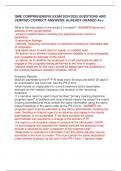
What is the information in the doctor's 1st report? -ANSWER Name and
address of the injured worker.
worker's medical history including any significant prior injuries or
disabilities.
Examination findings.
methods, frequency and duration of treatment including an estimated date
of completion.
Estimated return to work date for regular or modified work.
An opinion as to whether residual permanent disability is to be anticipated
and if possible an estimate of this extent.
an opinion as to whether the employee is or will eventually be able to
engage in the occupation being performed at the time of surgery.
Medical treatment for this injury should be based upon the guidelines in
the medical treatment utilization schedule. MTUS
Progress Reports:
Must be submitted by the PTP At least every 45 days and within 20 days if
an examination has occurred. Use the PR-2 form.
Must include an explanation for current treatment and a reasonable
estimate for the method, frequency and duration of the remaining
treatment.
If a narrative report is used it must be titled "primary treating physicians
progress report" in boldface and must indicate clearly the reason the report
is being submitted and must contain the same information using the same
subject headings in the same order as the PR-2 form. -ANSWER the
progress report must be submitted to the claims administrator handling the
case. Sending an original report to an attorney and copies to the claims
administrator is not acceptable. If not done correctly the claims
administrator can request for a change of the worker's PTP.
the report is not complete unless it contains all the information: SOAP.
to avoid dispute over payment for medical services the physician must
provide a rationale for each component of the treatment plan.
Responses to requests for information from the claims adjuster may be
submitted in the form of a letter. This must contain the same declaration
under penalty of perjury as set forth in the PR-2 form: "I declare under
,penalty of perjury that this report is true and correct to the best of my
knowledge and I have not violated Labor Code Section 139.3"
what events trigger the need for progress reports?
When ongoing treatment is provided, a progress report is required no later
than 45 days from the last report.
The worker's condition undergoes a previously unexpected significant
change.
A significant changes made in the treatment plan reported
the worker's condition permits return to modified or regular work.
The worker's condition requires them to leave work or requires changes in
work restrictions or modifications. -ANSWER The worker is discharged.
After the worker's condition has become permanent and stationary the
PTP concludes that the worker's permanent disability precludes or is likely
to preclude the worker from engaging in their usual occupation.
The employer reasonably request additional information necessary to
administer the claim.
Request for Authorization -ANSWER A treating physician is required to use
the request for authorization form to request treatment, diagnostic tests or
other medical services for an injured worker.
The treating physician must fill out the form and attach documentation that
substantiates the need for the requested treatment.
Permanent and Stationary Form (PR-3 and PR-4) -ANSWER When the
PTP determines that the worker's condition is permanent and stationary the
physician must report within 20 days from the date of examination any
findings concerning the existence and extent of permanent impairment and
limitations and any need for continuing future medical care resulting from
the injury. This information may be submitted on the "primary treating
physicians permanent and stationary report" PR-3 if pre-2005 and PR-4
after 1/1/2005.
What information is on the P&S form?
the date of the examination.
The history of the injury.
The patient's complaints.
A listing of all information received from the parties reviewed in preparation
of the report.
The patient's medical history.
,Findings on examination.
A diagnosis.
An opinion as to the nature, extent and duration of disability and work
limitations.
The cause of the disability.
The treatment indicated. -ANSWER An opinion as to whether or not
permanent disability has resulted from the injury and whether it is
stationary.
It is found to be stationary description of the disability with the complete
evaluation. An apportionment of the disability, if any. A determination of the
percentage of the total causation resulting from actual events of
employment if the injury is alleged to be a psychiatric injury.
The reasons for the opinion.
Signature of the physician.
If PR-4 form is used the PTP must describe the existence and extent of
permanent impairment in accordance with the AMA guides to the
evaluation on permanent impairment, 5th edition.
If the PTP finds that the employee is permanent and stationary with regard
to all conditions and that the injury has resulted in permanent partial
disability the physician must also complete the "physicians return to work
and voucher report" and attach it to the "primary treating physicians
permanent and stationary report" form. -ANSWER Reimbursement to the
MD Is made according to the official medical fee schedule (OMFS)
because it is not generated as result of a dispute but parties. Medical legal
reports which are generated with the intent to resolving dispute are
reimbursed according to the medical legal fee schedule (MLFS)
evidence based medical guidelines and the medical treatment utilization
schedule.
When can treatment be warranted on recommendations found outside the
MTUS? -ANSWER The MTUS is a set of evidence based Medical
Treatment guidelines that must be followed when evaluating and treating ill
and injured workers.
It must also be used in the utilization review process and medical dispute
resolution process. (IMRs).
The MTUS includes information from the American college of occupational
and environmental medicine and the official Disability guides. (ACOEM and
ODG)
, Outside MTUS: it is the medical condition or injury is not addressed by the
MTUS or if the MTUS's presumption of correctness is successfully
rebutted.
Presumption of Correctness: -ANSWER The MTUS is presumed to be
correct on the issue of the extent and scope of medical treatment and
diagnostic services it addresses. However it can be successfully
challenged by a preponderance of scientific medical evidence of high
quality.
Injuries not addressed by MTUS must be based on other evidence based
Medical Treatment guidelines that are nationally recognized by the medical
community.
Functional Improvement -ANSWER As defined by MTUS, functional
improvement means either a clinically significant improvement in activities
of daily living or a reduction in work restrictions as measured during a
history and physical exam, performed and documented as part of the
medical evaluation and treatment, and a reduction in the dependence on
continued medical treatment.
The PTP is expected to assess and clearly document functional
improvement and work status, including any restrictions, at every visit.
Delayed Recovery and Early Intervention:
10% of California worker's compensation cases consume more than 75%
of available medical and indemnity resources. -ANSWER Delayed recovery
and chronic pain, the final common pathway of delayed recovery, have
proved to be the major drivers of disproportionate overutilization by this
subpopulation in both worker's compensation and group health
populations.
Validated questionnaires can be used to identify those at risk for DR and
CP as early as possible after DOI.
Definitions of CP and DR -ANSWER CP: any pain that persists beyond the
anticipated time but healing.
DR: is understood as existing when complaints and dysfunction persists
beyond anticipated time frames outlined by standard disability guidelines.
Injured workers you do not recover in a timely way exhibit less emotional
resilience and do not exhibit the coping skills of those who do return.
psychosocial factors have proven better predictors of chronicity that clinical
findings.
VERIFIED CORRECT ANSWERS/ ALREADY GRADED A++
What is the information in the doctor's 1st report? -ANSWER Name and
address of the injured worker.
worker's medical history including any significant prior injuries or
disabilities.
Examination findings.
methods, frequency and duration of treatment including an estimated date
of completion.
Estimated return to work date for regular or modified work.
An opinion as to whether residual permanent disability is to be anticipated
and if possible an estimate of this extent.
an opinion as to whether the employee is or will eventually be able to
engage in the occupation being performed at the time of surgery.
Medical treatment for this injury should be based upon the guidelines in
the medical treatment utilization schedule. MTUS
Progress Reports:
Must be submitted by the PTP At least every 45 days and within 20 days if
an examination has occurred. Use the PR-2 form.
Must include an explanation for current treatment and a reasonable
estimate for the method, frequency and duration of the remaining
treatment.
If a narrative report is used it must be titled "primary treating physicians
progress report" in boldface and must indicate clearly the reason the report
is being submitted and must contain the same information using the same
subject headings in the same order as the PR-2 form. -ANSWER the
progress report must be submitted to the claims administrator handling the
case. Sending an original report to an attorney and copies to the claims
administrator is not acceptable. If not done correctly the claims
administrator can request for a change of the worker's PTP.
the report is not complete unless it contains all the information: SOAP.
to avoid dispute over payment for medical services the physician must
provide a rationale for each component of the treatment plan.
Responses to requests for information from the claims adjuster may be
submitted in the form of a letter. This must contain the same declaration
under penalty of perjury as set forth in the PR-2 form: "I declare under
,penalty of perjury that this report is true and correct to the best of my
knowledge and I have not violated Labor Code Section 139.3"
what events trigger the need for progress reports?
When ongoing treatment is provided, a progress report is required no later
than 45 days from the last report.
The worker's condition undergoes a previously unexpected significant
change.
A significant changes made in the treatment plan reported
the worker's condition permits return to modified or regular work.
The worker's condition requires them to leave work or requires changes in
work restrictions or modifications. -ANSWER The worker is discharged.
After the worker's condition has become permanent and stationary the
PTP concludes that the worker's permanent disability precludes or is likely
to preclude the worker from engaging in their usual occupation.
The employer reasonably request additional information necessary to
administer the claim.
Request for Authorization -ANSWER A treating physician is required to use
the request for authorization form to request treatment, diagnostic tests or
other medical services for an injured worker.
The treating physician must fill out the form and attach documentation that
substantiates the need for the requested treatment.
Permanent and Stationary Form (PR-3 and PR-4) -ANSWER When the
PTP determines that the worker's condition is permanent and stationary the
physician must report within 20 days from the date of examination any
findings concerning the existence and extent of permanent impairment and
limitations and any need for continuing future medical care resulting from
the injury. This information may be submitted on the "primary treating
physicians permanent and stationary report" PR-3 if pre-2005 and PR-4
after 1/1/2005.
What information is on the P&S form?
the date of the examination.
The history of the injury.
The patient's complaints.
A listing of all information received from the parties reviewed in preparation
of the report.
The patient's medical history.
,Findings on examination.
A diagnosis.
An opinion as to the nature, extent and duration of disability and work
limitations.
The cause of the disability.
The treatment indicated. -ANSWER An opinion as to whether or not
permanent disability has resulted from the injury and whether it is
stationary.
It is found to be stationary description of the disability with the complete
evaluation. An apportionment of the disability, if any. A determination of the
percentage of the total causation resulting from actual events of
employment if the injury is alleged to be a psychiatric injury.
The reasons for the opinion.
Signature of the physician.
If PR-4 form is used the PTP must describe the existence and extent of
permanent impairment in accordance with the AMA guides to the
evaluation on permanent impairment, 5th edition.
If the PTP finds that the employee is permanent and stationary with regard
to all conditions and that the injury has resulted in permanent partial
disability the physician must also complete the "physicians return to work
and voucher report" and attach it to the "primary treating physicians
permanent and stationary report" form. -ANSWER Reimbursement to the
MD Is made according to the official medical fee schedule (OMFS)
because it is not generated as result of a dispute but parties. Medical legal
reports which are generated with the intent to resolving dispute are
reimbursed according to the medical legal fee schedule (MLFS)
evidence based medical guidelines and the medical treatment utilization
schedule.
When can treatment be warranted on recommendations found outside the
MTUS? -ANSWER The MTUS is a set of evidence based Medical
Treatment guidelines that must be followed when evaluating and treating ill
and injured workers.
It must also be used in the utilization review process and medical dispute
resolution process. (IMRs).
The MTUS includes information from the American college of occupational
and environmental medicine and the official Disability guides. (ACOEM and
ODG)
, Outside MTUS: it is the medical condition or injury is not addressed by the
MTUS or if the MTUS's presumption of correctness is successfully
rebutted.
Presumption of Correctness: -ANSWER The MTUS is presumed to be
correct on the issue of the extent and scope of medical treatment and
diagnostic services it addresses. However it can be successfully
challenged by a preponderance of scientific medical evidence of high
quality.
Injuries not addressed by MTUS must be based on other evidence based
Medical Treatment guidelines that are nationally recognized by the medical
community.
Functional Improvement -ANSWER As defined by MTUS, functional
improvement means either a clinically significant improvement in activities
of daily living or a reduction in work restrictions as measured during a
history and physical exam, performed and documented as part of the
medical evaluation and treatment, and a reduction in the dependence on
continued medical treatment.
The PTP is expected to assess and clearly document functional
improvement and work status, including any restrictions, at every visit.
Delayed Recovery and Early Intervention:
10% of California worker's compensation cases consume more than 75%
of available medical and indemnity resources. -ANSWER Delayed recovery
and chronic pain, the final common pathway of delayed recovery, have
proved to be the major drivers of disproportionate overutilization by this
subpopulation in both worker's compensation and group health
populations.
Validated questionnaires can be used to identify those at risk for DR and
CP as early as possible after DOI.
Definitions of CP and DR -ANSWER CP: any pain that persists beyond the
anticipated time but healing.
DR: is understood as existing when complaints and dysfunction persists
beyond anticipated time frames outlined by standard disability guidelines.
Injured workers you do not recover in a timely way exhibit less emotional
resilience and do not exhibit the coping skills of those who do return.
psychosocial factors have proven better predictors of chronicity that clinical
findings.