

NR547 Week Six Quiz Summary
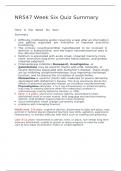
Here is the Week Six Quiz
Summary
Difficulty multitasking and/or resuming a task after an interruption
and getting organized are indicative of impaired executive
functioning.
The primary neurotransmitter hypothesized to be involved in
delirium is acetylcholine, and the major neuroanatomical area is
the reticular formation.
Delirium is associated with acute onset, impaired memory-more
short- term than long-term, prominent hallucinations, and grossly
impaired judgment.
Cholinesterase Inhibitors Donepezil, rivastigmine, or
galantamine may be used for clients with mild, moderate, or
severe dementia associated with Alzheimer’s disease. These drugs
act by inhibiting acetylcholinesterase, thus improving cholinergic
function, and increasing the circulation of acetylcholine.
Memantine is used for clients with moderate to severe dementia
associated with Alzheimer’s disease. This drug selectively blocks the
effects of abnormal glutamate release, an excitatory neurotransmitter.
Physostigmine salicylate, 1 to 2 mg intravenously or intramuscularly,
may help in treating delirium when the underlying condition is
anticholinergic toxicity Boland & Verduin, p. 228).
Early- 1-3 years- short term memory deficits, disoriented to date,
diminished recall of recent events, mild language and decision-making
deficits, mild problem copying figures (clock drawing)
social withdrawal, mood change, personality changes
problems with managing finances
Middle-mod- 2-8 years- cognitive decline- disoriented to date and place, may
get lost in familiar places impaired learning new skills, agitation, aggression,
restlessness, or anxiety difficulty with ADLs such as cooking and grooming
Late- 6-12 years- disoriented to person, time, or place, non-verbal long term
memory diminished, unable to groom or dress progress to need for total
care at end stage incontinent, motor or verbal agitation
Here is the Week Six Quiz
Summary
Difficulty multitasking and/or resuming a task after an interruption
and getting organized are indicative of impaired executive
functioning.
The primary neurotransmitter hypothesized to be involved in
delirium is acetylcholine, and the major neuroanatomical area is
the reticular formation.
Delirium is associated with acute onset, impaired memory-more
short- term than long-term, prominent hallucinations, and grossly
impaired judgment.
Cholinesterase Inhibitors Donepezil, rivastigmine, or
galantamine may be used for clients with mild, moderate, or
severe dementia associated with Alzheimer’s disease. These drugs
act by inhibiting acetylcholinesterase, thus improving cholinergic
function, and increasing the circulation of acetylcholine.
Memantine is used for clients with moderate to severe dementia
associated with Alzheimer’s disease. This drug selectively blocks the
effects of abnormal glutamate release, an excitatory neurotransmitter.
Physostigmine salicylate, 1 to 2 mg intravenously or intramuscularly,
may help in treating delirium when the underlying condition is
anticholinergic toxicity Boland & Verduin, p. 228).
Early- 1-3 years- short term memory deficits, disoriented to date,
diminished recall of recent events, mild language and decision-making
deficits, mild problem copying figures (clock drawing)
social withdrawal, mood change, personality changes
problems with managing finances
Middle-mod- 2-8 years- cognitive decline- disoriented to date and place, may
get lost in familiar places impaired learning new skills, agitation, aggression,
restlessness, or anxiety difficulty with ADLs such as cooking and grooming
Late- 6-12 years- disoriented to person, time, or place, non-verbal long term
memory diminished, unable to groom or dress progress to need for total
care at end stage incontinent, motor or verbal agitation


