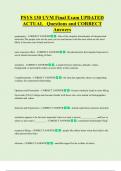
PSYS 130 UVM Final Exam UPDATED
ACTUAL Questions and CORRECT
Answers
propinquity - CORRECT ANSWER - One of the simplest determinants of interpersonal
attraction;The people who are the ones you see and interact with the most often are the most
likely to become your friends and lovers
mere exposure effect - CORRECT ANSWER - the phenomenon that repeated exposure to
novel stimuli increases liking of them
similarity - CORRECT ANSWER - a match between interests, attitudes, values,
background, or personality makes us more likely to like someone
Complimentarity - CORRECT ANSWER - the idea that opposites attract; no supporting
evidence for committed relationships
Opinions and Personality - CORRECT ANSWER - Greater similarity leads to more liking
Newcomb (1961) College men became friends with those who were similar in Demographics
attitudes and values
Interests and Experiences - CORRECT ANSWER - shared experiences promote attraction
similarity appears to be far more important when we want a serious, ____________, and less so
when we just want a _________ - CORRECT ANSWER - committed relationship;"fling"
reciprocal liking - CORRECT ANSWER - people like others better when they believe the
other person likes them
altruism - CORRECT ANSWER - unselfish regard for the welfare of others
, egoism - CORRECT ANSWER - a motive to increase one's own welfare; helping behavior
provides some benefit to the helper
bystander effect - CORRECT ANSWER - the finding that a person is less likely to provide
help when there are other bystanders
"Carol" study (Toi & Batson, 1982) - CORRECT ANSWER -
diffusion of responsibility - CORRECT ANSWER - reduction in sense of responsibility
often felt by individuals in a group; may be responsible for the bystander effect
social exchange theory - CORRECT ANSWER - the theory that our social behavior is an
exchange process, the aim of which is to maximize benefits and minimize costs
empathy-altruism hypothesis - CORRECT ANSWER - the idea that when we feel empathy
for a person, we will attempt to help that person for purely altruistic reasons, regardless of what
we have to gain
negative state relief model - CORRECT ANSWER - the proposal that prosocial behavior is
motivated by the bystander's desire to reduce his or her own uncomfortable negative emotions or
feelings
the feeling that is most likely to increase helping is - CORRECT ANSWER - guilt
reciprocity norm - CORRECT ANSWER - expectation that people will help, not hurt,
those who have helped them
direct reciprocity - CORRECT ANSWER - individuals help each other and both benefit
ACTUAL Questions and CORRECT
Answers
propinquity - CORRECT ANSWER - One of the simplest determinants of interpersonal
attraction;The people who are the ones you see and interact with the most often are the most
likely to become your friends and lovers
mere exposure effect - CORRECT ANSWER - the phenomenon that repeated exposure to
novel stimuli increases liking of them
similarity - CORRECT ANSWER - a match between interests, attitudes, values,
background, or personality makes us more likely to like someone
Complimentarity - CORRECT ANSWER - the idea that opposites attract; no supporting
evidence for committed relationships
Opinions and Personality - CORRECT ANSWER - Greater similarity leads to more liking
Newcomb (1961) College men became friends with those who were similar in Demographics
attitudes and values
Interests and Experiences - CORRECT ANSWER - shared experiences promote attraction
similarity appears to be far more important when we want a serious, ____________, and less so
when we just want a _________ - CORRECT ANSWER - committed relationship;"fling"
reciprocal liking - CORRECT ANSWER - people like others better when they believe the
other person likes them
altruism - CORRECT ANSWER - unselfish regard for the welfare of others
, egoism - CORRECT ANSWER - a motive to increase one's own welfare; helping behavior
provides some benefit to the helper
bystander effect - CORRECT ANSWER - the finding that a person is less likely to provide
help when there are other bystanders
"Carol" study (Toi & Batson, 1982) - CORRECT ANSWER -
diffusion of responsibility - CORRECT ANSWER - reduction in sense of responsibility
often felt by individuals in a group; may be responsible for the bystander effect
social exchange theory - CORRECT ANSWER - the theory that our social behavior is an
exchange process, the aim of which is to maximize benefits and minimize costs
empathy-altruism hypothesis - CORRECT ANSWER - the idea that when we feel empathy
for a person, we will attempt to help that person for purely altruistic reasons, regardless of what
we have to gain
negative state relief model - CORRECT ANSWER - the proposal that prosocial behavior is
motivated by the bystander's desire to reduce his or her own uncomfortable negative emotions or
feelings
the feeling that is most likely to increase helping is - CORRECT ANSWER - guilt
reciprocity norm - CORRECT ANSWER - expectation that people will help, not hurt,
those who have helped them
direct reciprocity - CORRECT ANSWER - individuals help each other and both benefit