

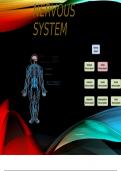
NERVOUS
SYSTEM
, INTRODUCTION
The nervous system is the part of an animal's body that coordinates its behavior and transmits signals
between different body areas. In vertebrates it consists of two main parts, called the central nervous
system (CNS) and the peripheral nervous system (PNS). The CNS contains the brain and spinal cord. T
PNS consists mainly of nerves, which are long fibers that connect the CNS to every other part of the b
but also includes other components such as peripheral ganglia, sympathetic and parasympathetic gan
and the enteric nervous system, a semi-independent part of the nervous system whose function is to
control the gastrointestinal system.
At the cellular level, the nervous system is defined by the presence of a special type of cell, called the
neuron, also known as a "nerve cell". Neurons have special properties that allow them to send signals
rapidly and precisely to other cells. They send these signals in the form of electrochemical waves trav
along thin fibers called axons, which cause chemicals called neurotransmitters to be released at juncti
to other neurons, called synapses. A cell that receives a synaptic signal from a neuron (a postsynaptic
neuron) may be excited, inhibited, or otherwise modulated. The connections between neurons form ne
circuits that can generate very complex patterns of dynamical activity. Along with neurons, the nervou
system also contains other specialized cells called glial cells (or simply glia), which provide structural
metabolic support. Recent evidence suggests that glia may also have a substantial signaling role.
, Nervous systems are found in almost all multicellular animals, but vary greatly in complexity. The only multicellular animals tha
nervous system at all are sponges and microscopic bloblike organisms called placozoans and mesozoans. The nervous system
ctenophores (comb jellies) and cnidarians (e.g., anemones, hydras, corals and jellyfishes) consist of a diffuse nerve net. All oth
of animals, with the exception of echinoderms and a few types of worms, have a nervous system containing a brain, a central c
two cords running in parallel), and nerves radiating from the brain and central cord. The size of the nervous system ranges from
hundred cells in the simplest worms, to on the order of 100 billion cells in humans.
At the most basic level, the function of the nervous system is to control movement of the organism and to affect the environme
through pheromones). This is achieved by sending signals from one cell to others, or from one part of the body to others. The o
from the nervous system derives from signals that travel to muscle cells, causing muscles to be activated, and from signals tha
endocrine cells, causing hormones to be released into the bloodstream or other internal fluids. The input to the nervous system
from sensory cells of widely varying types, which transmute physical modalities such as light and sound into neural activity. In
the nervous system contains complex webs of connections between nerve cells that allow it to generate patterns of activity tha
only partly on sensory input. The nervous system is also capable of storing information over time, by dynamically modifying th
strength of connections between neurons, as well as other mechanisms.
SYSTEM
, INTRODUCTION
The nervous system is the part of an animal's body that coordinates its behavior and transmits signals
between different body areas. In vertebrates it consists of two main parts, called the central nervous
system (CNS) and the peripheral nervous system (PNS). The CNS contains the brain and spinal cord. T
PNS consists mainly of nerves, which are long fibers that connect the CNS to every other part of the b
but also includes other components such as peripheral ganglia, sympathetic and parasympathetic gan
and the enteric nervous system, a semi-independent part of the nervous system whose function is to
control the gastrointestinal system.
At the cellular level, the nervous system is defined by the presence of a special type of cell, called the
neuron, also known as a "nerve cell". Neurons have special properties that allow them to send signals
rapidly and precisely to other cells. They send these signals in the form of electrochemical waves trav
along thin fibers called axons, which cause chemicals called neurotransmitters to be released at juncti
to other neurons, called synapses. A cell that receives a synaptic signal from a neuron (a postsynaptic
neuron) may be excited, inhibited, or otherwise modulated. The connections between neurons form ne
circuits that can generate very complex patterns of dynamical activity. Along with neurons, the nervou
system also contains other specialized cells called glial cells (or simply glia), which provide structural
metabolic support. Recent evidence suggests that glia may also have a substantial signaling role.
, Nervous systems are found in almost all multicellular animals, but vary greatly in complexity. The only multicellular animals tha
nervous system at all are sponges and microscopic bloblike organisms called placozoans and mesozoans. The nervous system
ctenophores (comb jellies) and cnidarians (e.g., anemones, hydras, corals and jellyfishes) consist of a diffuse nerve net. All oth
of animals, with the exception of echinoderms and a few types of worms, have a nervous system containing a brain, a central c
two cords running in parallel), and nerves radiating from the brain and central cord. The size of the nervous system ranges from
hundred cells in the simplest worms, to on the order of 100 billion cells in humans.
At the most basic level, the function of the nervous system is to control movement of the organism and to affect the environme
through pheromones). This is achieved by sending signals from one cell to others, or from one part of the body to others. The o
from the nervous system derives from signals that travel to muscle cells, causing muscles to be activated, and from signals tha
endocrine cells, causing hormones to be released into the bloodstream or other internal fluids. The input to the nervous system
from sensory cells of widely varying types, which transmute physical modalities such as light and sound into neural activity. In
the nervous system contains complex webs of connections between nerve cells that allow it to generate patterns of activity tha
only partly on sensory input. The nervous system is also capable of storing information over time, by dynamically modifying th
strength of connections between neurons, as well as other mechanisms.


