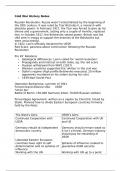
Cold War History Notes
Russian Revolution- Russia wasn’t industrialised by the beginning of
the 20th century. It was ruled by Tsar Nicholas II, a monarch with
absolute power. In February 1917, the Tsar was forced to give up his
throne and a government, lasting only a couple of months, replaced
him. In October 1917, the Bolsheviks seized power. Britain and the
USA sent in troops to support the enemies of the Bolsheviks but
were unsuccessful.
In 1922, Lenin officially declared the USSR
Red Scare- paranoia about communism following the Russian
Revolution
Pre 45’ Relations
Ideological differences. Lenin called for ‘world revolution’
Propaganda and mistrust on both sides, eg. the red scare
Russian withdrawal from WW1 (1917)
Western countries supported the ‘whites’ in the civil war
Stalin’s regime (high profile Bolsheviks executed, 20 million
opponents murdered on his orders during his rule)
1939 Nazi-Soviet Pact
Operation Barbarossa- summer of 1941
Forced Grand Alliance USA ❤ USSR
‘Uncle Joe’
Battle of Berlin: 150,000 Germans killed, 70,000 Russian soldiers
Percentages Agreement: written on a napkin by Churchill, ticked by
Stalin. Planned how to divide Eastern European countries formerly
held by the Nazis
The West’s Aims USSR’s Aims
Continued Cooperation with Continued Cooperation with UK
USSR and US
Germany rebuilt at independent Germany should remain weak so
democratic country it isn’t a threat. German industry
should pay for rebuilding of
USSR
Liberated Eastern European
countries have right to self Spheres of influence created to
determination and no spheres of guarantee USSR security
influence
Working with the UN Working with UN up to a point
, International Economic Would not accept authority of
Cooperation through the creation IMF or world bank
of the World Bank and IMF
Yalta (4-11 February 1945)
Churchill- Look after British interests and limit Soviet Expansion.
Strengthen relationship with USSR
Roosevelt- Working with the USSR to rebuild Europe. Got on with
Stalin but misunderstood his aims. Thought only Europe built on
American capitalist principles could prevent future war
Stalin- Prevent future war which had devastated his country,
recognised need for cooperation although his advisors were
distrustful of the West. Prepared to negotiate
Decided Germany should be divided into 4 zones, Berlin into 4 as
well
Liberated countries of Western and Central Europe allowed to hold
free elections
Official document confirming this, the Declaration of Liberated
Europe, was signed
Source of tension: Poland. Soviets wanted a communist gov, UK and
US wanted the old Polish gov back
Potsdam (July 1945)
Truman- wanted self determination for European countries.
Unfriendly relationship with Stalin. Saw the fact that he held the
atomic bomb as a way of ensuring he got what he wanted
Atlee- concerned by USSR expansionism. Thought key to peaceful
Europe was making sure Germany was safe from attack. Stay close
to USA. Improve life in Britain
Stalin- Less willing to compromise. Convinced USA was a rival for
power and influence in Europe
Decided Germany to be divided as discussed at Yalta
Nazi Party banned and its former leaders tried as war criminals
Poland would lose some territory in the east to USSR
Grand Alliance weakens- Just weeks after the end of the war in
Europe, disagreements about German reparations. Atlee and
Truman wanted countries in Eastern Europe to be independent and
hold free elections but had to accept communist governments held
power in most Eastern European countries
Russian Revolution- Russia wasn’t industrialised by the beginning of
the 20th century. It was ruled by Tsar Nicholas II, a monarch with
absolute power. In February 1917, the Tsar was forced to give up his
throne and a government, lasting only a couple of months, replaced
him. In October 1917, the Bolsheviks seized power. Britain and the
USA sent in troops to support the enemies of the Bolsheviks but
were unsuccessful.
In 1922, Lenin officially declared the USSR
Red Scare- paranoia about communism following the Russian
Revolution
Pre 45’ Relations
Ideological differences. Lenin called for ‘world revolution’
Propaganda and mistrust on both sides, eg. the red scare
Russian withdrawal from WW1 (1917)
Western countries supported the ‘whites’ in the civil war
Stalin’s regime (high profile Bolsheviks executed, 20 million
opponents murdered on his orders during his rule)
1939 Nazi-Soviet Pact
Operation Barbarossa- summer of 1941
Forced Grand Alliance USA ❤ USSR
‘Uncle Joe’
Battle of Berlin: 150,000 Germans killed, 70,000 Russian soldiers
Percentages Agreement: written on a napkin by Churchill, ticked by
Stalin. Planned how to divide Eastern European countries formerly
held by the Nazis
The West’s Aims USSR’s Aims
Continued Cooperation with Continued Cooperation with UK
USSR and US
Germany rebuilt at independent Germany should remain weak so
democratic country it isn’t a threat. German industry
should pay for rebuilding of
USSR
Liberated Eastern European
countries have right to self Spheres of influence created to
determination and no spheres of guarantee USSR security
influence
Working with the UN Working with UN up to a point
, International Economic Would not accept authority of
Cooperation through the creation IMF or world bank
of the World Bank and IMF
Yalta (4-11 February 1945)
Churchill- Look after British interests and limit Soviet Expansion.
Strengthen relationship with USSR
Roosevelt- Working with the USSR to rebuild Europe. Got on with
Stalin but misunderstood his aims. Thought only Europe built on
American capitalist principles could prevent future war
Stalin- Prevent future war which had devastated his country,
recognised need for cooperation although his advisors were
distrustful of the West. Prepared to negotiate
Decided Germany should be divided into 4 zones, Berlin into 4 as
well
Liberated countries of Western and Central Europe allowed to hold
free elections
Official document confirming this, the Declaration of Liberated
Europe, was signed
Source of tension: Poland. Soviets wanted a communist gov, UK and
US wanted the old Polish gov back
Potsdam (July 1945)
Truman- wanted self determination for European countries.
Unfriendly relationship with Stalin. Saw the fact that he held the
atomic bomb as a way of ensuring he got what he wanted
Atlee- concerned by USSR expansionism. Thought key to peaceful
Europe was making sure Germany was safe from attack. Stay close
to USA. Improve life in Britain
Stalin- Less willing to compromise. Convinced USA was a rival for
power and influence in Europe
Decided Germany to be divided as discussed at Yalta
Nazi Party banned and its former leaders tried as war criminals
Poland would lose some territory in the east to USSR
Grand Alliance weakens- Just weeks after the end of the war in
Europe, disagreements about German reparations. Atlee and
Truman wanted countries in Eastern Europe to be independent and
hold free elections but had to accept communist governments held
power in most Eastern European countries