

MEDICAL-SURGICAL NURSING
NERVOUS SYSTEM
Overview of structures and functions:
Central Nervous System
❑ Brain
❑ Spinal Cord
Peripheral Nervous System
❑ Cranial Nerves
❑ Spinal Nerves
Autonomic Nervous System
❑ Sympathetic nervous system
❑ Parasympathetic nervous system
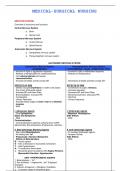
AUTONOMIC NERVOUS SYSTEM
Sympathetic Nervous System Parasympathetic Nervous System
(ADRENERGIC) (CHOLINERGIC, VAGAL, SYMPATHOLYTIC)
- Involved in fight or aggression response. - Involved in fight or withdrawal response.
- Release of Norepinephrine (cathecolamines) - Release of Acetylcholine.
from adrenal glands and causes
vasoconstriction.
- Increase all bodily activity except GIT - Decreases all bodily activities except GIT.
EFFECTS OF SNS EFFECTS OF PNS
- Dilation of pupils(mydriasis) in order to be aware. - Constriction of pupils (meiosis).
- Dry mouth (thickened saliva). - Increase salivation.
- Increase BP and Heart Rate. - Decrease BP and Heart Rate.
- Bronchodilation, Increase RR - Bronchoconstriction, Decrease RR.
- Constipation. - Diarrhea
- Urinary Retention. - Urinary frequency.
- Increase blood supply to brain, heart and skeletal
muscles.
- SNS
I. Adrenergic Agents I. Cholinergic Agents
- Give Epinephrine. - Mestinon, Neostigmine.
Signs and Symptoms: Side Effects
- SNS - PNS
Contraindication:
- Contraindicated to patients suffering from COPD
(Broncholitis, Bronchoectasis, Emphysema, Asthma).
II. Beta-adrenergic Blocking Agents II. Anti-cholinergic Agents
- Also called Beta-blockers. - To counter cholinergic agents.
- All ending with “lol” - Atropine Sulfate
- Propranolol, Atenelol, Metoprolol. Side Effects
Effects of Beta-blockers - SNS
B – roncho spasm
E – licits a decrease in myocardial contraction.
T – reats hypertension.
A – V conduction slows down.
❑ Should be given to patients with Angina Pectoris,
Myocardial Infarction, Hypertension.
ANTI- HYPERTENSIVE AGENTS
1. Beta-blockers – “lol”
2. Ace Inhibitors – Angiotensin, “pril” (Captopril,
Enalapril)
3. Calcium Antagonist – Nifedipine (Calcibloc)
❑ In chronic cases of arrhythmia give
,CENTRAL NERVOUS SYSTEM
❑ Brain and Spinal Cord.
I. CELLS
A. NEURONS
❑ Basic cells for nerve impulse and conduction.
PROPERTIES
Excitability – ability of neuron to be affected by changes in external environment.
Conductivity – ability of neuron to transmit a wave of excitation from one cell to another.
Permanent Cell – once destroyed not capable of regeneration.
TYPES OF CELLS BASED ON REGENERATIVE CAPACITY
1. Labile
❑ Capable of regeneration.
❑ Epidermal cells, GIT cells, GUT cells, cells of lungs.
2. Stable
❑ Capable of regeneration with limited time, survival period.
❑ Kidney cells, Liver cells, Salivary cells, pancreas.
3. Permanent
❑ Not capable of regeneration.
❑ Myocardial cells, Neurons, Bone cells, Osteocytes, Retinal Cells.
B. NEUROGLIA
❑ Support and protection of neurons.
TYPES
1. Astrocytes – maintains blood brain barrier semi-permeable.
✓ Majority of brain tumors (90%) arises from called astrocytoma.
2. Oligodendria
3. Microglia
4. Epindymal
SUBSTANCES THAT CAN PASS THE BLOOD-BRAIN BARRIER
1. Ammonia
❑ Cerebral toxin
❑ Hepatic Encephalopathy (Liver Cirrhosis)
❑ Ascites
❑ Esophageal Varices
Early Signs of Hepatic Encephalopathy
❑ asterixis (flapping hand tremors).
Late Signs of Hepatic Encephalopathy
❑ Headache
❑ Dizziness
❑ Confusion
❑ Fetor hepaticus (ammonia like breath)
❑ Decrease LOC
, PATHOGNOMONIC SIGNS
1. PTB – low-grade afternoon fever.
2. PNEUMONIA – rusty sputum.
3. ASTHMA – wheezing on expiration.
4. EMPHYSEMA – barrel chest.
5. KAWASAKI SYNDROME – strawberry tongue.
6. PERNICIOUS ANEMIA – red beefy tongue.
7. DOWN SYNDROME – protruding tongue.
8. CHOLERA – rice watery stool.
9. MALARIA – stepladder like fever with chills.
10. TYPHOID – rose spots in abdomen.
11. DIPTHERIA – pseudo membrane formation
12. MEASLES – koplik’s spots.
13. SLE – butterfly rashes.
14. LIVER CIRRHOSIS – spider like varices.
15. LEPROSY – lioning face.
16. BULIMIA – chipmunk face.
17. APPENDICITIS – rebound tenderness.
18. DENGUE – petechiae or (+) Herman’s sign.
19. MENINGITIS – Kernig’s sign (leg pain), Brudzinski sign (neck pain).
20. TETANY – HYPOCALCEMIA (+) Trousseau’s sign/carpopedal spasm; Chvostek sign (facial spasm).
21. TETANUS – risus sardonicus.
22. PANCREATITIS – Cullen’s sign (ecchymosis of umbilicus); (+) Grey turners spots.
23. PYLORIC STENOSIS – olive like mass.
24. PDA – machine like murmur.
25. ADDISON’S DISEASE – bronze like skin pigmentation.
26. CUSHING’S SYNDROME – moon face appearance and buffalo hump.
27. HYPERTHYROIDISM/GRAVE’S DISEASE – exopthalmus.
28. INTUSSUSCEPTION – sausage shaped mass
2. Carbon Monoxide and Lead Poisoning
❑ Can lead to Parkinson’s Disease.
❑ Epilepsy
❑ Treat with ANTIDOTE: Calcium EDTA.
3. Type 1 DM (IDDM)
❑ Causes diabetic ketoacidosis.
❑ And increases breakdown of fats.
❑ And free fatty acids
❑ Resulting to cholesterol and (+) to Ketones (CNS depressant).
❑ Resulting to acetone breath odor/fruity odor.
❑ KUSSMAUL’S respiration, a rapid shallow respiration.
❑ Which may lead to diabetic coma.
4. Hepatitis
❑ Signs of jaundice (icteric sclerae).
❑ Caused by bilirubin (yellow pigment)
, DEMYELINATING DISORDERS
1. ALZHEIMER’S DISEASE
❑ Atrophy of brain tissues.
Sign and Symptoms
4 A’s of Alzheimer
a. Amnesia – loss of memory.
b. Agnosia – no recognition of inanimate objects.
c. Apraxia – no recognition of objects function.
d. Aphasia – no speech (nodding).
*Expressive aphasia
❑ “motor speech center”
❑ Broca’s Aphasia
*Receptive aphasia
❑ inability to understand spoken words.
❑ Wernicke’s Aphasia
❑ General Knowing Gnostic Area or General Interpretative Area.
DRUG OF CHOICE: ARICEPT (taken at bedtime) and COGNEX.
2. MULTIPLE SCLEROSIS
❑ Chronic intermittent disorder of CNS characterized by white patches of demyelination in brain and
spinal cord.
❑ Characterized by remission and exacerbation.
❑ Women ages 15-35 are prone
❑ Unknown Cause
❑ Slow growing virus
❑ Autoimmune disorders
❑ Pernicious anemia
❑ Myasthenia gravis
❑ Lupus
❑ Hypothyroidism
❑ GBS
Ig G – only antibody that pass placental circulation causing passive immunity.
- short term protection.
- Immediate action.
Ig A – present in all bodily secretions (tears, saliva, colostrums).
Ig M – acute in inflammation.
Ig E – for allergic reaction.
Ig D – for chronic inflammation.
* Give palliative or supportive care.
Signs and Symptoms
1. Visual disturbances
❑ blurring of vision (primary)
❑ diplopia (double vision)
❑ scotomas (blind spots)
NERVOUS SYSTEM
Overview of structures and functions:
Central Nervous System
❑ Brain
❑ Spinal Cord
Peripheral Nervous System
❑ Cranial Nerves
❑ Spinal Nerves
Autonomic Nervous System
❑ Sympathetic nervous system
❑ Parasympathetic nervous system
AUTONOMIC NERVOUS SYSTEM
Sympathetic Nervous System Parasympathetic Nervous System
(ADRENERGIC) (CHOLINERGIC, VAGAL, SYMPATHOLYTIC)
- Involved in fight or aggression response. - Involved in fight or withdrawal response.
- Release of Norepinephrine (cathecolamines) - Release of Acetylcholine.
from adrenal glands and causes
vasoconstriction.
- Increase all bodily activity except GIT - Decreases all bodily activities except GIT.
EFFECTS OF SNS EFFECTS OF PNS
- Dilation of pupils(mydriasis) in order to be aware. - Constriction of pupils (meiosis).
- Dry mouth (thickened saliva). - Increase salivation.
- Increase BP and Heart Rate. - Decrease BP and Heart Rate.
- Bronchodilation, Increase RR - Bronchoconstriction, Decrease RR.
- Constipation. - Diarrhea
- Urinary Retention. - Urinary frequency.
- Increase blood supply to brain, heart and skeletal
muscles.
- SNS
I. Adrenergic Agents I. Cholinergic Agents
- Give Epinephrine. - Mestinon, Neostigmine.
Signs and Symptoms: Side Effects
- SNS - PNS
Contraindication:
- Contraindicated to patients suffering from COPD
(Broncholitis, Bronchoectasis, Emphysema, Asthma).
II. Beta-adrenergic Blocking Agents II. Anti-cholinergic Agents
- Also called Beta-blockers. - To counter cholinergic agents.
- All ending with “lol” - Atropine Sulfate
- Propranolol, Atenelol, Metoprolol. Side Effects
Effects of Beta-blockers - SNS
B – roncho spasm
E – licits a decrease in myocardial contraction.
T – reats hypertension.
A – V conduction slows down.
❑ Should be given to patients with Angina Pectoris,
Myocardial Infarction, Hypertension.
ANTI- HYPERTENSIVE AGENTS
1. Beta-blockers – “lol”
2. Ace Inhibitors – Angiotensin, “pril” (Captopril,
Enalapril)
3. Calcium Antagonist – Nifedipine (Calcibloc)
❑ In chronic cases of arrhythmia give
,CENTRAL NERVOUS SYSTEM
❑ Brain and Spinal Cord.
I. CELLS
A. NEURONS
❑ Basic cells for nerve impulse and conduction.
PROPERTIES
Excitability – ability of neuron to be affected by changes in external environment.
Conductivity – ability of neuron to transmit a wave of excitation from one cell to another.
Permanent Cell – once destroyed not capable of regeneration.
TYPES OF CELLS BASED ON REGENERATIVE CAPACITY
1. Labile
❑ Capable of regeneration.
❑ Epidermal cells, GIT cells, GUT cells, cells of lungs.
2. Stable
❑ Capable of regeneration with limited time, survival period.
❑ Kidney cells, Liver cells, Salivary cells, pancreas.
3. Permanent
❑ Not capable of regeneration.
❑ Myocardial cells, Neurons, Bone cells, Osteocytes, Retinal Cells.
B. NEUROGLIA
❑ Support and protection of neurons.
TYPES
1. Astrocytes – maintains blood brain barrier semi-permeable.
✓ Majority of brain tumors (90%) arises from called astrocytoma.
2. Oligodendria
3. Microglia
4. Epindymal
SUBSTANCES THAT CAN PASS THE BLOOD-BRAIN BARRIER
1. Ammonia
❑ Cerebral toxin
❑ Hepatic Encephalopathy (Liver Cirrhosis)
❑ Ascites
❑ Esophageal Varices
Early Signs of Hepatic Encephalopathy
❑ asterixis (flapping hand tremors).
Late Signs of Hepatic Encephalopathy
❑ Headache
❑ Dizziness
❑ Confusion
❑ Fetor hepaticus (ammonia like breath)
❑ Decrease LOC
, PATHOGNOMONIC SIGNS
1. PTB – low-grade afternoon fever.
2. PNEUMONIA – rusty sputum.
3. ASTHMA – wheezing on expiration.
4. EMPHYSEMA – barrel chest.
5. KAWASAKI SYNDROME – strawberry tongue.
6. PERNICIOUS ANEMIA – red beefy tongue.
7. DOWN SYNDROME – protruding tongue.
8. CHOLERA – rice watery stool.
9. MALARIA – stepladder like fever with chills.
10. TYPHOID – rose spots in abdomen.
11. DIPTHERIA – pseudo membrane formation
12. MEASLES – koplik’s spots.
13. SLE – butterfly rashes.
14. LIVER CIRRHOSIS – spider like varices.
15. LEPROSY – lioning face.
16. BULIMIA – chipmunk face.
17. APPENDICITIS – rebound tenderness.
18. DENGUE – petechiae or (+) Herman’s sign.
19. MENINGITIS – Kernig’s sign (leg pain), Brudzinski sign (neck pain).
20. TETANY – HYPOCALCEMIA (+) Trousseau’s sign/carpopedal spasm; Chvostek sign (facial spasm).
21. TETANUS – risus sardonicus.
22. PANCREATITIS – Cullen’s sign (ecchymosis of umbilicus); (+) Grey turners spots.
23. PYLORIC STENOSIS – olive like mass.
24. PDA – machine like murmur.
25. ADDISON’S DISEASE – bronze like skin pigmentation.
26. CUSHING’S SYNDROME – moon face appearance and buffalo hump.
27. HYPERTHYROIDISM/GRAVE’S DISEASE – exopthalmus.
28. INTUSSUSCEPTION – sausage shaped mass
2. Carbon Monoxide and Lead Poisoning
❑ Can lead to Parkinson’s Disease.
❑ Epilepsy
❑ Treat with ANTIDOTE: Calcium EDTA.
3. Type 1 DM (IDDM)
❑ Causes diabetic ketoacidosis.
❑ And increases breakdown of fats.
❑ And free fatty acids
❑ Resulting to cholesterol and (+) to Ketones (CNS depressant).
❑ Resulting to acetone breath odor/fruity odor.
❑ KUSSMAUL’S respiration, a rapid shallow respiration.
❑ Which may lead to diabetic coma.
4. Hepatitis
❑ Signs of jaundice (icteric sclerae).
❑ Caused by bilirubin (yellow pigment)
, DEMYELINATING DISORDERS
1. ALZHEIMER’S DISEASE
❑ Atrophy of brain tissues.
Sign and Symptoms
4 A’s of Alzheimer
a. Amnesia – loss of memory.
b. Agnosia – no recognition of inanimate objects.
c. Apraxia – no recognition of objects function.
d. Aphasia – no speech (nodding).
*Expressive aphasia
❑ “motor speech center”
❑ Broca’s Aphasia
*Receptive aphasia
❑ inability to understand spoken words.
❑ Wernicke’s Aphasia
❑ General Knowing Gnostic Area or General Interpretative Area.
DRUG OF CHOICE: ARICEPT (taken at bedtime) and COGNEX.
2. MULTIPLE SCLEROSIS
❑ Chronic intermittent disorder of CNS characterized by white patches of demyelination in brain and
spinal cord.
❑ Characterized by remission and exacerbation.
❑ Women ages 15-35 are prone
❑ Unknown Cause
❑ Slow growing virus
❑ Autoimmune disorders
❑ Pernicious anemia
❑ Myasthenia gravis
❑ Lupus
❑ Hypothyroidism
❑ GBS
Ig G – only antibody that pass placental circulation causing passive immunity.
- short term protection.
- Immediate action.
Ig A – present in all bodily secretions (tears, saliva, colostrums).
Ig M – acute in inflammation.
Ig E – for allergic reaction.
Ig D – for chronic inflammation.
* Give palliative or supportive care.
Signs and Symptoms
1. Visual disturbances
❑ blurring of vision (primary)
❑ diplopia (double vision)
❑ scotomas (blind spots)


