Virusziekten samenvatting HC.2
Introduction to virology
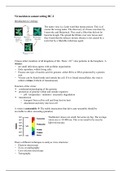
The name virus is a Latin word that means poison. This is of
course the wrong name. The discovery of viruses was done by
Ivanovsky and Beijerinck. They used a filter that did not let
bacteria trough. The spread the filtrate over new leaves and
they found that the tobacco mosaic disease is not caused by a
toxin but by a filterable infectious agent.
Viruses infect members of all kingdoms of life. There >1031 virus particles in the biosphere. A
viruses:
are small infectious agents with acellular organization
Only reproduce within living cells
Possess one type of nucleic acid for genome -either RNA or DNA-protected by a protein
coat
Viruses can be found inside and outside the cell. If it is found extracellular, the virus is
called a virion (Vehicle of transmission).
Function of the virion:
condensation/packaging of the genome
protection of genome within and outside organism
pH / temperature / radiation / enzymatic degradation
transmission
transport from cell-to-cell and from host-to-host
attachment and entry into host cell
A virion is metastable The stable interactions that drive auto-assembly should be
reversible to allow uncoating (paradox)
Traditional viruses are small, but some are big. The average
virion size is 10-400 nm. This is too small to be seen by
light microscopy.
There a different techniques to analyse virus structures:
Electron microscopy
X-ray crystallography
Cryo-electron microscopy
Tomography
, For EM you need a negative stain that generates a
negative contrast. The resolution is around 50-75A and
you can see the general morphology of the virus. We can
learn from EM pictures that there is a variety in sizes and
shapes but that there are also similarities in morphology
of viral particles.
Virion structures are often spherical of filamentous
Some viruses are naked and others are enveloped
As said above a virus can be enveloped (picture is a corona virion). There is a terminology for
virus components:
Capsid (coat) protein shell that encloses the genome (naked viruses)
Envelope host-derived lipid bilayer modified by viral (glyco)proteins
Spikes Surface projections
Subunit single folded polypeptide chain
Structural unit unit from which (nucleo)capsid or envelope is build; asymmetric unit
may comprise one protein subunit or protein complex protomer
Most viruses appear to be rod-shaped (filamentous) or spherical. You need at least 60 proteins
to make a protein coat. These can be the same (copies) or different proteins. There are two
main architectural solutions to build a coat:
1. Helical
This structure is a repetitive structure with equivalent
interactions. It is a open structure what means that
changes in genome length can be accommodates by
changing the length of the (nucleo)capsid. TMV
(tobacco mosaic virus) is a naked virus. All animal
viruses that have the helical symmetry are enveloped.
2. Icosahedral
Most efficient of all possible arrangement to build a
symmetrical closed shell with a maximal internal volume
from asymmetrical subunits. These subunits (asymmetric units)
can be 1 protein or more (60 proteins is minimum)
Geometric figure with 20 equilateral triangular faces (gelijk
zijdige driehoeken) and 12 vortices (corner points)
Characterized by specific symmetry: contains 2-fold, 3-fold
and 5-fold axes of rotational symmetry
Introduction to virology
The name virus is a Latin word that means poison. This is of
course the wrong name. The discovery of viruses was done by
Ivanovsky and Beijerinck. They used a filter that did not let
bacteria trough. The spread the filtrate over new leaves and
they found that the tobacco mosaic disease is not caused by a
toxin but by a filterable infectious agent.
Viruses infect members of all kingdoms of life. There >1031 virus particles in the biosphere. A
viruses:
are small infectious agents with acellular organization
Only reproduce within living cells
Possess one type of nucleic acid for genome -either RNA or DNA-protected by a protein
coat
Viruses can be found inside and outside the cell. If it is found extracellular, the virus is
called a virion (Vehicle of transmission).
Function of the virion:
condensation/packaging of the genome
protection of genome within and outside organism
pH / temperature / radiation / enzymatic degradation
transmission
transport from cell-to-cell and from host-to-host
attachment and entry into host cell
A virion is metastable The stable interactions that drive auto-assembly should be
reversible to allow uncoating (paradox)
Traditional viruses are small, but some are big. The average
virion size is 10-400 nm. This is too small to be seen by
light microscopy.
There a different techniques to analyse virus structures:
Electron microscopy
X-ray crystallography
Cryo-electron microscopy
Tomography
, For EM you need a negative stain that generates a
negative contrast. The resolution is around 50-75A and
you can see the general morphology of the virus. We can
learn from EM pictures that there is a variety in sizes and
shapes but that there are also similarities in morphology
of viral particles.
Virion structures are often spherical of filamentous
Some viruses are naked and others are enveloped
As said above a virus can be enveloped (picture is a corona virion). There is a terminology for
virus components:
Capsid (coat) protein shell that encloses the genome (naked viruses)
Envelope host-derived lipid bilayer modified by viral (glyco)proteins
Spikes Surface projections
Subunit single folded polypeptide chain
Structural unit unit from which (nucleo)capsid or envelope is build; asymmetric unit
may comprise one protein subunit or protein complex protomer
Most viruses appear to be rod-shaped (filamentous) or spherical. You need at least 60 proteins
to make a protein coat. These can be the same (copies) or different proteins. There are two
main architectural solutions to build a coat:
1. Helical
This structure is a repetitive structure with equivalent
interactions. It is a open structure what means that
changes in genome length can be accommodates by
changing the length of the (nucleo)capsid. TMV
(tobacco mosaic virus) is a naked virus. All animal
viruses that have the helical symmetry are enveloped.
2. Icosahedral
Most efficient of all possible arrangement to build a
symmetrical closed shell with a maximal internal volume
from asymmetrical subunits. These subunits (asymmetric units)
can be 1 protein or more (60 proteins is minimum)
Geometric figure with 20 equilateral triangular faces (gelijk
zijdige driehoeken) and 12 vortices (corner points)
Characterized by specific symmetry: contains 2-fold, 3-fold
and 5-fold axes of rotational symmetry