

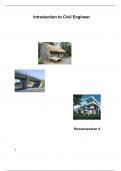
Introduction to Civil Engineer
Ramachandran V
1
, Kerala Technological University which has just come into being in 2014 has
formulated a new syllabus for the first and second semester students. One of the compulsory
subjects for them is Introduction to Civil Engineering. I was teaching the subject for the last
couple of years. Though there are a large number of text books on the subject, the students
have to refer to more than one book. It was felt that there was a need to make available all the
subject matter in one place and this prompted me to compile the book as per the syllabus of K
Tech University. Some topics like cement concrete, RCC etc which have not been included in
the K Tech University syllabus have been incorporated in this book for sake of continuity.
Attempt has been made to present the topic in a very simple and lucid language with a
large number of illustrations. In order to make clear the steps of lay out of buildings, brick
masonry (English bond and Flemish bond) few video clips have been included. At the end of
each chapter, the main points to be revised and remembered are given as “Points to Ponder”.
Also a good number of questions have been given at the end of each chapter for practice.
Hope that the students will be able to take full advantage of the book.
Comments/suggestions are most welcome!
Ramachandran V
2
, (As per Kerala Technological University - 2015)
1. General Introduction to Civil Engineering
2. History of Civil Engineering
3. Relevance of Civil Engineering in the Overall development of the country
4. Type and classification of structures : Buildings, Towers, Chimneys, Bridges, Dams,
Retaining Walls, Water tanks, Silos, Roads, Railways, Runways, Pipe lines
5. Definition and type of buildings as per National Building Code of India
6. Selection of site
7. Components of buildings and their functions
8. Setting out of a building
9. Stones
10. Bricks
11. Tiles
12. Aggregates
13. Cement mortar
14. Stone masonry
15. Brick masonry
16. Timber
17. Steel
18. Floors
19. Roofs
3
, SN Chapter Page No
Introduction
1. General Introduction to Civil Engineering 7
2. History of Civil Engineering 9
3. Relevance of Civil Engineering in the development of the country 11
4. Types and classification of structures 17
5. Definition and Type of Buildings as per National Building Code 28
6. Components of a Residential Building 33
Building Materials
7. Stones 48
8. Bricks 53
9. Tiles 64
10. Cement 70
11. Aggregates 77
12. Cement Mortar 86
13. Cement Concrete 90
14. Iron & Steel 101
15. Reinforced Cement Concrete (RCC) 107
16. Timber 111
Construction
17 Selection of site 122
18 Setting out of a building 125
19. Stone Masonry 127
20. Brick Masonry 134
4
Ramachandran V
1
, Kerala Technological University which has just come into being in 2014 has
formulated a new syllabus for the first and second semester students. One of the compulsory
subjects for them is Introduction to Civil Engineering. I was teaching the subject for the last
couple of years. Though there are a large number of text books on the subject, the students
have to refer to more than one book. It was felt that there was a need to make available all the
subject matter in one place and this prompted me to compile the book as per the syllabus of K
Tech University. Some topics like cement concrete, RCC etc which have not been included in
the K Tech University syllabus have been incorporated in this book for sake of continuity.
Attempt has been made to present the topic in a very simple and lucid language with a
large number of illustrations. In order to make clear the steps of lay out of buildings, brick
masonry (English bond and Flemish bond) few video clips have been included. At the end of
each chapter, the main points to be revised and remembered are given as “Points to Ponder”.
Also a good number of questions have been given at the end of each chapter for practice.
Hope that the students will be able to take full advantage of the book.
Comments/suggestions are most welcome!
Ramachandran V
2
, (As per Kerala Technological University - 2015)
1. General Introduction to Civil Engineering
2. History of Civil Engineering
3. Relevance of Civil Engineering in the Overall development of the country
4. Type and classification of structures : Buildings, Towers, Chimneys, Bridges, Dams,
Retaining Walls, Water tanks, Silos, Roads, Railways, Runways, Pipe lines
5. Definition and type of buildings as per National Building Code of India
6. Selection of site
7. Components of buildings and their functions
8. Setting out of a building
9. Stones
10. Bricks
11. Tiles
12. Aggregates
13. Cement mortar
14. Stone masonry
15. Brick masonry
16. Timber
17. Steel
18. Floors
19. Roofs
3
, SN Chapter Page No
Introduction
1. General Introduction to Civil Engineering 7
2. History of Civil Engineering 9
3. Relevance of Civil Engineering in the development of the country 11
4. Types and classification of structures 17
5. Definition and Type of Buildings as per National Building Code 28
6. Components of a Residential Building 33
Building Materials
7. Stones 48
8. Bricks 53
9. Tiles 64
10. Cement 70
11. Aggregates 77
12. Cement Mortar 86
13. Cement Concrete 90
14. Iron & Steel 101
15. Reinforced Cement Concrete (RCC) 107
16. Timber 111
Construction
17 Selection of site 122
18 Setting out of a building 125
19. Stone Masonry 127
20. Brick Masonry 134
4


