

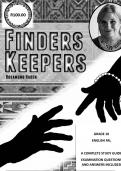
GRADE 10
ENGLISH FAL
A COMPLETE STUDY GUIDE
EXAMINATION QUESTIONS
AND ANSWERS INCLUDED
, Themes
THEME 1: Different kinds of love
We all have different kinds of love in our lives. These kinds of
love have the power to help us get over terrible things that
have happened to us in our lives. They can be healing and
supportive, as we understand that we do not have to be stuck
in the past. We can form new relationships, and experience new
love at any stage of our lives.
Parental or familial love is the connection between relatives
or people who have grown up together. We don’t choose our
family. This love can be between people who are biologically
related (by blood), or people who are related by adoption.
EXPLANATION OF Friendly (platonic) or affectionate love is between people who
THEME: have chosen to be friends – usually people we have known a
long time, or people in a similar school or community situation
(context).
Romantic or sexual love is between two people who feel
physically (body) and emotionally (feelings) attracted to one
another.
Romantic love is the love that most people fantasise about or
imagine. We often want our love to be the way it is in books or
movies. But this is not realistic. Real love accepts us the way we
are. We should be able to trust people, and we hope that they
love us in the same way as we love them.
1 What kinds of love do you already have in your life?
DISCUSSION 2 How do you show your love for someone? Give examples.
QUESTION/S: 3 What kinds of love would you like to have in your life? Why
or why not?
THEME 2: Prejudice versus tolerance
We all belong to social groups. This can be because of our age,
EXPLANATION OF race, gender, sexual orientation, religion and so on. We are
THEME: born into some groups (such as race). We can choose to belong
to some groups (such as religion).
,THEME 2: Prejudice versus tolerance (continued)
Sometimes these groups are in conflict (fight) with one another.
Often a group has an unfair idea of what another group is like,
without really knowing for sure. For example, some people are
racist, sexist, homophobic (fear and hatred of gay people) and
so on. When groups have unproven ideas about one another,
we call this prejudice. Prejudice is making your mind up without
really investigating a group/person properly or having real
proof.
Prejudice is a problem because it makes individual people
untrusting (suspicious) of one another. When it comes to
making social rules and laws, governments can be prejudiced
against a whole group. For example, Apartheid was extreme
prejudice against people of colour. It was an unjust or unfair
system because it asked people to make judgements about
their fellow humans without knowing what they were really
like. White people thought they were superior to black people.
Apartheid caused great suffering for black people.
1 Which groups were you born into? Why?
2 Which groups do you choose to belong to? Why?
3 Which groups is YOUR group prejudiced against? Why?
DISCUSSION
4 Do you have friends from other social groups? Why or why
QUESTION/S:
not?
5 Do you think prejudice helps or harms societies? Explain
your ideas.
THEME 3: Individuals and communities
We all have things that we want to do because they’re fun – see
our friends, eat and drink delicious treats, listen to music and
so on.
But we also all have duties and responsibilities to the rest of the
EXPLANATION OF people around us (our communities) – things like doing chores
THEME: at home, studying consistently, having a paying job, or looking
after siblings and relatives.
Sometimes we struggle to balance these two parts of us. We
want to be true to ourselves, but we also have to be part of our
families and societies.
1 What things do you like to do? Why?
DISCUSSION 2 What duties, chores or responsibilities do you have?
QUESTION/S: 3 How do these responsibilities make you feel? Explain your
answer.
, PLOT SUMMARY
Lufuno Mukwevho is a girl from Johannesburg who has just moved to Cape Town. Her parents have found work
in a bread factory. Lufuno misses her best friend, Dudu, and thinks about her all the time. At the beginning, we
think that Dudu is still in Johannesburg, but then we find out that she is actually dead.
Lufuno has ordinary teenage problems, such as looking after her annoying little sister, Tshilidzi. Her biggest
problem in the story is that she has to go to a new school: Victory High School. Lufuno and her family are
Vhavenda. Their skin is darker than most South Africans’. In her new high school everyone speaks isiXhosa, and
she worries about being new and different from all the other students.
On Lufuno’s first day a girl named Sindi bullies her. Sindi is jealous that Lufuno is getting attention from a boy,
Mandla, the good-looking star of the soccer team and also a chief’s son. Some other students also tease Lufuno
about her dark skin and her Vhavenda heritage. Lufuno feels angry and powerless. She concentrates on making
up fantasy romantic film stories to tell Tshilidzi, instead of dealing with the difficult things in her daily life. But
she soon finds new friends, Chantelle and Noki. These friends show Lufuno how to stand up to a group of boys
who harass her, and shout back at them.
Lufuno and Mandla like each other. One day Sindi pushes her down, and Lufuno’s bead bracelet falls to the
floor. Mandla helps Lufuno up and rescues the bracelet. The bracelet is very special to Lufuno because her
grandmother made it. Mandla keeps it so she has to see him again. Mandla tells Lufuno “Finders, keepers –
losers, weepers”. This saying means good luck for the person who finds something, and too bad for the person
who has lost it.
Mandla and Lufuno want to date, but both their families do not want them to be together. Lufuno’s parents
don’t want her to date anyone. Mandla’s family objects because his father, the chief, is very strict. He wants
Mandla to prepare to serve as chief. He and Mandla do not agree on many issues. Mandla is also especially
angry with his father and cannot talk to him. Mandla thinks that it is his father’s fault that his sister, Nandi, died
of asthma.
Lufuno and Mandla disobey their parents and meet each other secretly. They have both seen someone close
to them die: for Lufuno, it is her friend Dudu. For Mandla, it is his sister Nandi. Their love helps them to accept
that the two loved ones are gone.
The climax of the story comes when there is a strike at the bread factory where Lufuno’s parents work. The
union wants to punish everyone who does not join the strike, but the workers need money to live. Lufuno’s
family fears being attacked because they are Vhavenda, and because they do not join the strike. Mandla’s
father and Lufuno’s family are on opposite sides of the strike. The strikers attack Baba Mukwevho because he
goes in to work, and his leg is injured.
When her parents go in to work, Tshilidzi goes missing. No one realises that she has gone to hide in her own
house. Then someone sets the Lufuno family’s house on fire, and Tshilidzi is stuck inside. Mandla comes to
check that Lufuno is alright. She is not there, but he goes into the house and rescues little Tshilidzi, with his
father’s help. The chief admits that he was wrong to ignore the warnings before, that Nandi was in serious
trouble with her asthma. He apologises to Mandla, and Mandla forgives his father. Lufuno’s family is very
grateful that Tshilidzi is safe, and the two families realise that they both want the best for their children, and
they both want to keep their culture alive. They accept that Lufuno and Mandla are together. Mandla returns
Lufuno’s bead bracelet. Lufuno finally understands that she does not have to make up fantasy love stories
anymore, because she has her own real love, with her family, her friends, and with Mandla.
ENGLISH FAL
A COMPLETE STUDY GUIDE
EXAMINATION QUESTIONS
AND ANSWERS INCLUDED
, Themes
THEME 1: Different kinds of love
We all have different kinds of love in our lives. These kinds of
love have the power to help us get over terrible things that
have happened to us in our lives. They can be healing and
supportive, as we understand that we do not have to be stuck
in the past. We can form new relationships, and experience new
love at any stage of our lives.
Parental or familial love is the connection between relatives
or people who have grown up together. We don’t choose our
family. This love can be between people who are biologically
related (by blood), or people who are related by adoption.
EXPLANATION OF Friendly (platonic) or affectionate love is between people who
THEME: have chosen to be friends – usually people we have known a
long time, or people in a similar school or community situation
(context).
Romantic or sexual love is between two people who feel
physically (body) and emotionally (feelings) attracted to one
another.
Romantic love is the love that most people fantasise about or
imagine. We often want our love to be the way it is in books or
movies. But this is not realistic. Real love accepts us the way we
are. We should be able to trust people, and we hope that they
love us in the same way as we love them.
1 What kinds of love do you already have in your life?
DISCUSSION 2 How do you show your love for someone? Give examples.
QUESTION/S: 3 What kinds of love would you like to have in your life? Why
or why not?
THEME 2: Prejudice versus tolerance
We all belong to social groups. This can be because of our age,
EXPLANATION OF race, gender, sexual orientation, religion and so on. We are
THEME: born into some groups (such as race). We can choose to belong
to some groups (such as religion).
,THEME 2: Prejudice versus tolerance (continued)
Sometimes these groups are in conflict (fight) with one another.
Often a group has an unfair idea of what another group is like,
without really knowing for sure. For example, some people are
racist, sexist, homophobic (fear and hatred of gay people) and
so on. When groups have unproven ideas about one another,
we call this prejudice. Prejudice is making your mind up without
really investigating a group/person properly or having real
proof.
Prejudice is a problem because it makes individual people
untrusting (suspicious) of one another. When it comes to
making social rules and laws, governments can be prejudiced
against a whole group. For example, Apartheid was extreme
prejudice against people of colour. It was an unjust or unfair
system because it asked people to make judgements about
their fellow humans without knowing what they were really
like. White people thought they were superior to black people.
Apartheid caused great suffering for black people.
1 Which groups were you born into? Why?
2 Which groups do you choose to belong to? Why?
3 Which groups is YOUR group prejudiced against? Why?
DISCUSSION
4 Do you have friends from other social groups? Why or why
QUESTION/S:
not?
5 Do you think prejudice helps or harms societies? Explain
your ideas.
THEME 3: Individuals and communities
We all have things that we want to do because they’re fun – see
our friends, eat and drink delicious treats, listen to music and
so on.
But we also all have duties and responsibilities to the rest of the
EXPLANATION OF people around us (our communities) – things like doing chores
THEME: at home, studying consistently, having a paying job, or looking
after siblings and relatives.
Sometimes we struggle to balance these two parts of us. We
want to be true to ourselves, but we also have to be part of our
families and societies.
1 What things do you like to do? Why?
DISCUSSION 2 What duties, chores or responsibilities do you have?
QUESTION/S: 3 How do these responsibilities make you feel? Explain your
answer.
, PLOT SUMMARY
Lufuno Mukwevho is a girl from Johannesburg who has just moved to Cape Town. Her parents have found work
in a bread factory. Lufuno misses her best friend, Dudu, and thinks about her all the time. At the beginning, we
think that Dudu is still in Johannesburg, but then we find out that she is actually dead.
Lufuno has ordinary teenage problems, such as looking after her annoying little sister, Tshilidzi. Her biggest
problem in the story is that she has to go to a new school: Victory High School. Lufuno and her family are
Vhavenda. Their skin is darker than most South Africans’. In her new high school everyone speaks isiXhosa, and
she worries about being new and different from all the other students.
On Lufuno’s first day a girl named Sindi bullies her. Sindi is jealous that Lufuno is getting attention from a boy,
Mandla, the good-looking star of the soccer team and also a chief’s son. Some other students also tease Lufuno
about her dark skin and her Vhavenda heritage. Lufuno feels angry and powerless. She concentrates on making
up fantasy romantic film stories to tell Tshilidzi, instead of dealing with the difficult things in her daily life. But
she soon finds new friends, Chantelle and Noki. These friends show Lufuno how to stand up to a group of boys
who harass her, and shout back at them.
Lufuno and Mandla like each other. One day Sindi pushes her down, and Lufuno’s bead bracelet falls to the
floor. Mandla helps Lufuno up and rescues the bracelet. The bracelet is very special to Lufuno because her
grandmother made it. Mandla keeps it so she has to see him again. Mandla tells Lufuno “Finders, keepers –
losers, weepers”. This saying means good luck for the person who finds something, and too bad for the person
who has lost it.
Mandla and Lufuno want to date, but both their families do not want them to be together. Lufuno’s parents
don’t want her to date anyone. Mandla’s family objects because his father, the chief, is very strict. He wants
Mandla to prepare to serve as chief. He and Mandla do not agree on many issues. Mandla is also especially
angry with his father and cannot talk to him. Mandla thinks that it is his father’s fault that his sister, Nandi, died
of asthma.
Lufuno and Mandla disobey their parents and meet each other secretly. They have both seen someone close
to them die: for Lufuno, it is her friend Dudu. For Mandla, it is his sister Nandi. Their love helps them to accept
that the two loved ones are gone.
The climax of the story comes when there is a strike at the bread factory where Lufuno’s parents work. The
union wants to punish everyone who does not join the strike, but the workers need money to live. Lufuno’s
family fears being attacked because they are Vhavenda, and because they do not join the strike. Mandla’s
father and Lufuno’s family are on opposite sides of the strike. The strikers attack Baba Mukwevho because he
goes in to work, and his leg is injured.
When her parents go in to work, Tshilidzi goes missing. No one realises that she has gone to hide in her own
house. Then someone sets the Lufuno family’s house on fire, and Tshilidzi is stuck inside. Mandla comes to
check that Lufuno is alright. She is not there, but he goes into the house and rescues little Tshilidzi, with his
father’s help. The chief admits that he was wrong to ignore the warnings before, that Nandi was in serious
trouble with her asthma. He apologises to Mandla, and Mandla forgives his father. Lufuno’s family is very
grateful that Tshilidzi is safe, and the two families realise that they both want the best for their children, and
they both want to keep their culture alive. They accept that Lufuno and Mandla are together. Mandla returns
Lufuno’s bead bracelet. Lufuno finally understands that she does not have to make up fantasy love stories
anymore, because she has her own real love, with her family, her friends, and with Mandla.


