100% satisfaction guarantee Immediately available after payment Both online and in PDF No strings attached 4.6 TrustPilot
logo-home
Exam (elaborations)

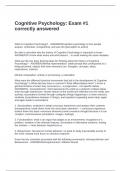
Cognitive Psychology: Exam #1 correctly answered

Rating
-
Sold
-
Pages
9
Grade
A+
Uploaded on
03-03-2025
Written in
2024/2025

What is Cognitive Psychology? - ANSWERSCognitive psychology is how people acquire, remember, comprehend, and use info (perception to action) Be able to articulate why the history of Cognitive Psychology is important to know - ANSWERSTo know what works and what doesn't... to avoid making the same mistakes What are the two (key) framing ideas for thinking about the history of Cognitive Psychology? - ANSWERSMental representation: state/concept that corresponds to a thing perceived, objects that have semantics (ex: thoughts, concepts, ideas, impressions, notions) Mental computation: activity or processing, a calculation What were the different historical movements that led to the development of Cognitive Psychology? o What did they have in common? What differentiates them? o Know a general timeline of when they occurred (i.e., a progression - not specific dates) - ANSWERS1. Associationism: mind represents the world as a network of ideas (ideas arise through experience); senses (traces of the world) and reflection (on the minds own activity); associations formed through contiguity (things happening in a close session), similarity (resemblance between 2 things), and repetition (repeating same ideas again and again leads to association) 2. Structuralism: analyzed in detail conscious experience and analyze their contents (introspection); break down mind into most basic elements---> conscious experience broken down into basic conscious elements;cannot research thought because it is too complex; consciousness (sensations, images, feelings) 3. Functionalism: mind is an organ that adapts to its environment; recognition of a problem, isolation of the relevant features, formulation of alternative solutions, testing the solution---->how behavior helps/hurts us 4. Behaviorism: focused on human behavior; no point to study inaccessible events of the mind; instead must focus on stimulus-response Know the key scientists associated with the following movements: Introspectionism and Behaviorism - ANSWERSIntrospectionism: Wilhelm Wundt Behaviorism: John B. Watson and B.F. Skinner Be able to articulate the advantages and disadvantages of different approaches. o E.g., what did behaviorists criticize about introspectionism? -- Why was behaviorism successful (albeit for a limited time)? What were the critiques of behaviorism? - ANSWERSIntrospectionism advantages: many people can use, people can repeat procedure, no fancy equipment, access to thinking Introspectionism disadvantages: results do not replicate (reliability), subjective (interpretation), different people may interpret the same experience differently Behaviorism worked well for simple learning scenarios but could not explain thinking (what was happening in the head) using S-R theory (ex: language has rules of abstract thought) Know concepts like: Classical and Operant Conditioning o Be able to differentiate between these different types of learning. - ANSWERSClassical conditioning: US-->UR to NS---> US becomes CS---->CR (ex: presenting meat (US)=salivation(UR) ring bell (NS) then present meat (US)=salivation(UR) then ring bell (CS)=salivation(CR)) Operant conditioning: reinforcement or punishment (feedback); change probability of response (ex: press bar=food --> press bar=reinforced) Know the differences between Cognitive Psychology and Behaviorist approaches to understanding human behavior. - ANSWERSCognitive psychology studies the components of thinking, from perception to action (figure out what steps in the head produce behavior) Behaviorist: focus on behaviors, explanation in terms of which stimuli which responses- associations S--->R What is the role of theory? - ANSWERSRole: organize current results-provide coherence, explanation; predict new results-guide research Know the differences between observations and experiments. - ANSWERSObservation: don't interfere, just watch Experiment: manipulate variable • How should we design experiments to test an issue? o You may be asked to determine the best approach to test a hypothesis - requires logical reasoning about alternatives. Must know the difference between independent and dependent variables. - ANSWERSExperiments should have random assignment of subject to conditions Independent variable: the thing being manipulated Dependent variable: the thing being measured Allows casual interference Approaches to Cognitive Psychology o Know the similarities and differences between Information Processing (IP) and Connectionism (i.e., PDP models) (be able to characterize and identify each one) - ANSWERSInformation processing: based on analogy with computer; assumes a series of processing stages; symbols Input--->Process 1--->Process 2--->Output ex: traffic light P1: green (sensory memory) P2: I see a green light (short term) O: green means go (long term) Parallel Distributed Processing: "Brain-like" approach; simple "units" that are off or on; units work in parallel and are connected with different strengths; activity in one affects activity of other; excite or inhibit Know the methods of Cognitive Psychology (from lecture and the book) o What are they? Know advantages and disadvantages of each. o You may be asked to select one most appropriate for testing a given issue - ANSWERSIntrospection: give ideas about what people do but people can't describe many aspects of cognition (unconscious processes); even when people can describe what they are thinking, they may be wrong Behavioral: what do they do? Brain: invasive techniques: single cell recording, electrode implant, lesion studies, chemical alterations noninvasive: patient-populations, neuro-imaging, EEG/ERP MRI/fMRI Information processing approach: analyze cognition as a set of steps for processing an abstract entity called "information" Why is vision hard? o E.g., size vs. distance; shape vs. orientation; much ambiguous information How do our visual systems deal with these problems? - ANSWERSDifferent objects can change shapes, changing orientation (objects changing shapes)---> brains lag behind processing it Occlusion (3d shape---some parts are hidden); optics vs reverse optics→ brain has to make assumption about why object is the way it is (optical illusions) Bottom up processing and top-down processing Assumptions What is vision for? - ANSWERSIdentifying objects, discrimination What can we learn from patients with different types of neurological deficits? How does it inform cognitive theory? - ANSWERSWhen people have damage to certain areas of brain, they have trouble processing objects---cannot recognize objects visually; visual agnosia (apperceptive--cannot recognize simple shapes) or (associative--cannot recognize complex objects)--->perception is so hard for individuals Know and be able to differentiate both: low-level and high-level visual processes. - ANSWERSLow-level: edges, motion, depth High-level: object recognition, face recognition How do we identify objects? o Know the processes of: § Analysis § Grouping (know the different Gestalt Principles -- from both the lecture and the book -- be prepared to identify these principles in examples) § Match to memory - ANSWERSAnalysis: What are the parts? Retina-spatial locations and colors Marr-primal sketch (use to determine blobs, edges, if make assumptions about the world) and description of image (highlight areas of sudden change (edges) and little changes (blobs)) Grouping: What parts go together? proximity: entities near one another are perceived as the same object XXX XXX XXX XXX similarity: we tend to see similar objects going together XXX OOO XXX OOO continuity: we tend to assume that entities along a continuous line or surface are one object (curvy x) closure: we often assume shapes are closed and fill in information that is hidden (lecture slides) Matching to memory: What is the object with these parts? Models: 1) Feature 2)Templates 3)Structural-recognition by components Know the three different theories of object identification: o Features o Templates o Recognition-by-components (i.e., structural) o Know their strengths and weaknesses - ANSWERSFeature models: assume that objects are composed of separable parts, called features. The memory representation of an object consists of a list of critical features associated with the object's labels (Features of letter A: left slanted line, horizontal line, and right slanted line) -Strengths: some evidence for feature detectors lots of flexibility (recognize objects in all orientations,shapes,etc.-->"T") -Weaknesses: does not discriminate many objects with the same features because does not take into account complex structural relations among features (ex: in notes about "A") Template models: a template is like a reverse stencil. it is a copy of a previous experienced retinal pattern that is associated with it.; the visual image must be transformed in order to deal with possible differences between the size and orientation of the visual input of the template (ex: in notes) -Strengths: memory representations built from perceptual information -Weaknesses: need many templates for each object-changes in orientation, size, etc.-even so, can be confusing similar objects RBC (structural): object recognition is mediated by recognition components (geons); analysis, grouping, matching to memory -Strengths: structural features; small vocab of geons can build many objects; large number of predictions supported -Weaknesses: cannot capture all objects (ex: bread); objects with similar shapes not distinguished (dog vs wolf) Know differences between top-down and bottom-up influences. o You may be asked to interpret an example. - ANSWERSTop-down processing: context or general knowledge of the world guides perception (prior knowledge affects how we perceive things) Bottom-up processing: the processing of a stimulus in which information from a physical stimulus, rather than from general context, is used to help recognize the stimulus (sensory information) What do context effects tell us about the human visual (and more generally the perceptual) system? - ANSWERSPrior knowledge/expectations affects what we think Context effect- swinging arms (prior expectations) What is the word superiority effect? - ANSWERSthe superior recognition of letters presented in a word context than when the letters are presented alone (page 47) What are the different types of attention? (i.e., the family of processes we call attention) - ANSWERSFocused attention: selection Divided: dual tasks Why do we have attention? o What problem is our attentional system solving? - ANSWERSAttention--filter out unimportant info; focus on only specific/important things What is the sensory store? o What does it tell us how information is processed? o Know the Sperling Experiment (demo from lecture) - ANSWERSIdea that people only attend to certain information that is important to them; not external information--->until it disappears from memory Sperling Experiment:Information is available for a short period of time and if it is not selected it is lost (human beings store a perfect image of the visual world for a brief moment, before it is discarded from memory) Partial report→ arrow helps you see letters in certain areas Arrow w/ delay--slowed down processing; forget information Know the difference between Focused (Selective) versus Divided attention. o Know how these two types of attention are examined experimentally and the central findings. - ANSWERSSelective: cocktail party effect--focus on a single speaker although lots of background noise ----> Two messages, one to each ear ----> Can tell if voice or noise/male or female but not if foreign language or not or if repeat just a few words over and over (unattended channel) ----> Suggest that we do some filtering but not on the meaning Divided attention: Performance decrement with dual (one of the 2 tasks will suffer) ex: cell phones and driving Know the different models of attentional limits (i.e., filter, attenuation, and late-selection). What does each predict? - ANSWERSFilter (Broadbent): quick early analysis to select what information to process; based on physical characteristics; filter out all other info Attenuation: Don't completely filter out everything; turn radio down (this one!); attend to as much as one needs to select Late-selection: All information sent forward and selection happens at short memory stage What is the capacity model of attention? o How is it different than the selection models? - ANSWERSTasks require mental effort or resources; Harder tasks require more resources; Resources are finite; If task require more resources than available, one of the 2 tasks will suffer Capacity model→ limited resources to exert a task, performance cost Selection model---> doesn't mention resources; we only focus on a specific amount of information to attend to which allows us to perceive to things available to us (capacity model says we can attend to as much as we can possibly can) Is visual attention spatial or object based? o Know the support for each view. - ANSWERSBoth Spatial→ Experimental and patient studies research has shown that we are able to select things by object and space that it occupies---> we can tell role of the object through its context (ex: hammer and saying what its used for) Object→ A spotlight on those objects, when we focus on those objects specifically then we can say this does this without knowing its context What is attentional binding? o Know the Feature Integration Theory § What are its predictions - what results support it? - ANSWERSAttentional binding: how the brain puts together various features in the visual field Feature Integration Theory: people must focus their attention on a stimulus before they can synthesize its features into a pattern (when an object has a unique feature, we can attend to it without a search)-->page 63 What is automaticity? o Know the difference between automatic and controlled processing. o Know the empirical support for the development of automaticity. - ANSWERSAbility to perform some task with little or no attention Empirical support: multiple tasks Automatic: without intention (punch code, don't remember until you do it); not conscious; few, if any attentional resources; rapid; inflexible (not adaptable; can't do punch code w/o keypad in front of me) Controlled: with intention, conscious, uses most, if not all, attentional resources, relatively slow, flexible Why is cognitive psychology difficult to study? - ANSWERSMental processes are not directly observable (can't see what someone is thinking) Many cognitive acts involve perceiving, attending, remembering, problem solving, etc. (multiple processes) Many ways of arriving at any answer How does the scientific process work? o Be prepared to interpret examples. - ANSWERSData--->Induction---->Theory---->Deduction----> Know the differences between different imaging techniques - ANSWERSERP: measure on-going electrical activity of the brain; looks at response to events of interest; provides very accurate timing ("He was stung by a..") fMRI (magnetic resonance imaging): which brain areas are active; good for spatial information; poor timing information Define: change blindness - ANSWERSfailing to notice changes in the environment (ex: first class) Explain the washing laundry demo - ANSWERSThose who were primed with the words "washing clothes" were able to recall more words than those who were not primed What was the purpose of the free association example? - ANSWERSIntrospectionism Show how people can arrive to answer differently/lie Define: theory - ANSWERSOrganized body of general explanatory principles about a phenomenon All theories are... - ANSWERStentative (new data, new measurements) With theories, making a correct prediction is not the same as being... - ANSWERStrue; alternate explanations and can often find some differences Ex: Students who sit in the front are more likely to perform better, why? - ANSWERSSit in front because more interested in class; more likely to pay attention Experiment: Have 20 uninterested and 20 interested; 10 of each sit in front and back; Test grades at end of semester Physiological measures - ANSWERSeye movements other muscle activity (ex: facial muscles) pupil size, heart rate, sweat Model building - ANSWERS-Popular with IP and PDP -Must be explicit -Provides tests of assumptions -Is the model sufficient to produce performance? -Is it consistent with our other knowledge? -Does it lead to new predictions? T in I,Z vs T in I,Y - ANSWERSFeature models Showing curves and lines - ANSWERSRecognition by components (vertices more important than mid segments) White vs red text experiment - ANSWERSFiltering info/attention Have students read red text and see if they can remember anything in white Problems with filter model - ANSWERSSays we filter out all other info, not true -Can hear if own name in unattended channel -If both voices (physical) are the same, we can filter by context -Notice if message is in a different language Problems with late selection model - ANSWERS-Research shows that there is some selection early -Cannot make simple response to unattended channel (ex: tapping for word) How does focused attention work? visual search - ANSWERSGive a target to search for; Show display; Measure reaction time to respond Single feature search - ANSWERSexample: search for a red letter embedded in black & blue distractors; happens quickly conjuctive search - ANSWERSexample: search for a green T embedded in green letters; takes longer Define: illusory conjunctions - ANSWERSa pattern of errors in which observers correctly perceive the features present in a display, such as color and shape, but misperceive how they were combined (feature-integration)

Show more Read less
Institution
Cognitive Psychology
Course
Cognitive Psychology


Whoops! We can’t load your doc right now. Try again or contact support.

Written for

Institution
Cognitive Psychology
Course
Cognitive Psychology

Document information

Uploaded on
March 3, 2025
Number of pages
9
Written in
2024/2025
Type
Exam (elaborations)
Contains
Questions & answers

Subjects

Content preview

Cognitive Psychology: Exam #1
correctly answered

What is Cognitive Psychology? - ANSWERSCognitive psychology is how people
acquire, remember, comprehend, and use info (perception to action)

Be able to articulate why the history of Cognitive Psychology is important to know -
ANSWERSTo know what works and what doesn't... to avoid making the same mistakes

What are the two (key) framing ideas for thinking about the history of Cognitive
Psychology? - ANSWERSMental representation: state/concept that corresponds to a
thing perceived, objects that have semantics (ex: thoughts, concepts, ideas,
impressions, notions)

Mental computation: activity or processing, a calculation

What were the different historical movements that led to the development of Cognitive
Psychology? o What did they have in common? What differentiates them? o Know a
general timeline of when they occurred (i.e., a progression - not specific dates) -
ANSWERS1. Associationism: mind represents the world as a network of ideas (ideas
arise through experience); senses (traces of the world) and reflection (on the minds own
activity); associations formed through contiguity (things happening in a close session),
similarity (resemblance between 2 things), and repetition (repeating same ideas again
and again leads to association)

2. Structuralism: analyzed in detail conscious experience and analyze their contents
(introspection); break down mind into most basic elements---> conscious experience
broken down into basic conscious elements;cannot research thought because it is too
complex; consciousness (sensations, images, feelings)

3. Functionalism: mind is an organ that adapts to its environment; recognition of a
problem, isolation of the relevant features, formulation of alternative solutions, testing
the solution---->how behavior helps/hurts us

4. Behaviorism: focused on human behavior; no point to study inaccessible events of
the mind; instead must focus on stimulus-response

Know the key scientists associated with the following movements: Introspectionism and
Behaviorism - ANSWERSIntrospectionism: Wilhelm Wundt

, Behaviorism: John B. Watson and B.F. Skinner

Be able to articulate the advantages and disadvantages of different approaches. o E.g.,
what did behaviorists criticize about introspectionism? -- Why was behaviorism
successful (albeit for a limited time)? What were the critiques of behaviorism? -
ANSWERSIntrospectionism advantages: many people can use, people can repeat
procedure, no fancy equipment, access to thinking

Introspectionism disadvantages: results do not replicate (reliability), subjective
(interpretation), different people may interpret the same experience differently

Behaviorism worked well for simple learning scenarios but could not explain thinking
(what was happening in the head) using S-R theory (ex: language has rules of abstract
thought)

Know concepts like: Classical and Operant Conditioning o Be able to differentiate
between these different types of learning. - ANSWERSClassical conditioning: US-->UR
to NS---> US becomes CS---->CR
(ex: presenting meat (US)=salivation(UR) ring bell (NS) then present meat
(US)=salivation(UR) then ring bell (CS)=salivation(CR))

Operant conditioning: reinforcement or punishment (feedback); change probability of
response
(ex: press bar=food --> press bar=reinforced)

Know the differences between Cognitive Psychology and Behaviorist approaches to
understanding human behavior. - ANSWERSCognitive psychology studies the
components of thinking, from perception to action (figure out what steps in the head
produce behavior)

Behaviorist: focus on behaviors, explanation in terms of which stimuli which responses-
associations S--->R

What is the role of theory? - ANSWERSRole: organize current results-provide
coherence, explanation; predict new results-guide research

Know the differences between observations and experiments. - ANSWERSObservation:
don't interfere, just watch

Experiment: manipulate variable

• How should we design experiments to test an issue? o You may be asked to
determine the best approach to test a hypothesis - requires logical reasoning about
alternatives. Must know the difference between independent and dependent variables. -
ANSWERSExperiments should have random assignment of subject to conditions

$13.49
Get access to the full document:

100% satisfaction guarantee
Immediately available after payment
Both online and in PDF
No strings attached

Get to know the seller
Seller avatar
paugrades1479
2.0
(1)

Also available in package deal

Thumbnail
Package deal
A PACKAGE DEAL OF COGNITIVE PSYCHOLOGY DISTINCTIO GUARANTEE
-
9 2025
$ 114.91 More info

Get to know the seller

Seller avatar
paugrades1479 Nursing
View profile
Follow You need to be logged in order to follow users or courses
Sold
1
Member since
2 year
Number of followers
1
Documents
470
Last sold
2 year ago

2.0

1 reviews

5
0
4
0
3
0
2
1
1
0

Recently viewed by you

Why students choose Stuvia

Created by fellow students, verified by reviews

Quality you can trust: written by students who passed their tests and reviewed by others who've used these notes.

Didn't get what you expected? Choose another document

No worries! You can instantly pick a different document that better fits what you're looking for.

Pay as you like, start learning right away

No subscription, no commitments. Pay the way you're used to via credit card and download your PDF document instantly.

Student with book image

“Bought, downloaded, and aced it. It really can be that simple.”

Alisha Student

Frequently asked questions