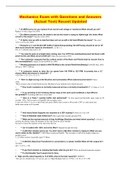
CHAA Exam Questions with Correct Answers Latest Update 2025 Graded A+
Accepting Assignment - Answers When a provider agrees to accept the allowable charges as the full fee
and cannot charge the patient the difference between the insurance payment and the provider's normal
fee.
Access - Answers The patient's ability to obtain medical care. The ease of access is determined by such
components as the availability to the patient, the location of health care facilities. transportation, hours
of operation and cost of care.
Account Number - Answers A number assigned to each account. This number is used to identify the
account and all charges and payments received.
Acute Care - Answers Medical attention given to patients with conditions of sudden onset that demand
urgent attention or care of limited duration when the patient's health and wellness would deteriorate
without treatment. The care is general short-term rather than long-term or chronic care.
Acute Inpatient Care - Answers A level of healthcare delivered to patients experiencing acute illness or
trauma. Acute care is generally short-term (< 30 days)
Add-Ons - Answers Patients who are schedules for services less than 24 hours in advance of the actual
service time.
Adjustor - Answers Insurance company representative.
Administrative Costs - Answers Costs associated with creating and submitting a bill for services, which
could include: registration, utilization review, coding, billing, and collection expenses.
Admission Authorization - Answers The process of third party payor notification of urgent/emergent
inpatient admission with in specified time as determined by the payors (usually 24-48 hours or next
business day).
Admission Date - Answers The first date the patient entered the hospital for a specific visit.
Admitting Diagnosis - Answers Word, phrase, of International Classification of Disease (ICD9) code used
by the admitting physician to identify a condition or disease from which the patient suffers and for
which the patient needs or seeks medical care.
Admitting Physician - Answers The physician who writes the order for the patient to be admitted to the
hospital. This physician must have admitting privileges at the facility providing the healthcare services.
Advance Beneficiary Notice (ABN) - Answers A notice that a care provider should give a Medicare
beneficiary to sign if the services being provided may not be considered medically necessary and
Medicare pay not pay for them.
Advance Directive - Answers An advance directive is a written instruction relating to the provision of
healthcare when a patient is incapacitated.
,Adverse Selection - Answers Among applicants for a given group or individual program, the tendency for
those with an impaired health status, or who are prone to higher than average utilization of benefits to
be enrolled in disproportionate numbers and lower deductible plans.
Alias - Answers A name by which the patient is also "known as", or formally known as.
All Patient Diagnosis Related Groups Assignment of Benefits (APDRG) - Answers A prospective hospital
claims reimbursement system currently utilized by the federal government Medicaid program and the
states of New York and New Jersey. APDRG's were designed to describe the complete cross section of
patients seen in acute care hospitals. Approximately 639 APDRG's are defined according to the principal
diagnosis, secondary diagnoses, procedures, age, birth weight, sex, discharge status.
Alphanumeric - Answers Letters, numbers, punctuation marks and mathematical symbols, as opposed to
"numeric" which is numbers only. Term typically related to the kind of data accepted in a computer field
or in coding.
Ambulatory Care Patient - Answers Patient receives medical or surgical care in an outpatient setting that
involves a broader, less specialized range of care. Ambulatory patient are generally able to walk and are
not confined to a bed. In a hospital setting, ambulatory care generally refers to healthcare services
provided on an outpatient basis.
Ambulatory Payment Classification (APC) - Answers A system of averaging and bundling using Current
Procedural Terminology (CPT) procedure codes, Healthcare Common Procedure Coding System (HCPCS)
Level II, and revenue codes submitted for payment. The APC system utilizes groups of CPT codes based
on clinical and resource similarity and establishes payment rates for each APC grouping.
Ambulatory Surgical Center - Answers A freestanding facility, other than a physician's office, where
surgical, diagnostic, and therapeutic services are provided on an outpatient ambulatory basis.
Ancillary Services - Answers A unit of the hospital, other than a nursing unit, which provides medical
services such as diagnostic testing, therapeutic procedures, or dispenses medical products, such as
medications or medical/surgical supplies.
Annual Maximum Benefit Amount Deductible - Answers The maximum dollar amount set by a Managed
Care Organization (MCO) that limits the total amount the plan must pay for all health care services
provided to a subscriber in a year. A deductible is the set amount, per benefit year or period, the third
party payor designates as the patient/guarantors responsibility. Usually the deductible must be paid
before the benefits will be paid by the payor.
Appeal - Answers An appeal is a special kind of complaint made when a beneficiary or provider disagrees
with decisions about health care services - typically related to payment issues. There is usually a special
process used to appeal payor decisions.
Appropriate Care - Answers A diagnostic or treatment measure whose expected health benefits exceed
its expected health risks by a wide enough margin to justify the measure.
, Assignment of Benefits - Answers Written authorization from the policyholder for their insurance
company to pay benefits directly to the care provider. Normally acquired at the time of admission or
registration.
Attending Physician - Answers The physician who writes outpatient orders for tests, or supervises the
patient's care during an inpatient stay.
Authorization - Answers Approval obtained from an insurance carrier for a service that represents an
agreement for payment.
Authorization to Release Medical Information - Answers The form authorizing to release information
from the medical records to doctors, hospitals, insurance, other agencies, etc.
Average Daily Census - Answers The average number of inpatient maintained in the hospital for each
day for a specific period of time.
Average Length of Stay - Answers The average number of days of service rendered to each patient
during a specific time period.
Bad Debt - Answers An accounts receivable that is regarded as uncollectible and is charged as a credit
loss even though the patient has the ability to pay.
Balance Billing - Answers The practice of billing a patient for the fee amount remaining after the insurer
payment and co-payment have been made.
Batch Processing - Answers Information technology term referring to grouping similar input items and
then processing them together during a single machine run.
Behavioral Health - Answers Assessment and treatment of mental and/or psychoactive substance abuse
disorders.
Beneficiary - Answers Person designated to receive the proceeds of an insurance policy; the insured
under a health insurance policy. Also referred to as eligible; enrollee; or member. Any person eligible as
either a subscriber or a dependent for a managed care service in accordance with a contract.
Benefit Period - Answers The number of days that Medicare covers care in hospitals and skilled nursing
facilities are measured in benefit periods. A benefit period begins on the first day of services of a patient
in a hospital or skilled nursing facility and ends 60 days after discharge from the hospital or skilled facility
if 60 days has not been interrupted by skilled care in any other facility.
Benefit Verification Period - Answers A benefit period begins on the day of admission to a hospital of
skilled nursing facility and ends when the beneficiary has not received hospital or skilled nursing care for
60 days in a row. After the 60 days have elapsed a new benefit period begins. The beneficiary must pay
the inpatient hospital deductible for each benefit period. There is no limit to the number of covered
benefit periods.
Accepting Assignment - Answers When a provider agrees to accept the allowable charges as the full fee
and cannot charge the patient the difference between the insurance payment and the provider's normal
fee.
Access - Answers The patient's ability to obtain medical care. The ease of access is determined by such
components as the availability to the patient, the location of health care facilities. transportation, hours
of operation and cost of care.
Account Number - Answers A number assigned to each account. This number is used to identify the
account and all charges and payments received.
Acute Care - Answers Medical attention given to patients with conditions of sudden onset that demand
urgent attention or care of limited duration when the patient's health and wellness would deteriorate
without treatment. The care is general short-term rather than long-term or chronic care.
Acute Inpatient Care - Answers A level of healthcare delivered to patients experiencing acute illness or
trauma. Acute care is generally short-term (< 30 days)
Add-Ons - Answers Patients who are schedules for services less than 24 hours in advance of the actual
service time.
Adjustor - Answers Insurance company representative.
Administrative Costs - Answers Costs associated with creating and submitting a bill for services, which
could include: registration, utilization review, coding, billing, and collection expenses.
Admission Authorization - Answers The process of third party payor notification of urgent/emergent
inpatient admission with in specified time as determined by the payors (usually 24-48 hours or next
business day).
Admission Date - Answers The first date the patient entered the hospital for a specific visit.
Admitting Diagnosis - Answers Word, phrase, of International Classification of Disease (ICD9) code used
by the admitting physician to identify a condition or disease from which the patient suffers and for
which the patient needs or seeks medical care.
Admitting Physician - Answers The physician who writes the order for the patient to be admitted to the
hospital. This physician must have admitting privileges at the facility providing the healthcare services.
Advance Beneficiary Notice (ABN) - Answers A notice that a care provider should give a Medicare
beneficiary to sign if the services being provided may not be considered medically necessary and
Medicare pay not pay for them.
Advance Directive - Answers An advance directive is a written instruction relating to the provision of
healthcare when a patient is incapacitated.
,Adverse Selection - Answers Among applicants for a given group or individual program, the tendency for
those with an impaired health status, or who are prone to higher than average utilization of benefits to
be enrolled in disproportionate numbers and lower deductible plans.
Alias - Answers A name by which the patient is also "known as", or formally known as.
All Patient Diagnosis Related Groups Assignment of Benefits (APDRG) - Answers A prospective hospital
claims reimbursement system currently utilized by the federal government Medicaid program and the
states of New York and New Jersey. APDRG's were designed to describe the complete cross section of
patients seen in acute care hospitals. Approximately 639 APDRG's are defined according to the principal
diagnosis, secondary diagnoses, procedures, age, birth weight, sex, discharge status.
Alphanumeric - Answers Letters, numbers, punctuation marks and mathematical symbols, as opposed to
"numeric" which is numbers only. Term typically related to the kind of data accepted in a computer field
or in coding.
Ambulatory Care Patient - Answers Patient receives medical or surgical care in an outpatient setting that
involves a broader, less specialized range of care. Ambulatory patient are generally able to walk and are
not confined to a bed. In a hospital setting, ambulatory care generally refers to healthcare services
provided on an outpatient basis.
Ambulatory Payment Classification (APC) - Answers A system of averaging and bundling using Current
Procedural Terminology (CPT) procedure codes, Healthcare Common Procedure Coding System (HCPCS)
Level II, and revenue codes submitted for payment. The APC system utilizes groups of CPT codes based
on clinical and resource similarity and establishes payment rates for each APC grouping.
Ambulatory Surgical Center - Answers A freestanding facility, other than a physician's office, where
surgical, diagnostic, and therapeutic services are provided on an outpatient ambulatory basis.
Ancillary Services - Answers A unit of the hospital, other than a nursing unit, which provides medical
services such as diagnostic testing, therapeutic procedures, or dispenses medical products, such as
medications or medical/surgical supplies.
Annual Maximum Benefit Amount Deductible - Answers The maximum dollar amount set by a Managed
Care Organization (MCO) that limits the total amount the plan must pay for all health care services
provided to a subscriber in a year. A deductible is the set amount, per benefit year or period, the third
party payor designates as the patient/guarantors responsibility. Usually the deductible must be paid
before the benefits will be paid by the payor.
Appeal - Answers An appeal is a special kind of complaint made when a beneficiary or provider disagrees
with decisions about health care services - typically related to payment issues. There is usually a special
process used to appeal payor decisions.
Appropriate Care - Answers A diagnostic or treatment measure whose expected health benefits exceed
its expected health risks by a wide enough margin to justify the measure.
, Assignment of Benefits - Answers Written authorization from the policyholder for their insurance
company to pay benefits directly to the care provider. Normally acquired at the time of admission or
registration.
Attending Physician - Answers The physician who writes outpatient orders for tests, or supervises the
patient's care during an inpatient stay.
Authorization - Answers Approval obtained from an insurance carrier for a service that represents an
agreement for payment.
Authorization to Release Medical Information - Answers The form authorizing to release information
from the medical records to doctors, hospitals, insurance, other agencies, etc.
Average Daily Census - Answers The average number of inpatient maintained in the hospital for each
day for a specific period of time.
Average Length of Stay - Answers The average number of days of service rendered to each patient
during a specific time period.
Bad Debt - Answers An accounts receivable that is regarded as uncollectible and is charged as a credit
loss even though the patient has the ability to pay.
Balance Billing - Answers The practice of billing a patient for the fee amount remaining after the insurer
payment and co-payment have been made.
Batch Processing - Answers Information technology term referring to grouping similar input items and
then processing them together during a single machine run.
Behavioral Health - Answers Assessment and treatment of mental and/or psychoactive substance abuse
disorders.
Beneficiary - Answers Person designated to receive the proceeds of an insurance policy; the insured
under a health insurance policy. Also referred to as eligible; enrollee; or member. Any person eligible as
either a subscriber or a dependent for a managed care service in accordance with a contract.
Benefit Period - Answers The number of days that Medicare covers care in hospitals and skilled nursing
facilities are measured in benefit periods. A benefit period begins on the first day of services of a patient
in a hospital or skilled nursing facility and ends 60 days after discharge from the hospital or skilled facility
if 60 days has not been interrupted by skilled care in any other facility.
Benefit Verification Period - Answers A benefit period begins on the day of admission to a hospital of
skilled nursing facility and ends when the beneficiary has not received hospital or skilled nursing care for
60 days in a row. After the 60 days have elapsed a new benefit period begins. The beneficiary must pay
the inpatient hospital deductible for each benefit period. There is no limit to the number of covered
benefit periods.