100% satisfaction guarantee Immediately available after payment Both online and in PDF No strings attached 4.6 TrustPilot
logo-home
Exam (elaborations)

Chapter 22 – Psychiatry Text Guide

Rating
-
Sold
-
Pages
4
Grade
A+
Uploaded on
27-02-2025
Written in
2024/2025

Affect - ANSWERSThe external expression of emotion attached ideas or mental representations of objects Amnesia - ANSWERSLack or loss of memory; inability to remember past experiences Amphetamines - ANSWERSA group of nervous system stimulants that are subject to abuse because of their capacity to produce wakefulness, euphoria, and weight loss Anorexia nervosa - ANSWERSEating disorder characterized by refusal to maintain a normal minimal body weight and intense fear of gaining weight Apathy - ANSWERSLack of feeling or emotion; indifference Autism - ANSWERSPervasive developmental disorder involving impaired social interaction and communication and a repertoire of activities and interests Benzodiazepines - ANSWERSGroup of compounds with a common molecular structure that act similarly to depressants of the central nervous system Bipolar Disorder - ANSWERSMood disorder marked by a history of manic, mixed, or hypomanic episodes, often with concurrent or previous major depressive episodes bulimia nervosa - ANSWERSEating disorder characterized by episodic binge eating followed by behaviors designed to prevent weight gain Cognitive behavioral therapy - ANSWERSDirective form of psychotherapy based on the theory that emotional problems result from distorted thinking that can be corrected Compulsion - ANSWERSA persistent and irresistible impulse to perform an irrational, ritualistic, or apparently useless act Conversion disorder - ANSWERSMental disorder characterized by conversion symptoms suggesting physical illness but having no demonstrable physiological basis defense mechanism - ANSWERSUsually unconscious mental process that serves to relieve conflict and anxiety arising from one's impulses and drives Delirium - ANSWERSAcute, transient disturbance of consciousness accompanied by a change in cognition and having a fluctuating course Delusion - ANSWERSFalse belief that is firmly maintained despite incontrovertible and obvious evidence to the contrary Dementia - ANSWERSGeneral loss of cognitive abilities, including impairment of memory Depression - ANSWERSA mental state of depressed mood characterized by feelings of sadness, despair, and discouragement Dissociative disorder - ANSWERSMental disorder in which normally integrated memories or parts of the personality are segregated from the main identity of the individual Ego - ANSWERSPart of the psyche that keeps contact with reality and tempers the drives of the id and demands of the superego with the needs of society Electroconvulsive therapy - ANSWERSTreatment for mental disorders in which a seizure is induced by a brief pulse of low-voltage alternating current to the brain Free association - ANSWERSPsychoanalytical method in which the patient is encouraged to describe the association of thoughts and emotions as they arise Fugue - ANSWERSPathologic altered consciousness in which a person acts as though conscious but with behavior not directed by the normal personality Hallucination - ANSWERSA sensory perception that does not result from an external stimulus and that occurs in the waking state Hypnosis - ANSWERSPassive trancelike state, resembling normal sleep, during which perception and memory are altered Id - ANSWERSThe part of the psyche, functioning in the unconscious, that is the source of instinctive energy, impulses, and drives Labile - ANSWERSCharacterized by a tendency to change or be altered or modified Lithium - ANSWERSDrug used as a mood stabilizer in treatment of acute manic and hypomanic states in bipolar disorder and in maintenance therapy Mania - ANSWERSPhase of bipolar disorder marked by expansiveness, elation, agitation, hyperexcitability, and hyperactivity Mutism - ANSWERSThe inability to speak because of a physical defect or emotional problem obsessive-compulsive disorder - ANSWERSAnxiety disorder marked by recurrent obsessions or compulsions severe enough to interfere significantly with personal or social function Paranoia - ANSWERSA condition characterized by an elaborate, overly suspicious system of thinking Paraphilia - ANSWERSA condition in which the sexual instinct is expressed in ways that are socially prohibited or unacceptable or are biologically undesirable Phobia - ANSWERSPersistent, irrational, intense fear of an object, activity, or situation that is recognized as excessive or unreasonable by the individual post-traumatic stress disorder - ANSWERSAnxiety disorder caused by exposure to an intensely traumatic event Psychiatrist - ANSWERSA physician with additional medical training and experience in the diagnosis, prevention, and treatment of mental disorders. Psychoanalysis - ANSWERSTherapy focusing on the influence of unconscious forces (repressed impulses, internal conflicts, childhood trauma) on mental state Psychologist - ANSWERSA person who specializes in the study of the structure and function of the brain and related mental processes of animals and human beings Psychopharmacology - ANSWERSStudy of the action of drugs on psychological functions and mental states and the use of drugs to modify these functions and states Psychosis - ANSWERSAny major mental disorder of organic or emotional origin characterized by a gross impairment in reality testing Repression - ANSWERSAn unconscious defense mechanism in which unacceptable ideas, fears, and impulses are thrust out or kept out of consciousness Schizophrenia - ANSWERSLarge group of psychotic disorders characterized by gross distortion of reality and disturbances of language and cognitive function Sedatives - ANSWERSAgents that decrease functional activity, diminish irritability, and allay excitement Somatoform disorder - ANSWERSMental disorder characterized by symptoms suggesting but not explained by a general medical condition Superego - ANSWERSAspect of the personality acting as a monitor and evaluator of ego function Transference - ANSWERSUnconscious tendency to assign to others in one's environment feelings and attitudes associated with significant persons in one's early life tricyclic antidepressants - ANSWERSGroup of antidepressant drugs that contain three fused rings on their chemical structure and that potentiate the action of catecholamines

Show more Read less
Institution
Psych
Course
Psych


Whoops! We can’t load your doc right now. Try again or contact support.

Written for

Institution
Psych
Course
Psych

Document information

Uploaded on
February 27, 2025
Number of pages
4
Written in
2024/2025
Type
Exam (elaborations)
Contains
Questions & answers

Subjects

Content preview

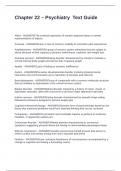
Chapter 22 – Psychiatry Text Guide


Affect - ANSWERSThe external expression of emotion attached ideas or mental
representations of objects

Amnesia - ANSWERSLack or loss of memory; inability to remember past experiences

Amphetamines - ANSWERSA group of nervous system stimulants that are subject to
abuse because of their capacity to produce wakefulness, euphoria, and weight loss

Anorexia nervosa - ANSWERSEating disorder characterized by refusal to maintain a
normal minimal body weight and intense fear of gaining weight

Apathy - ANSWERSLack of feeling or emotion; indifference

Autism - ANSWERSPervasive developmental disorder involving impaired social
interaction and communication and a repertoire of activities and interests

Benzodiazepines - ANSWERSGroup of compounds with a common molecular structure
that act similarly to depressants of the central nervous system

Bipolar Disorder - ANSWERSMood disorder marked by a history of manic, mixed, or
hypomanic episodes, often with concurrent or previous major depressive episodes

bulimia nervosa - ANSWERSEating disorder characterized by episodic binge eating
followed by behaviors designed to prevent weight gain

Cognitive behavioral therapy - ANSWERSDirective form of psychotherapy based on the
theory that emotional problems result from distorted thinking that can be corrected

Compulsion - ANSWERSA persistent and irresistible impulse to perform an irrational,
ritualistic, or apparently useless act

Conversion disorder - ANSWERSMental disorder characterized by conversion
symptoms suggesting physical illness but having no demonstrable physiological basis

defense mechanism - ANSWERSUsually unconscious mental process that serves to
relieve conflict and anxiety arising from one's impulses and drives

Delirium - ANSWERSAcute, transient disturbance of consciousness accompanied by a
change in cognition and having a fluctuating course

$13.49
Get access to the full document:

100% satisfaction guarantee
Immediately available after payment
Both online and in PDF
No strings attached

Get to know the seller
Seller avatar
paugrades1479
2.0
(1)

Also available in package deal

Thumbnail
Package deal
A PACKAGE DEAL OF PSYCHIATRY DISTINTION GRANTEED
-
15 2025
$ 190.35 More info

Get to know the seller

Seller avatar
paugrades1479 Nursing
View profile
Follow You need to be logged in order to follow users or courses
Sold
1
Member since
2 year
Number of followers
1
Documents
470
Last sold
2 year ago

2.0

1 reviews

5
0
4
0
3
0
2
1
1
0

Recently viewed by you

Why students choose Stuvia

Created by fellow students, verified by reviews

Quality you can trust: written by students who passed their tests and reviewed by others who've used these notes.

Didn't get what you expected? Choose another document

No worries! You can instantly pick a different document that better fits what you're looking for.

Pay as you like, start learning right away

No subscription, no commitments. Pay the way you're used to via credit card and download your PDF document instantly.

Student with book image

“Bought, downloaded, and aced it. It really can be that simple.”

Alisha Student

Frequently asked questions