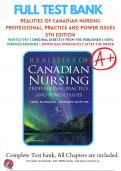
Test Bank For Professional Issues in Nursing Challenges and Opportunities, Second Edition Carol J.
Huston
1. When describing the NCLEX examination, which of the following
would the instructor include?
A) Includes content standardized for baccalaureate education in
nursing
B) Measures minimum technical competencies for safe entry into
basic nursing practice
C) Tests content determined appropriate for practice entry by the
American Nurses Association
D) Requires different passing scores for RNs educated at the ADN
level than at the BSN level
2. Which of the following would a prospective student expect to find when examining a
typical associate degree in nursing (ADN) program?
A) A maximum requirement for 120 semester hours or 180 quarter units
B) Similar curricular content as BSN programs, with greater clinical hours
C) Completion possible within 18 months to 2 years
D) Additional coursework for preparation to practice in multiple settings
3. Raising the educational level for entry into professional nursing
A) should be relatively easy due to unanimous support.
B) is likely to have a short-term effect of reducing the current nursing shortage.
C) may increase recruitment to and retention in the field in the long run.
D) may destabilize the nursing workforce due to increased job satisfaction for ADNs.
4. Which of the following best reflects most of the RNs working in the United States
today?
A) They have received an associate degree in nursing (ADN).
B) They have adequate educational preparation for roles in leadership and
management.
C) There are significant differences in care provided by ADN- and BSN-prepared
nurses.
D) Separate NCLEX examinations are supported for BSN- and ADN-educated nurses.
Page 1
,Test Bank For Professional Issues in Nursing Challenges and Opportunities, Second Edition Carol J.
Huston
5. A nursing instructor is teaching a group of students about “grandfathering” that may
result if the entry level to nursing practice is raised. The instructor determines that the
teaching was successful when the students describe it as which of the following?
A) A way to allow an individual to continue to practice his or her profession or
occupation after new qualifications have been enacted into law
B) A mandate for nurses with greater education and knowledge levels to be
responsible for supervising those prepared at lower levels
C) A necessary requirement by state and federal laws when educational entry
requirements change
D) A concept that is not supported by most professional nursing associations that
support raising the entry level for professional nursing practice
6. Transitioning from a predominantly ADN educational model of nursing education to a
baccalaureate model
A) is already occurring in a seamless, integrated manner that maximizes the use of
educational resources.
B) will be relatively inexpensive, given that adequate institutions of higher learning
already exist to meet this need.
C) will require the development of alternative pathways for RN education for learners
who may not otherwise be able to pursue additional nursing education.
D) is supported by both the National Organization for Associate Degree Nursing and
the American Association of Colleges of Nursing.
7. Which of the following would a nurse identify as a positive force for raising the
educational entry level in professional nursing?
A) There is often little if any difference in pay between BSN- and ADN-educated
nurses.
B) Patient outcomes are better when ADN representation in the staffing mix is high.
C) Consumers generally have no understanding of the entry-to-practice issue in
nursing.
D) The entry level in nursing is significantly lower than for other health professions.
8. A group of students is reviewing for a test on levels of preparation for nurses. Which of
the following if stated by the students as reflecting Mildred Montag's view of associate
degree educational programs indicates that the students have understood the
information?
A) Preparation for beginning, technical practitioners who would provide direct, safe
nursing care under the supervision of the professional nurse in an acute-care setting
B) Preparation of advanced professional nurses capable of the independent judgment
and autonomy required to successfully function as a registered nurse in the 21st
century
C) Preparation of professional registered nurses who could function safely in a variety
of health care settings including acute care, home care, and public health
D) Preparation of broadly educated registered nurses with an understanding of
cultural, political, economic, and social issues affecting patients and health care
delivery
Page 2
,Test Bank For Professional Issues in Nursing Challenges and Opportunities, Second Edition Carol J.
Huston
9. Which of the following best reflects the suggestions of the 1965 position paper by the
American Nurses Association for nursing education?
A) The education of all those who are licensed to practice nursing should take place in
institutions of higher education.
B) Minimum preparation for beginning professional nursing practice should be the
associate degree in nursing.
C) Minimum preparation for beginning technical practice should be the baccalaureate
degree in nursing.
D) There was no need for assistant nurses in the health care occupations.
10. When reviewing the demographics related to ADN and BSN programs, which of the
following would be an expected finding?
A) ADN program graduates tend to be younger than graduates of baccalaureate
programs.
B) ADN program graduates tend to be more diverse in race, gender, and age than
baccalaureate-prepared nurses.
C) ADN program graduates are more likely to be single or divorced than
baccalaureate graduates.
D) ADN program graduates typically have at least twice as many children as nurses
educated in baccalaureate programs.
11. Which of the following was the most likely cause fueling the debate about entry to
practice?
A) Brown's publication of Nursing for the Future
B) Mildred Montag's dissertation
C) ANA's 1965 position paper
D) The Veterans Administration's requirement for BSN
12. A nurse is presenting a discussion to a group of local high school students about nursing
and the various types of educational programs available. One of the students asks,
“What's the difference between a nurse with an associate's degree and one with a
baccalaureate degree?” Which response would be most appropriate?
A) “Both can be licensed as registered nurses, but an associate's degree education
requires more nursing coursework units.”
B) “Both take the same test for licensure, but a nurse with a baccalaureate degree must
get a higher score to pass.”
C) “Employers have routinely paid baccalaureate degree nurses a higher starting
salary than associate's degree nurses.”
D) “The outcomes for patients cared for by baccalaureate-prepared nurses appear to be
better than those for associate's degree nurses.”
Page 3
, Test Bank For Professional Issues in Nursing Challenges and Opportunities, Second Edition Carol J.
Huston
13. Which of the following would be considered an important factor related to changes in
health care that would emphasize the need for a BSN degree for entry to practice?
A) Shift from community settings to acute care
B) Rapid advances in health care technology and complexity
C) The need to work as a dependent member of the team
D) Dramatic increase in curative care
14. After reviewing different health professions and their required entry level degree, a
student identifies which profession as requiring the lowest degree level?
A) Pharmacy
B) Social work
C) Speech pathology
D) Nursing
15. Which of the following organizations recommends that the nursing profession have
multiple entry points?
A) American Nurses Association (ANA)
B) National League for Nursing (NLN)
C) Nurse Alliance of Service Employees International Union (SEIU)
D) American Nephrology Nurses' Association (ANNA)
16. When reviewing the factors involved with obtaining advanced education, which of the
following would a nurse expect as being the chief obstacle?
A) Cost
B) Age of the nurse
C) Gender
D) Ethnic minority status
17. After teaching a group of students about the two levels of preparation for registered
nurses, the instructor determines that the teaching was successful when the students
identify which of the following as a characteristic of technical nurses?
A) Four-year program of education in a college or university
B) Achievement of a baccalaureate degree
C) In-depth coverage of nursing research
D) Ability to provide care in acute-care settings
18. A group of students are reviewing material about the proliferation of ADN education in
preparation for a quiz the next day. The students demonstrate understanding of the
material when they identify which of the following as a characteristic of the 1960s?
A) Associate's degree programs were just beginning.
B) Diploma education was on the decline.
C) The majority of nurses were educated in colleges and universities.
D) Enrollment in baccalaureate programs was decreasing.
Page 4
Huston
1. When describing the NCLEX examination, which of the following
would the instructor include?
A) Includes content standardized for baccalaureate education in
nursing
B) Measures minimum technical competencies for safe entry into
basic nursing practice
C) Tests content determined appropriate for practice entry by the
American Nurses Association
D) Requires different passing scores for RNs educated at the ADN
level than at the BSN level
2. Which of the following would a prospective student expect to find when examining a
typical associate degree in nursing (ADN) program?
A) A maximum requirement for 120 semester hours or 180 quarter units
B) Similar curricular content as BSN programs, with greater clinical hours
C) Completion possible within 18 months to 2 years
D) Additional coursework for preparation to practice in multiple settings
3. Raising the educational level for entry into professional nursing
A) should be relatively easy due to unanimous support.
B) is likely to have a short-term effect of reducing the current nursing shortage.
C) may increase recruitment to and retention in the field in the long run.
D) may destabilize the nursing workforce due to increased job satisfaction for ADNs.
4. Which of the following best reflects most of the RNs working in the United States
today?
A) They have received an associate degree in nursing (ADN).
B) They have adequate educational preparation for roles in leadership and
management.
C) There are significant differences in care provided by ADN- and BSN-prepared
nurses.
D) Separate NCLEX examinations are supported for BSN- and ADN-educated nurses.
Page 1
,Test Bank For Professional Issues in Nursing Challenges and Opportunities, Second Edition Carol J.
Huston
5. A nursing instructor is teaching a group of students about “grandfathering” that may
result if the entry level to nursing practice is raised. The instructor determines that the
teaching was successful when the students describe it as which of the following?
A) A way to allow an individual to continue to practice his or her profession or
occupation after new qualifications have been enacted into law
B) A mandate for nurses with greater education and knowledge levels to be
responsible for supervising those prepared at lower levels
C) A necessary requirement by state and federal laws when educational entry
requirements change
D) A concept that is not supported by most professional nursing associations that
support raising the entry level for professional nursing practice
6. Transitioning from a predominantly ADN educational model of nursing education to a
baccalaureate model
A) is already occurring in a seamless, integrated manner that maximizes the use of
educational resources.
B) will be relatively inexpensive, given that adequate institutions of higher learning
already exist to meet this need.
C) will require the development of alternative pathways for RN education for learners
who may not otherwise be able to pursue additional nursing education.
D) is supported by both the National Organization for Associate Degree Nursing and
the American Association of Colleges of Nursing.
7. Which of the following would a nurse identify as a positive force for raising the
educational entry level in professional nursing?
A) There is often little if any difference in pay between BSN- and ADN-educated
nurses.
B) Patient outcomes are better when ADN representation in the staffing mix is high.
C) Consumers generally have no understanding of the entry-to-practice issue in
nursing.
D) The entry level in nursing is significantly lower than for other health professions.
8. A group of students is reviewing for a test on levels of preparation for nurses. Which of
the following if stated by the students as reflecting Mildred Montag's view of associate
degree educational programs indicates that the students have understood the
information?
A) Preparation for beginning, technical practitioners who would provide direct, safe
nursing care under the supervision of the professional nurse in an acute-care setting
B) Preparation of advanced professional nurses capable of the independent judgment
and autonomy required to successfully function as a registered nurse in the 21st
century
C) Preparation of professional registered nurses who could function safely in a variety
of health care settings including acute care, home care, and public health
D) Preparation of broadly educated registered nurses with an understanding of
cultural, political, economic, and social issues affecting patients and health care
delivery
Page 2
,Test Bank For Professional Issues in Nursing Challenges and Opportunities, Second Edition Carol J.
Huston
9. Which of the following best reflects the suggestions of the 1965 position paper by the
American Nurses Association for nursing education?
A) The education of all those who are licensed to practice nursing should take place in
institutions of higher education.
B) Minimum preparation for beginning professional nursing practice should be the
associate degree in nursing.
C) Minimum preparation for beginning technical practice should be the baccalaureate
degree in nursing.
D) There was no need for assistant nurses in the health care occupations.
10. When reviewing the demographics related to ADN and BSN programs, which of the
following would be an expected finding?
A) ADN program graduates tend to be younger than graduates of baccalaureate
programs.
B) ADN program graduates tend to be more diverse in race, gender, and age than
baccalaureate-prepared nurses.
C) ADN program graduates are more likely to be single or divorced than
baccalaureate graduates.
D) ADN program graduates typically have at least twice as many children as nurses
educated in baccalaureate programs.
11. Which of the following was the most likely cause fueling the debate about entry to
practice?
A) Brown's publication of Nursing for the Future
B) Mildred Montag's dissertation
C) ANA's 1965 position paper
D) The Veterans Administration's requirement for BSN
12. A nurse is presenting a discussion to a group of local high school students about nursing
and the various types of educational programs available. One of the students asks,
“What's the difference between a nurse with an associate's degree and one with a
baccalaureate degree?” Which response would be most appropriate?
A) “Both can be licensed as registered nurses, but an associate's degree education
requires more nursing coursework units.”
B) “Both take the same test for licensure, but a nurse with a baccalaureate degree must
get a higher score to pass.”
C) “Employers have routinely paid baccalaureate degree nurses a higher starting
salary than associate's degree nurses.”
D) “The outcomes for patients cared for by baccalaureate-prepared nurses appear to be
better than those for associate's degree nurses.”
Page 3
, Test Bank For Professional Issues in Nursing Challenges and Opportunities, Second Edition Carol J.
Huston
13. Which of the following would be considered an important factor related to changes in
health care that would emphasize the need for a BSN degree for entry to practice?
A) Shift from community settings to acute care
B) Rapid advances in health care technology and complexity
C) The need to work as a dependent member of the team
D) Dramatic increase in curative care
14. After reviewing different health professions and their required entry level degree, a
student identifies which profession as requiring the lowest degree level?
A) Pharmacy
B) Social work
C) Speech pathology
D) Nursing
15. Which of the following organizations recommends that the nursing profession have
multiple entry points?
A) American Nurses Association (ANA)
B) National League for Nursing (NLN)
C) Nurse Alliance of Service Employees International Union (SEIU)
D) American Nephrology Nurses' Association (ANNA)
16. When reviewing the factors involved with obtaining advanced education, which of the
following would a nurse expect as being the chief obstacle?
A) Cost
B) Age of the nurse
C) Gender
D) Ethnic minority status
17. After teaching a group of students about the two levels of preparation for registered
nurses, the instructor determines that the teaching was successful when the students
identify which of the following as a characteristic of technical nurses?
A) Four-year program of education in a college or university
B) Achievement of a baccalaureate degree
C) In-depth coverage of nursing research
D) Ability to provide care in acute-care settings
18. A group of students are reviewing material about the proliferation of ADN education in
preparation for a quiz the next day. The students demonstrate understanding of the
material when they identify which of the following as a characteristic of the 1960s?
A) Associate's degree programs were just beginning.
B) Diploma education was on the decline.
C) The majority of nurses were educated in colleges and universities.
D) Enrollment in baccalaureate programs was decreasing.
Page 4