

Written by students who passed Immediately available after payment Read online or as PDF Wrong document? Swap it for free 4.6 TrustPilot
logo-home
Document preview thumbnail
Preview 2 out of 11 pages
Exam (elaborations)

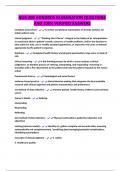
NUR 200 HONDROS EXAMINATION QUESTIONS AND 100% VERIFIED ANSWERS Maslow's Hierarchy of Needs - 1. Physiological needs 2. Safety and security 3. Love and belonging 4. Self-esteem 5. Self-actualization Autonomy - Respecting the rights of others to mak

Document preview thumbnail
Preview 2 out of 11 pages

NUR 200 HONDROS EXAMINATION QUESTIONS AND 100% VERIFIED ANSWERS Maslow's Hierarchy of Needs - 1. Physiological needs 2. Safety and security 3. Love and belonging 4. Self-esteem 5. Self-actualization Autonomy - Respecting the rights of others to make their own decisions Nonmaleficence - Obligation to do no harm to others Beneficence - Duty to do good to others Justice - Distribution of benefits and services fairly Veracity - Obligation to tell the truth Fidelity - Following through with a promise Integrity - Honest--does what they say they will do Compassion - Feeling what another is feeling Courage - To stand in opposition for moral rightness Humility - Taking neither credit nor blame for a situation Advocacy - Acting as a last line of defense on behalf of the patient Human flourishing - Duty to foster outcomes that lead to human growth Patient centered interview - Conducted during nursing history Periodic assessment - Conducted during ongoing contact with patients Physical exam - Conducted during nursing history and anytime new symptoms present Subjective data - Things the patients says to you Objective data - Result from direct observation or measurement. Including what you see, hear, touch 3 phases of the interview process - 1. Orientation/setting the agenda 2. Working phase--collecting assessment data 3. Termination of interview Nurse practice act - Regulates the scope of practice -Different in each state -Protects the public from unsafe nurses Scope of practice - Defines nursing and the values -Tells the nurse what you can and cannot do -Regulated by the state and individual facilities Standards of Practice - Expected to be able to perform certain duties. -Regulated by ANA Standards of Professional Performance - High quality care -Regulated by ANA Code of Ethics - Ideals of right and wrong -Regulated by ANA Novice - Nursing student--beginner Advanced beginner - Graduate nurse -step by step approach Competent - 2-3 years experience in the same unit Proficient - Addresses issues without going step by step Expert - Diverse experience, focuses on problem at hand Patient cues - Something you see with the patient--a sign -shuffling gait, wheezing, warm skin, foul odor from drainage Inference - A conclusion based on the observed cue -Shuffling gait, so inference would be a fall risk -Wheezing, so inference would be compromised airway The nurse sees a large hematoma on the patients abdomen. Cue or inference? - Cue The nurse interprets the patient suffered trauma to the site. Cue or inference? - Inference Primary source of data - The patient Secondary source of data - Family/caregiver Medical records Other healthcare professionals Phases of the interview 1. Orientation and setting an agenda - -Introduce self and explain agenda Phases of the interview 2. Working phases - -start with open ended questions -have patient describe symptoms Phases of the interview 3. Termination phase - -When the interview is ending -Summarize discussion and check for accuracy The nurse is caring for a patient who has Diabetes Mellitus Type 1. Which step is the most important for the nurse to take first? A. Administer morning dose of insulin B. Complete a head to toe assessment C. Order a breakfast tray D. Reinforce education on diabetes - B. Complete a head to toe assessment SPICES tool - Used specifically for older adults S-Sleep disorders P-Problems with eating/feeding I-Incontinence C-Confusion E-Evidence of falls S-Skin breakfown How does an experienced nurse think differently than a novice nurse? - The experienced nurse recognizes patterns and subtle differences between patients Which thinking skill requires the nurse to respond to the information regarding a change in vital signs? - Identifying signs and symptoms When a nurse conducts an assessment, data about a patient often comes from which of the following sources? (Select all that apply.) A. An observation of how a patient turns and moves in bed B. The unit policy and procedure manual C. The care recommendations of a physical therapist D. The results of a diagnostic x-ray film E. Your experiences in caring for other patients with similar problems - A. An observation of how a patient turns & moves in bed C. The care recommendations of a physical therapist ACES - Advancing Care Excellence for Seniors A-Assess function and expectations C-Coordinate and manage care E-use Evidence based knowledge S-make Situational decisions Epworth Sleepiness Scale - Determines how likely a patient will fall asleep. 0=would never doze 1=slight chance of dozing 2=moderate chance of dozing 3=high chance of dozing The nurse is using an electric thermometer to take an oral temperature. After taking the oral temperature, the nurse obtain a reading of 94.2, Which action should the nurse do next? A. Use another electronic thermometer to retake the temperature B. Feel the clients skin temperature C. Take a rectal temperature D. Record the findings - A. Use another electronic thermometer to retake the temperature 5 rights of delegation - Right task Right circumstance Right person Right direction and communication Right supervision 4 C's for effective communication - Comfort Courteous Connection Confirmation What are the two steps in the nursing assessment? - 1. Collection of information (interview) 2. Interpretation and validation The registered nurse is caring for post op patient with abdominal incision which actions could be delegated to the experience UAP? - Collect the vital signs and oxygen saturation. A diabetic patient blood glucose reading is 48. Patient is confused drowsy complaining of dizziness. Which intervention by the nurse will Clinical judgement step in responding in judgment. - Administer 1 mg of glucagon by order. The nurse is providing pre-op operation, left lower lobectomy ( Left lower lung removal). Which instructions are consistent with the noticing step of tanners model of clinical subject - 1. How to use a incentive spirometer, reporting pain so it could be address early. Parents instruct there under age son's nurse to not provide any information about his condition even though the son is begging for information - UAP personal care I&O, RN catheter irrigation and meds . The UAP reports a patients vital signs as bp 210/112 Hr 80, Res 12 Temp 98.4 Pulse ox99. The nurse enters the room observed and calmly listening to music and reading the newspaper. What action will the nurse demonstrate in tanners skilled? - Manually checking the patient bp The UAP reports a BS of 30 to the Rn with a patient with diabetes type 1. The Rn proceeds by obtaining a second glucose reading prior to administering medication of glucagon injection per doctor. What thinking skilled of tanners? - Checking accuracy and reliability The nurse is using what thinking skill in tanners known best to ensure that data gathering is complete in accurate? - Assessing systematically comprehensively The nurse is caring for a patient 2 days after a partial left lung lobectomy. The patient finally experiences severe difficulty breathing and as extremely anxious. Which action will the nurse do first? - Perform a focus respiratory assessment . A nurse is using a thinking skill of Tanners model in the noticing step that requires the collection objective and subjective data. Which nursing action will ensure the patient data is complete and accurate? - Gathers data from all sources available to the nurse. The patient complains of abdominal pain 5/10 and the nurse medicate patient with oral pain medication instead of IV. Which critical thinking skill of tanners will the nurse used in the patient. - .Judging how much ambiguity is acceptable Hondros NUR 200 final -

Content preview

NUR 200 HONDROS EXAMINATION QUESTIONS
AND 100% VERIFIED ANSWERS
Complete assessment - A review and physical examination of all body systems, for
stable patients only

clinical judgment - "Thinking Like A Nurse". integral to the Safety of pt. Interpretation
or conclusion about a patient's needs, concerns, or health problems, and/or the decision to
take action (or not), use or modify standard approaches, or improvise new ones as deemed
appropriate by the patient's response.

Database - Completed health history and physical examination, large store or bank of
info

clinical reasoning - is the thinking process by which a nurse reaches a clinical
judgement. an iterative process of noticing, interpreting, and responding- reasoning in
transition with a fine attunement to the patient and how the patient responds to the nurses
action

Psychosocial history - Psychological and social factors

evidence-based practice - clinical decision making that integrates the best available
research with clinical expertise and patient characteristics and preferences

1st method of data collection - Interiew patient, health history. Patient is your primary
source

Tanner's Model - Noticing
Interpreting
Responding
Reflecting

2nd method of data collection - Physical examination ( guided by subjective and
objective)

noticing (tanners model) - identify s/s, gather complete and accurate data, assessing
systematically and comprehensively, *predicting (and managing) potential complications,
identifying assumptions

Concepts of clinical judgment - 1. Safety
2. Healthcare quality

, 3. Leadership
4. Patient education
5. Evidence
6. Professionalism
7. Care coordination

objective data (noticing) - information that is seen, heard, felt, or smelled by an
observer; signs

Analytic reasoning - Situation is unfamiliar

subjective data (noticing) - things a person tells you about that you cannot observe
through your senses; symptoms

Intuitive reasoning - Able to recognize the situation immedialy. Pattern based

factors that influence "Noticing" - -intrapersonal characteristics of the nurse
-theoretical and experiential knowledge of the nurse
-knowing the patient
-context or environment of care

Narrative reasoning - Situation to patient experience with illness.

Interpreting (tanners) - comparing and contrast data, clustering related information,
recognizing inconsistencies, checking accuracy, distinguishing relevant from irrelevant,
determine importance of info, judge how much ambiguity is acceptable (ie b/p dt condition),
determine legal ethical professional guidelines, (predicting and) *managing potential
complications

Noticing - 1. Identify signs and symptoms
2. Complete and accurate date
3. Assessing systemically and comprehensively
4. Predicting and managing patient complications
5. Identifying assumptions

analytic reasoning (interpreting) - based on theoretical knowledge. nurse makes a
hypothesis or best guess about the pt care situation and then tests. typically students and
novice nurses


Document information

Uploaded on
February 26, 2025
Number of pages
11
Written in
2024/2025
Type
Exam (elaborations)
Contains
Questions & answers
$11.99

Wrong document? Swap it for free Within 14 days of purchase and before downloading, you can choose a different document. You can simply spend the amount again.
Written by students who passed
Immediately available after payment
Read online or as PDF

Sold
12
Followers
1
Items
2578
Last sold
3 days ago


Why students choose Stuvia

Created by fellow students, verified by reviews

Quality you can trust: written by students who passed their tests and reviewed by others who've used these notes.

Didn't get what you expected? Choose another document

No worries! You can instantly pick a different document that better fits what you're looking for.

Pay as you like, start learning right away

No subscription, no commitments. Pay the way you're used to via credit card and download your PDF document instantly.

Student with book image

“Bought, downloaded, and aced it. It really can be that simple.”

Alisha Student

Working on your references?

Create accurate citations in APA, MLA and Harvard with our free citation generator.

Working on your references?

Frequently asked questions
