1 | Page
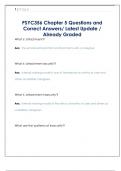
PSYC356 Chapter 5 Questions and
Correct Answers/ Latest Update /
Already Graded
What is 'attachment'?
Ans: The emotional bond that an infant forms with a caregiver
What is 'attachment security'?
Ans: Internal working model is one of themselves as worthy of care and
others as reliable caregivers
What is 'attachment insecurity'?
Ans: Internal working model of the self as unworthy of care and others as
unreliable caregivers
What are the 'patterns of insecurity'?
,2 | Page
Ans: - Resistant attachment: generally related to inconsistent or
unpredictable care
- Avoidant attachment: generally related to inadequate care
- Disorganized attachment: signals that the caregiver is perceived as
frightening, frightened, or malicious
What is the 'strange situation paradigm 1'?
Ans: - Mary Ainsworth
- Developed as an extension of Bowlby's attachment theory
- The caregiver and child enter a room with toys, and the child is allowed
to explore. A stranger enters the room, talks to the caregiver, and
approaches the child. The caregiver leaves the child with the stranger.
The caregiver returns, and the stranger leaves. The caregiver leaves the
child alone in the room. The stranger returns to the room. The caregiver
returns, and the stranger leaves.
What does the 'strange situation paradigm' look like for each
attachment pattern?
, 3 | Page
Ans: - Secure Attachment: children feel secure when the caregiver is
present, may become upset when the caregiver leaves, but are easily
comforted upon their return.
- Insecure-Avoidant Attachment: children may avoid the caregiver, show
little distress when they leave, and may not seek comfort upon their return.
- Insecure-Resistant/Anxious Attachment: children may be clingy, show
high levels of distress when the caregiver leaves, and may have difficulty
being comforted upon their return
What are the main components of attachment?
Ans: - Caregiver provides a safe haven
- Separation distress
- Allow for proximity maintenance
- Act as a secure base
What are other characterizations of 'attachment'?
PSYC356 Chapter 5 Questions and
Correct Answers/ Latest Update /
Already Graded
What is 'attachment'?
Ans: The emotional bond that an infant forms with a caregiver
What is 'attachment security'?
Ans: Internal working model is one of themselves as worthy of care and
others as reliable caregivers
What is 'attachment insecurity'?
Ans: Internal working model of the self as unworthy of care and others as
unreliable caregivers
What are the 'patterns of insecurity'?
,2 | Page
Ans: - Resistant attachment: generally related to inconsistent or
unpredictable care
- Avoidant attachment: generally related to inadequate care
- Disorganized attachment: signals that the caregiver is perceived as
frightening, frightened, or malicious
What is the 'strange situation paradigm 1'?
Ans: - Mary Ainsworth
- Developed as an extension of Bowlby's attachment theory
- The caregiver and child enter a room with toys, and the child is allowed
to explore. A stranger enters the room, talks to the caregiver, and
approaches the child. The caregiver leaves the child with the stranger.
The caregiver returns, and the stranger leaves. The caregiver leaves the
child alone in the room. The stranger returns to the room. The caregiver
returns, and the stranger leaves.
What does the 'strange situation paradigm' look like for each
attachment pattern?
, 3 | Page
Ans: - Secure Attachment: children feel secure when the caregiver is
present, may become upset when the caregiver leaves, but are easily
comforted upon their return.
- Insecure-Avoidant Attachment: children may avoid the caregiver, show
little distress when they leave, and may not seek comfort upon their return.
- Insecure-Resistant/Anxious Attachment: children may be clingy, show
high levels of distress when the caregiver leaves, and may have difficulty
being comforted upon their return
What are the main components of attachment?
Ans: - Caregiver provides a safe haven
- Separation distress
- Allow for proximity maintenance
- Act as a secure base
What are other characterizations of 'attachment'?