The study of Language – George Yule
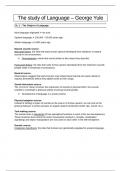
Ch. 1 – The Origins of Language
How language originated 🡪 not sure.
Spoken language 🡪 100,000 – 50,000 years ago.
Written language 🡪 5,000 years ago.
Natural sounds source:
Bow-wow theory: the idea that early human speech developed from imitations of natural
sounds in the environment.
⮚ Onomatopoeia: words that sound similar to the noises they describe.
Pooh-pooh theory: the idea that early human speech developed from the instinctive sounds
people make in emotional circumstances.
Musical source:
Observations suggest that early humans may indeed have learned and used melody to
express themselves before they added words to their songs.
Social interaction source:
The ‘yo-he-ho’ theory involves the expression of sounds in physical effort, the sounds
needed to coordinate a physical activity involving several people.
⮚ Development of language in a social context.
Physical adaption source:
Instead of looking at types of sounds as the source of human speech, we can look at the
physical features a human possess to support speech production (teeth, lips, mouth, etc.).
Tool-making source:
The human brain is lateralized (it has specialized functions in each of the two hemispheres).
Those functions that control the motor movements involved in complex vocalization
(speaking) and object manipulation are very close to each other in the left hemisphere.
Genetic source:
Innateness hypothesis: the idea that humans are genetically equipped to acquire language.
,Ch. 2 – Animals and Human Language
Communicative signals: behaviour used intentionally to provide information.
Informative signals: behaviour that provides information, usually unintentionally.
Glossolalia: humans are capable of producing sounds and syllables in a steam of speech
that appears to have no communicative purpose.
⮚ ‘speaking in tongues’
Properties of human language:
- Reflexivity: humans are able to reflect on languages by using language.
- Displacement: humans can refer to past and future time by using language.
- Arbitrariness: the fact that there is no natural connection between a linguistic form and its
meaning.
- Cultural transmission: the process whereby knowledge of a language is passed from one
generation to the next.
- Productivity: a property of language that allows users to create new expressions.
- Duality: linguistic forms have two simultaneous levels of sound production and meaning =
‘double articulation’.
, Ch. 5 – Word formation
Neologism: a new word.
Etymology: the study of the origin and history of words.
⮚ The origin of most English words come from Latin, Greek or Germanic.
Borrowing: the process of taking words from other languages.
Sometimes a new sound comes along with these words.
⮚ Loan-translation: a type of borrowing in which each element of a word is translated
into the borrowing language (also called calque). Example: skyscraper,
wolkenkrabber, wolkenkratzer.
Compounding: the process of combining two (or more) words to form a new word.
Blending: the process of combining the beginning of one word and the end of another word
to form a new word (example: brunch = breakfast + lunch).
Clipping: the process of reducing a word of more than one syllable to a shorter form
(example: ad = advertisement).
Hypocorisms: a word-formation process in which a longer word is reduced to a shorter form
with -y or -ie at the end (example: telly = television).
Backformation: the process of reducing a word such as a noun to a shorter version and using
it as a new word (example: babysit > babysitter).
Conversion: the process of changing the function of a word, such as a noun to a verb, as a
way of forming new words. Also known as ‘category change’ or ‘functional shift’ (example:
vacation > vacationing).
Coinage: the invention of new words.
⮚ Acronyms: new words formed from the initial letters of a set of other words (example:
CD = compact disk).
Derivation: the process of forming new words by adding affixes, which are a bound
morpheme such as un- or -ed (example: undressed).
⮚ Prefixes: a bound morpheme added to the beginning of a word (example: unhappy).
⮚ Suffixes: a bound morpheme added to the end of a word (example: fainted).
⮚ Infixes: a morpheme that is inserted in the middle of a word (example: -rn- in srnal).
Analogy: a process of forming a new word that is similar in some way to an existing word.
Ch. 1 – The Origins of Language
How language originated 🡪 not sure.
Spoken language 🡪 100,000 – 50,000 years ago.
Written language 🡪 5,000 years ago.
Natural sounds source:
Bow-wow theory: the idea that early human speech developed from imitations of natural
sounds in the environment.
⮚ Onomatopoeia: words that sound similar to the noises they describe.
Pooh-pooh theory: the idea that early human speech developed from the instinctive sounds
people make in emotional circumstances.
Musical source:
Observations suggest that early humans may indeed have learned and used melody to
express themselves before they added words to their songs.
Social interaction source:
The ‘yo-he-ho’ theory involves the expression of sounds in physical effort, the sounds
needed to coordinate a physical activity involving several people.
⮚ Development of language in a social context.
Physical adaption source:
Instead of looking at types of sounds as the source of human speech, we can look at the
physical features a human possess to support speech production (teeth, lips, mouth, etc.).
Tool-making source:
The human brain is lateralized (it has specialized functions in each of the two hemispheres).
Those functions that control the motor movements involved in complex vocalization
(speaking) and object manipulation are very close to each other in the left hemisphere.
Genetic source:
Innateness hypothesis: the idea that humans are genetically equipped to acquire language.
,Ch. 2 – Animals and Human Language
Communicative signals: behaviour used intentionally to provide information.
Informative signals: behaviour that provides information, usually unintentionally.
Glossolalia: humans are capable of producing sounds and syllables in a steam of speech
that appears to have no communicative purpose.
⮚ ‘speaking in tongues’
Properties of human language:
- Reflexivity: humans are able to reflect on languages by using language.
- Displacement: humans can refer to past and future time by using language.
- Arbitrariness: the fact that there is no natural connection between a linguistic form and its
meaning.
- Cultural transmission: the process whereby knowledge of a language is passed from one
generation to the next.
- Productivity: a property of language that allows users to create new expressions.
- Duality: linguistic forms have two simultaneous levels of sound production and meaning =
‘double articulation’.
, Ch. 5 – Word formation
Neologism: a new word.
Etymology: the study of the origin and history of words.
⮚ The origin of most English words come from Latin, Greek or Germanic.
Borrowing: the process of taking words from other languages.
Sometimes a new sound comes along with these words.
⮚ Loan-translation: a type of borrowing in which each element of a word is translated
into the borrowing language (also called calque). Example: skyscraper,
wolkenkrabber, wolkenkratzer.
Compounding: the process of combining two (or more) words to form a new word.
Blending: the process of combining the beginning of one word and the end of another word
to form a new word (example: brunch = breakfast + lunch).
Clipping: the process of reducing a word of more than one syllable to a shorter form
(example: ad = advertisement).
Hypocorisms: a word-formation process in which a longer word is reduced to a shorter form
with -y or -ie at the end (example: telly = television).
Backformation: the process of reducing a word such as a noun to a shorter version and using
it as a new word (example: babysit > babysitter).
Conversion: the process of changing the function of a word, such as a noun to a verb, as a
way of forming new words. Also known as ‘category change’ or ‘functional shift’ (example:
vacation > vacationing).
Coinage: the invention of new words.
⮚ Acronyms: new words formed from the initial letters of a set of other words (example:
CD = compact disk).
Derivation: the process of forming new words by adding affixes, which are a bound
morpheme such as un- or -ed (example: undressed).
⮚ Prefixes: a bound morpheme added to the beginning of a word (example: unhappy).
⮚ Suffixes: a bound morpheme added to the end of a word (example: fainted).
⮚ Infixes: a morpheme that is inserted in the middle of a word (example: -rn- in srnal).
Analogy: a process of forming a new word that is similar in some way to an existing word.