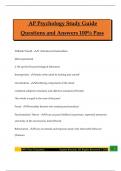
AP Psychology Study Guide
Questions and Answers 100% Pass
Wilhelm Wundt - ✔✔1. Introduced structuralism
(Bell experiment)
2. Set up the first psychological laboratory
Introspection - ✔✔study of the mind by looking into oneself
structuralism - ✔✔identifying components of the mind:
combined subjective emotions and objective sensations (Wundt)
"the whole is equal to the sum of the parts"
Freud - ✔✔Personality theorist who created psychoanalysis
Psychoanalytic Theory - ✔✔Focus on past childhood experience, repressed memories,
and study of the unconscious mind (Freud)
Behaviorism - ✔✔Focus on stimuli and response-study only observable behavior
(Watson)
100% Pass Guarantee Sophia Bennett, All Rights Reserved © 2025 1
,Humanistic Perspective - ✔✔Emphasized the human capacity for free-will and
individual choice (Rogers & Maslow)
Evolutionary Perspective - ✔✔Examines how behaviors help a species survive from on
generation to the next, focus on natural selection
Biopsychology - ✔✔Explains human thought in terms of the relationship between
biology and psychology
Social-Cultural - ✔✔behavior varies by culture
Pavlov - ✔✔Behaviorist-Classically conditioned dogs to salivate at the sound of a bell
Watson - ✔✔Behaviorist-In his Little Albert Experiment he conditioned Albert to fear
white rat by associating it with loud noises
Skinner - ✔✔Behaviorist-Proposed theory of operant conditioning with skinner box
experiment, reinforcing rats behavior with rewards or punishments
Independent Variable - ✔✔Changed by experimenter-what is being controlled
Dependent Variable - ✔✔Changed by independent variable
Operational definition - ✔✔Defining how something is measured in an experiment:
help to easily replicate
Target Population - ✔✔Demographic experimenter wants to study
100% Pass Guarantee Sophia Bennett, All Rights Reserved © 2025 2
,Representative Sample - ✔✔Group that resembles target population
Stratified Sample - ✔✔Takes specific criteria (race, gender, %) into account
Matched pairs - ✔✔Similar people for different conditions of a study
Experimenter bias - ✔✔when experimenter treats people differently because of his/her
expected results
Double blind - ✔✔Neither experimenter nor subject knows which group subject is in
Single blind - ✔✔Subject does not know which group (control or experimental) they are
in
Demand characteristics - ✔✔Cues that subject picks up on and uses in order to respond
appropriately
Placebo effect - ✔✔Taking a drug that has no pharmacological effects produces similar
results as the real medication
Positive Correlation - ✔✔A direct relationship in which both variables are increasing or
both are decreasing
Negative Correlation - ✔✔An inverse relationship in which one variable increases and
the other decreases or vice versa
100% Pass Guarantee Sophia Bennett, All Rights Reserved © 2025 3
, Survey Method - ✔✔Easy to distriubute to large population and inexpensive, but can't
control who sends it back, and has other confounding variables
Naturalistic Observation - ✔✔Has high ecological validity (acts normally in natural
habitat) but can't control variables and therefore does not show cause and effect
Case studies - ✔✔Follows in detail one person or a group of people with a rare
condition
Hindsight bias - ✔✔Tendency to believe, once the outcome is already known, that you
would have foreseen it (Also "I-Knew-It-All-Along Phenomenon)
Applied research - ✔✔Solving a problem
Basic research - ✔✔Just because
Validity - ✔✔Measures what experiment is supposed to
Reliability - ✔✔Same result every time
Random assignment - ✔✔Equal chance of anyone in sample population to be placed in
either control or experimental group
Random selection - ✔✔Randomly gathering a representative sample for a study by
identifying a population and randomly selecting people from that population
Social desirability effect - ✔✔Tendenecy to give the politically correct answer
100% Pass Guarantee Sophia Bennett, All Rights Reserved © 2025 4
Questions and Answers 100% Pass
Wilhelm Wundt - ✔✔1. Introduced structuralism
(Bell experiment)
2. Set up the first psychological laboratory
Introspection - ✔✔study of the mind by looking into oneself
structuralism - ✔✔identifying components of the mind:
combined subjective emotions and objective sensations (Wundt)
"the whole is equal to the sum of the parts"
Freud - ✔✔Personality theorist who created psychoanalysis
Psychoanalytic Theory - ✔✔Focus on past childhood experience, repressed memories,
and study of the unconscious mind (Freud)
Behaviorism - ✔✔Focus on stimuli and response-study only observable behavior
(Watson)
100% Pass Guarantee Sophia Bennett, All Rights Reserved © 2025 1
,Humanistic Perspective - ✔✔Emphasized the human capacity for free-will and
individual choice (Rogers & Maslow)
Evolutionary Perspective - ✔✔Examines how behaviors help a species survive from on
generation to the next, focus on natural selection
Biopsychology - ✔✔Explains human thought in terms of the relationship between
biology and psychology
Social-Cultural - ✔✔behavior varies by culture
Pavlov - ✔✔Behaviorist-Classically conditioned dogs to salivate at the sound of a bell
Watson - ✔✔Behaviorist-In his Little Albert Experiment he conditioned Albert to fear
white rat by associating it with loud noises
Skinner - ✔✔Behaviorist-Proposed theory of operant conditioning with skinner box
experiment, reinforcing rats behavior with rewards or punishments
Independent Variable - ✔✔Changed by experimenter-what is being controlled
Dependent Variable - ✔✔Changed by independent variable
Operational definition - ✔✔Defining how something is measured in an experiment:
help to easily replicate
Target Population - ✔✔Demographic experimenter wants to study
100% Pass Guarantee Sophia Bennett, All Rights Reserved © 2025 2
,Representative Sample - ✔✔Group that resembles target population
Stratified Sample - ✔✔Takes specific criteria (race, gender, %) into account
Matched pairs - ✔✔Similar people for different conditions of a study
Experimenter bias - ✔✔when experimenter treats people differently because of his/her
expected results
Double blind - ✔✔Neither experimenter nor subject knows which group subject is in
Single blind - ✔✔Subject does not know which group (control or experimental) they are
in
Demand characteristics - ✔✔Cues that subject picks up on and uses in order to respond
appropriately
Placebo effect - ✔✔Taking a drug that has no pharmacological effects produces similar
results as the real medication
Positive Correlation - ✔✔A direct relationship in which both variables are increasing or
both are decreasing
Negative Correlation - ✔✔An inverse relationship in which one variable increases and
the other decreases or vice versa
100% Pass Guarantee Sophia Bennett, All Rights Reserved © 2025 3
, Survey Method - ✔✔Easy to distriubute to large population and inexpensive, but can't
control who sends it back, and has other confounding variables
Naturalistic Observation - ✔✔Has high ecological validity (acts normally in natural
habitat) but can't control variables and therefore does not show cause and effect
Case studies - ✔✔Follows in detail one person or a group of people with a rare
condition
Hindsight bias - ✔✔Tendency to believe, once the outcome is already known, that you
would have foreseen it (Also "I-Knew-It-All-Along Phenomenon)
Applied research - ✔✔Solving a problem
Basic research - ✔✔Just because
Validity - ✔✔Measures what experiment is supposed to
Reliability - ✔✔Same result every time
Random assignment - ✔✔Equal chance of anyone in sample population to be placed in
either control or experimental group
Random selection - ✔✔Randomly gathering a representative sample for a study by
identifying a population and randomly selecting people from that population
Social desirability effect - ✔✔Tendenecy to give the politically correct answer
100% Pass Guarantee Sophia Bennett, All Rights Reserved © 2025 4