History of Marriage and Family Therapy (Chapter 1)
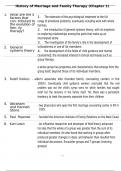
1. What are the 5
factors that 1. The extension of the psychological treatment to the full
range of emotional problems, eventually including work with whole
con- tributed to
the evolution of
families.
fam- ily
therapy? 2. the introduction of general systems theory, with its emphasis
on exploring relationships among the parts that make up an
interrelated whole
3. The investigation of the family's role in the development of
2. General schizophrenia in one of its members
systems theory 4. the development of the fields of child guidance and marital
counseling5. the increased interest in clinical techniques such as
group therapy.
a whole group has properties and characteristics that emerge from the
group itself, beyond those of its individual members.
3. Rudolf Dreikurs - alder's associate who founded family counseling centers in the
1920's. Eventually child guidance workers concluded that the real
problem was not the child's symp- toms for which families had sought
relief but the tensions in the family itself. Yet, there was a persistent
tendency to treat the parents separate from their children
4. Abraham -two physicians who open the first marriage counseling center in NY in
and Hannah
Stone 1929.
5. Paul Popenoe - founded the American Institute of Family Relations on the West Coast.
6. Kurt Lewin - An influential researcher and developer of field theory advanced
his idea that the whole of a group was greater than the sum of its
individual members. He also found that working in groups often
produced greater changes in ideas and behavior than resulted from
individual discussions. Encounter groups and T-groups (training
groups)
, History of Marriage and Family Therapy (Chapter 1)
7. Wilfred Bion At the Tavistock Institute in England studied groups and found that
predictable properties emerge out of the group's dynamics
8. Distinction -distinction between what the groups discussed (content) and how
made in group
therapy they discussed it (process). This become important in family therapy as
therapists learned to
, History of Marriage and Family Therapy (Chapter 1)
that is important attend as much to the ways families discussed their problems as to
what problems
for family therapy were being reported.
9. Jacob Moreno - Austrian psychiatrist in the 1940's created psychodrama which is a
combination of theatrical techniques and group therapy where
participants would engage in lively enactments of troubles events,
exploring family relations in the process.
10. Group therapy to- - besides group couples therapy, the primary residual influence of
group therapy
day for families is the process/content distinction because family dynamics ditter
significantly.
11. Peter Laqueur - Start multiple family group therapy in 1950 in NY where he saw
several families together in a group setting using traditional therapy,
psychodrama, and encounter groups. families were used as co-
therapists for each other.
12. Ackerman and 16. MRI theory
Jackson 1962
13. Ludwig
von
Bertalanff
y
14. Nathan
Acker- man
15. Important peo-
ple in Mental
Re- search
Institute (MRI)
1. What are the 5
factors that 1. The extension of the psychological treatment to the full
range of emotional problems, eventually including work with whole
con- tributed to
the evolution of
families.
fam- ily
therapy? 2. the introduction of general systems theory, with its emphasis
on exploring relationships among the parts that make up an
interrelated whole
3. The investigation of the family's role in the development of
2. General schizophrenia in one of its members
systems theory 4. the development of the fields of child guidance and marital
counseling5. the increased interest in clinical techniques such as
group therapy.
a whole group has properties and characteristics that emerge from the
group itself, beyond those of its individual members.
3. Rudolf Dreikurs - alder's associate who founded family counseling centers in the
1920's. Eventually child guidance workers concluded that the real
problem was not the child's symp- toms for which families had sought
relief but the tensions in the family itself. Yet, there was a persistent
tendency to treat the parents separate from their children
4. Abraham -two physicians who open the first marriage counseling center in NY in
and Hannah
Stone 1929.
5. Paul Popenoe - founded the American Institute of Family Relations on the West Coast.
6. Kurt Lewin - An influential researcher and developer of field theory advanced
his idea that the whole of a group was greater than the sum of its
individual members. He also found that working in groups often
produced greater changes in ideas and behavior than resulted from
individual discussions. Encounter groups and T-groups (training
groups)
, History of Marriage and Family Therapy (Chapter 1)
7. Wilfred Bion At the Tavistock Institute in England studied groups and found that
predictable properties emerge out of the group's dynamics
8. Distinction -distinction between what the groups discussed (content) and how
made in group
therapy they discussed it (process). This become important in family therapy as
therapists learned to
, History of Marriage and Family Therapy (Chapter 1)
that is important attend as much to the ways families discussed their problems as to
what problems
for family therapy were being reported.
9. Jacob Moreno - Austrian psychiatrist in the 1940's created psychodrama which is a
combination of theatrical techniques and group therapy where
participants would engage in lively enactments of troubles events,
exploring family relations in the process.
10. Group therapy to- - besides group couples therapy, the primary residual influence of
group therapy
day for families is the process/content distinction because family dynamics ditter
significantly.
11. Peter Laqueur - Start multiple family group therapy in 1950 in NY where he saw
several families together in a group setting using traditional therapy,
psychodrama, and encounter groups. families were used as co-
therapists for each other.
12. Ackerman and 16. MRI theory
Jackson 1962
13. Ludwig
von
Bertalanff
y
14. Nathan
Acker- man
15. Important peo-
ple in Mental
Re- search
Institute (MRI)