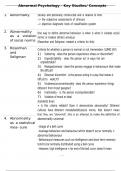
Abnormal Psychology - Key Studies/ Concepts
1. Abnormality Socially and personally constructed and is relative to time
--> the subjective assessments of clinicans
--> objective diagnostic tools of classification system
2. Abnormality One way to define abnormal behaviour is when is when it violates social
as a violation norms or makes others anxious
of social norms (Rosenhan and Seligman created a criteria for this)
3. Rosenhan Criteria for whether a person is normal or not (remember: SUMO VIV)
and 1) Suttering - does the person experience stress or discomfort?
Seligman 2) Unpredictability - does the person act in ways hat are
unpredictable?
3) Malapativeness - does the person engage in behaviours that make
life diflcult?
4) Observer discomfort - is the person acting in a way that makes it
diflcult to watch?
5) Vividness/unconventionality- does the person experience things
ditterent from most people?
6) Irrationality - is the person incomprehensible?
7) Violation of moral or ideal
standards Eval:
= Is this criteria reliable? Does it demonstrate abnormality? Ditterent
cultures have ditterent morals/beliefs/social norms, that doesn't mean
that they are "abnormal", this is an attempt to make the definition of
4. Abnormality abonormality universal
as a statistical
mea- sure -Usage of a bell curve
-Average behaviour and behaviour which doesn't occur normally =
abnormal behaviour
-Behavioural measures such as intelligence and short term memory
tend to be normally distributed using a bell curve
-However, high intelligence = far end of the bell curve, doesn't mean
, Abnormal Psychology - Key Studies/ Concepts
that it is dysfunctional
-Depression + obesity are
statistically normal but not
healthy or desirable things
, Abnormal Psychology - Key Studies/ Concepts
5. Abnormality -Tried to establish what "normality" is (remember: VERTSS)
through 1) Eflcient self-perception
criteria - 2) Realistic self-esteem and acceptance
Jahoda 3) Voluntary control of behaviour
4) True perception of the world
5) Sustaining relationships/ giving attections
6) Self-direction and productivity
-Must be objective
6. Abnormality -Mental illness criterion is rooted in a view from the medical world that
through the abnormal behaviour is rooted in physiological origin
medical -Treatment = alleviate symptoms of illness through medication
model
(mental
illness ...
criterion)
7. Abnormality
as social
construc- tion
- Thomas
Szasz
8. Diagnosis A process by which psychologists or psychiatrists define the mental health
problem of an individual
9. ABC'S Attective;
symptoms of a Behavioural
disorder ;
Cognitive;
Somatic.
10. Reliability of diag- Diagnosis must yield stable and consistent assessments
, Abnormal Psychology - Key Studies/ Concepts
nosis -This should be high when ditterent psychiatrists agree on a patients
diagnosis while using the same diagnostic system (inter-reliability)
11. Validity of Diagnosis must be an accurate reflection for conditions observed so that
diag- nosis an appropriate treatment can be applied
1. Abnormality Socially and personally constructed and is relative to time
--> the subjective assessments of clinicans
--> objective diagnostic tools of classification system
2. Abnormality One way to define abnormal behaviour is when is when it violates social
as a violation norms or makes others anxious
of social norms (Rosenhan and Seligman created a criteria for this)
3. Rosenhan Criteria for whether a person is normal or not (remember: SUMO VIV)
and 1) Suttering - does the person experience stress or discomfort?
Seligman 2) Unpredictability - does the person act in ways hat are
unpredictable?
3) Malapativeness - does the person engage in behaviours that make
life diflcult?
4) Observer discomfort - is the person acting in a way that makes it
diflcult to watch?
5) Vividness/unconventionality- does the person experience things
ditterent from most people?
6) Irrationality - is the person incomprehensible?
7) Violation of moral or ideal
standards Eval:
= Is this criteria reliable? Does it demonstrate abnormality? Ditterent
cultures have ditterent morals/beliefs/social norms, that doesn't mean
that they are "abnormal", this is an attempt to make the definition of
4. Abnormality abonormality universal
as a statistical
mea- sure -Usage of a bell curve
-Average behaviour and behaviour which doesn't occur normally =
abnormal behaviour
-Behavioural measures such as intelligence and short term memory
tend to be normally distributed using a bell curve
-However, high intelligence = far end of the bell curve, doesn't mean
, Abnormal Psychology - Key Studies/ Concepts
that it is dysfunctional
-Depression + obesity are
statistically normal but not
healthy or desirable things
, Abnormal Psychology - Key Studies/ Concepts
5. Abnormality -Tried to establish what "normality" is (remember: VERTSS)
through 1) Eflcient self-perception
criteria - 2) Realistic self-esteem and acceptance
Jahoda 3) Voluntary control of behaviour
4) True perception of the world
5) Sustaining relationships/ giving attections
6) Self-direction and productivity
-Must be objective
6. Abnormality -Mental illness criterion is rooted in a view from the medical world that
through the abnormal behaviour is rooted in physiological origin
medical -Treatment = alleviate symptoms of illness through medication
model
(mental
illness ...
criterion)
7. Abnormality
as social
construc- tion
- Thomas
Szasz
8. Diagnosis A process by which psychologists or psychiatrists define the mental health
problem of an individual
9. ABC'S Attective;
symptoms of a Behavioural
disorder ;
Cognitive;
Somatic.
10. Reliability of diag- Diagnosis must yield stable and consistent assessments
, Abnormal Psychology - Key Studies/ Concepts
nosis -This should be high when ditterent psychiatrists agree on a patients
diagnosis while using the same diagnostic system (inter-reliability)
11. Validity of Diagnosis must be an accurate reflection for conditions observed so that
diag- nosis an appropriate treatment can be applied