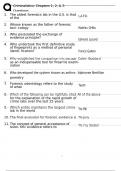
Criminalistics: Chapters 1, 2, & 3
Questions
1. The oldest forensics lab in the U.S. is that L.A.P.D.
of the
2. Whose known as the father of forensic
toxi- cology Mathieu Orfila
3. Who postulated the exchange of
evidence principle?
Edmond Locard
4. Who undertook the first definitive study
of fingerprints as a method of personal
identi- fication? Francis Galton
5. Who established the comparison microscope Calvin Goddard
as an indispensable tool for firearms exami-
nation
6. Who developed the system known as anthro- Alphonse Bertillon
pometry
7. Forensic odontology refers to the study Teeth
of what
8. Which of the following can be rightfully cited All of the above
for the explanation of the rapid growth of
crime labs over the last 25 years
9. Which entity maintains the largest crime The FBI
lab in the world
10. The final evaluator for forensic evidence is The Jury
11. The concept of general acceptance of The Fray Standard
scien- tific evidence refers to
1/
5
, Criminalistics: Chapters 1, 2, & 3
Questions
12. In the case of Daubert vs. Merrell The Trial Judge
Pharma- ceutical the U.S. Supreme Court
advocated that the gatekeeper
determines the admissi- bility and
reliability of scientific evidence
13. The collection of standard reference samples They permit comparisons to be
made
at the crime scene is important because they with evidence
14. Which is NOT a manner of death? Drowning
15. Who is the first witness to arrive at a A Fly
crime scene
16. Rigor Mortis refers to Stittness of death
17. The successful outcome of a criminal investi- The manner in which the
evidence is col-
gation is almost always directly related to lected and preserved
18. The rate of cooling of a dead body can Gender of the
be influenced by all BUT the
victim
19. Which part of the decedent's body
resists rapid decomposition and is used
by the forensic anthropologist to provide
informa- tion about the descendant The bones
20. If the cause of death cannot be found
through simple observation you would
need to do an
Autopsy
21. Typically about an hour and a half after
death, the descendants body loses heat
at a rate of
to 1.5 degrees fahrenheit
2/
5
Questions
1. The oldest forensics lab in the U.S. is that L.A.P.D.
of the
2. Whose known as the father of forensic
toxi- cology Mathieu Orfila
3. Who postulated the exchange of
evidence principle?
Edmond Locard
4. Who undertook the first definitive study
of fingerprints as a method of personal
identi- fication? Francis Galton
5. Who established the comparison microscope Calvin Goddard
as an indispensable tool for firearms exami-
nation
6. Who developed the system known as anthro- Alphonse Bertillon
pometry
7. Forensic odontology refers to the study Teeth
of what
8. Which of the following can be rightfully cited All of the above
for the explanation of the rapid growth of
crime labs over the last 25 years
9. Which entity maintains the largest crime The FBI
lab in the world
10. The final evaluator for forensic evidence is The Jury
11. The concept of general acceptance of The Fray Standard
scien- tific evidence refers to
1/
5
, Criminalistics: Chapters 1, 2, & 3
Questions
12. In the case of Daubert vs. Merrell The Trial Judge
Pharma- ceutical the U.S. Supreme Court
advocated that the gatekeeper
determines the admissi- bility and
reliability of scientific evidence
13. The collection of standard reference samples They permit comparisons to be
made
at the crime scene is important because they with evidence
14. Which is NOT a manner of death? Drowning
15. Who is the first witness to arrive at a A Fly
crime scene
16. Rigor Mortis refers to Stittness of death
17. The successful outcome of a criminal investi- The manner in which the
evidence is col-
gation is almost always directly related to lected and preserved
18. The rate of cooling of a dead body can Gender of the
be influenced by all BUT the
victim
19. Which part of the decedent's body
resists rapid decomposition and is used
by the forensic anthropologist to provide
informa- tion about the descendant The bones
20. If the cause of death cannot be found
through simple observation you would
need to do an
Autopsy
21. Typically about an hour and a half after
death, the descendants body loses heat
at a rate of
to 1.5 degrees fahrenheit
2/
5